Let’s have some context. We are drawing toward the end of the liturgical year, when the Church’s gaze turns ever more intently to the consummation of all things, the Second Coming of the Lord, the resurrection of the dead, and judgment. Pius Parsch, in The Church’s Year of Grace, sees in these autumn Sundays a tripartite structure:
In the Sunday liturgies of autumn time it is not too difficult to detect a progression in three stages. The first stage consists in the Sundays transitional from summer to fall (15th to 17th after Pentecost); the second stage embraces the four finest formularies in the Church’s Harvest Time (19-21); the last stage begins today and brings the season to its conclusion (23-24). Nevertheless, the liturgy is at all times concerned primarily with the present situation, even when her sights are directed momentarily to the end of things. It is no different today.
The Offertory for this Sunday intones the great De profundis: De profúndis clamávi ad te, Dómine: Dómine, exáudi oratiónem meam. The cry “out of the depths” is a cry from the bottom of human frailty, the pit of sin, the place where we find ourselves bound by the cords of death and longing for the liberating approach of the Redeemer.
In this eschatological frame we hear the reading from Philippians 3:17–21 and 4:1–3. This same reading also appears on the Feast of St. Clement, and for good reason: Clement is mentioned by name in the passage. The division of the reading between chapters 3 and 4 is no Novus Ordo-style splice, but simply the reality that Paul did not write in chapters or verses. These were later impositions on an inspired text that flows with the unforced logic of an apostolic heart.
Paul writes to Philippi, a community he knew well, a place visited during both his second and third missionary journeys. With him had been Silas and Timothy, the latter listed as “co-signer” of the epistle. Acts 16 recounts their beating, imprisonment, and the miraculous earthquake that broke their chains, leading to the conversion of their jailer. Paul never forgot this episode of bondage and liberation. It colors the whole letter, which also houses the great Christological hymn of kenosis (2:5–11). Christ, though equal to the Father, “did not consider equality with God something to be exploited/grasped at” (Greek harpagmón), but “emptied himself”, ekenosen, taking the form of a doulos, a servant, obedient unto death on the cross. This hymn was probably liturgical, taught by Paul to the Philippians for their worship.
Paul calls his children to imitation: “Brethren, join in imitating me,” not because he arrogates divine status, but because he himself imitates Christ. At the very opening of the letter Paul and Timothy identify themselves as douloi, servants. Christ is the model, Paul conforms himself to the model, the Philippians conform themselves to Paul, and so “the God of peace” (4:9) remains with them. This is not Paul’s only exhortation to imitation; in 1 Corinthians 4:16–17 he urges, “I urge you, then, be imitators of me… to remind you of my ways in Christ.” In all of this, Timothy is again the seal of Paul’s authenticity.
But the Philippians are beset by false teachers, probably Judaizers, whose insistence on Mosaic practices for Gentile converts would bind the faithful to old chains. Paul warns “even with tears” that these men are “enemies of the cross of Christ. Their end is destruction, their god is the belly, and they glory in their shame, with minds set on earthly things.” The “belly” represents not gluttony alone but the whole regime of the flesh, the worldview that grasps at the earth and refuses to look up. Paul immediately contrasts it with the term políteuma, “our commonwealth is in heaven.” This word sometimes becomes “conversation” (conversatio) in Latin Christian tradition, meaning manner of life. Christians, therefore, must not be ruled by amorphous “lived experience” that contradicts perennial teaching. Nor may we reduce the Church’s demands to “ideals” few can attain. If that sounds a bit familiar, remember what we were told from the highest places in confusing documents like Amoris laetitia that “lived experience” suggests that, for example, sexual continence in an adulterous marriage is an “impossible ideal.” Hence, “lived experience,” trumping perennial doctrine and law, allows those living manifestly in objectively illicit relationships to receive Holy Communion because… you know… “discernment” and “accompaniment” … and reasons and… stuff.
Paul teaches that to capitulate is to “glory in their shame” (3:19). Christ’s call is real, not rhetorical. His grace is sufficient, not illusory. The standard is attainable, not mockingly beyond reach. We must hold firm to the catechism, to the perennial teaching on faith and morals, resisting the cleverboot sophistry of those who would reinterpret the yoke of Christ into a soft cushion of moral laxity.
Paul’s exhortation climaxes in the eschatological promise: Christ “will change our lowly body to be like his glorious body,” subjecting all things to Himself (3:21). This is the blessed hope sung through November when we in a special way remember the dead: that the Savior who comes will unbind us from death, loosen the cords of corruption, and raise us into His glory. That hope then pours immediately into his tender entreaty that Euodia and Syntyche “agree in the Lord” and that the community help these women who labored with him and Clement in the Gospel.
Unity – not uniformity – is part of eschatological readiness.
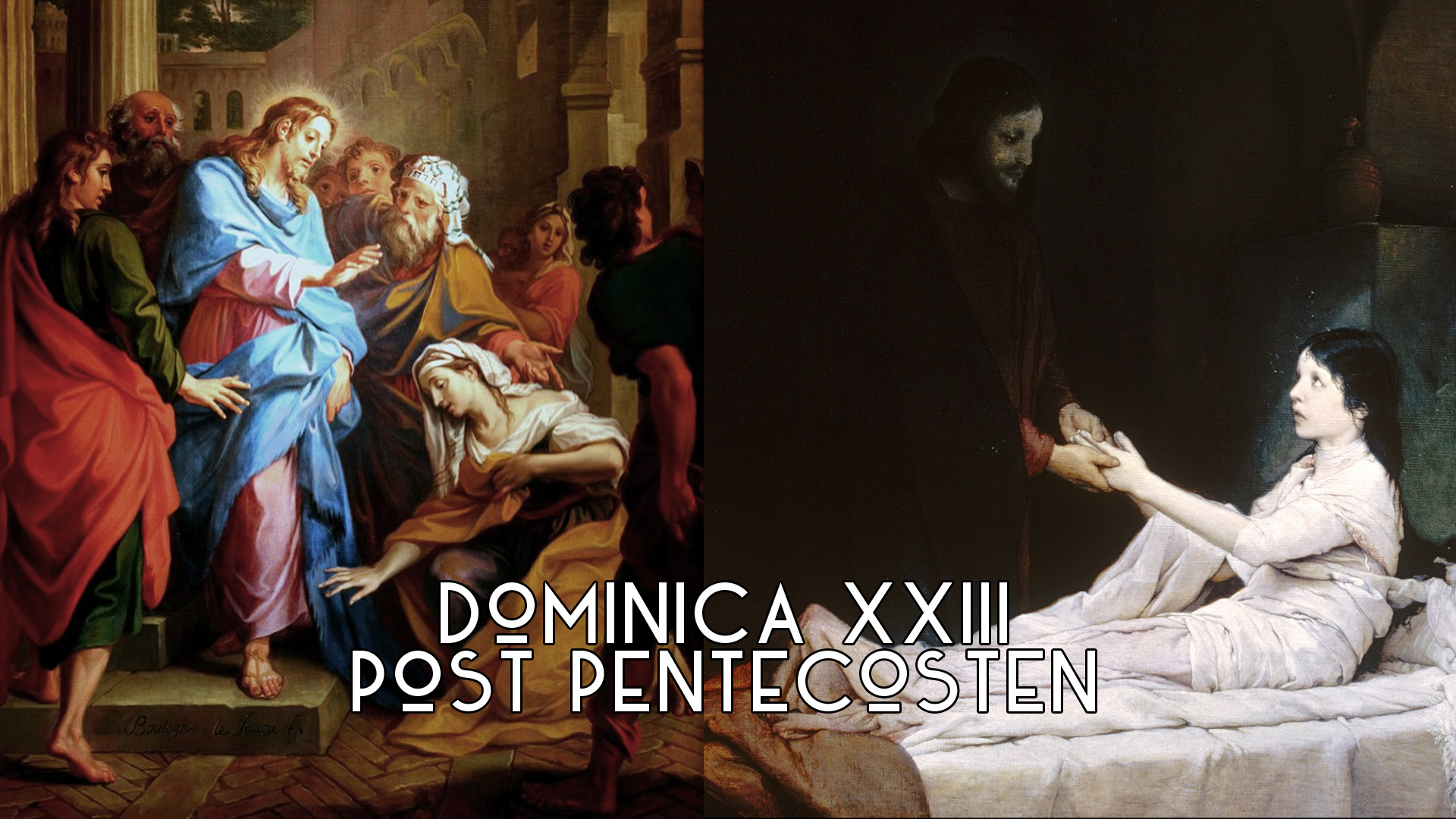
This brings us naturally to our Sunday Gospel scene which exemplifies unbinding and newness of life: Matthew 9:18–26. A ruler (Greek archon – literally “a first guy”, so a “chief magistrate”) kneels before Jesus declaring, “My daughter has just died; but come and lay your hand on her, and she will live.” As Jesus goes to the man’s house, a woman with a hemorrhage for twelve years touches the fringe of His garment, believing, “If I only touch His cloak, I shall be made well.” Jesus turns: “Take heart, daughter; your faith has made you well.” By calling the woman “daughter” we recognize the connection between this miracle in the street and the miracle of the raising of the ruler’s daughter. At the ruler’s house, despite the mourners’ laughter, He takes the dead girl by the hand and she rises.
In the healing of the “daughter” woman and the raising of the ruler’s daughter the Lord shows, in act, what Paul later teaches in doctrine: Christ alone can unbind the nexus of sin and death, restore life, and “change our lowly body” (v. 3:21) The hemorrhaging woman is like the human race, draining life, ritual purity shattered, unable to heal itself. She touches the garment of the One who “emptied Himself,” and so her infirmity is unloosed. The dead child is the image of humanity bound by Adam’s sin; Christ enters the room, bids the tumultuous wailing to cease, and with a simple touch restores the breathless to life. The two miracles together mirror the double wonder Paul preaches: we are healed of our inward affliction, and we are raised from death.
This imagery of binding and unbinding also suffuses the Collect for the Sunday:
Absolve, quaesumus, Domine, tuorum delicta populorum:
ut a peccatorum nexibus,
quae pro nostra fragilitate contraximus,
tua benignitate liberemur.
This beautiful and ancient prayer survived the snipper-pasters rallied by Father Bugnini of the Consilium to live on in the Novus Ordo as the Collect for Friday in the 5th week of Lent.
The vocabulary here repays close inspection. A nexus is a binding, a legal or personal obligation, a weaving together. Absolvo means “to loosen from,” with juridical overtone of acquittal and the domestic image of “bringing a woven work to its completion” by severing it from the loom. The ancient world heard the clacking of looms as ubiquitously as we hear the hum of engines or televisions today. Women spun wool and wove cloth; spinning and weaving symbolized feminine virtue. A Roman bride carried a distaff and spindle, tools of order and familial fruitfulness. A distaff holds the unspun fibers and keeps them from getting tangled. The word “distaff” has come in English to describe the female branch of a family tree.
LITERAL TRANSLATION
Unloose, O Lord, we implore, the transgressions of Your peoples,
so that by Your bountiful goodness we may be loosed
from the entanglings of the sins
which we contracted on account of our weakness.
The Collect says we have contraximus these bonds “on account of our weakness.” Contraho gives us “contract”, a drawing together, binding, lessening the gap but restricting movement. Albert Blaise’s Dictionnaire Latin-Français des Auteur Chrétiens notes that among Christian Latin authors (Cyprian, Ambrose, Augustine) it also means “to commit sin.” Adam, by sin, “contracted” guilt for the whole race. Humanity’s loom became tangled. Our fragile threads knotted themselves into a web that captured the sinful weaver. Only one solution remained: the New Adam had to assume the whole web, the nexus of humanity’s debts and, by being bound to the Cross, unloose the world.
Christ entered our tangled mess. He became poor. He emptied Himself. He touched the dead girl, He was touched by the hemorrhaging woman; He was stripped of everything and nailed to the wood/loom/Cross. Then, in the great absolutio, He unloosed His spirit from His body and thereby unloosed ours from Hell. In His death, the cloth was finished: absolved in its deepest sense. The web of sin has been cut from the loom. The old garment, threadbare, torn, polluted, is replaced by the radiant robe promised in Philippians: the transformation of our lowly bodies into His glorious Body (Phil 3:21). The New Man has given us our new man garment (cf. Eph 4:24).
Both the Collect and the Gospel suggest more.
Our days, says Job, are “swifter than a weaver’s shuttle.” They fly back and forth, warp and weft crossing, life interlacing with grace if only we consent to the Weaver’s hand. Those who “live as enemies of the cross of Christ” let the shuttle run wild, weaving tangles of ego and earthliness. Those who imitate Paul, and hence Christ, allow the divine Weaver to guide the shuttle to its proper end.
The hemorrhaging woman spent twelve years watching her life unravel; one touch of Christ set the thread right again. The ruler’s daughter saw her thread severed; Christ knotted life back into her, restoring the cloth of her days.
Paul tells the Philippians to “stand firm in the Lord,” a posture of stability even as the loom moves swiftly. He urges Euodia and Syntyche to reconcile. Frayed threads are a scandal in the Church’s garment. He calls Clement and the others “fellow workers whose names are in the book of life”, a lovely counter-image to the nexus of sin. The book of life is the record of those unbound, whose threads have been woven into the pattern of Christ. Its writing is eschatological: “The Lord is at hand… Have no anxiety… and the peace of God, which passes all understanding, will keep your hearts and minds in Christ Jesus” (Phil 4:4-7).
Thus the Mass formulary on this increasingly eschatological Sunday, especially the Collect, the Gospel, and Paul’s letter converge on the same movement: from bondage to freedom, from sickness to healing, from death to life, from earthly “belly” existence to heavenly políteuma, from tangled web to completed cloth, from shameful “glorying” to a share in the glory of Christ.
November reminds us of our mortality; we pray for the Poor Souls, we contemplate our own death. No earthly advantage will raise us to the Beatific Vision, only fidelity to Christ and humble service patterned on His self-emptying.
We must practice dying well by living better, attentive to the gifts God weaves into our lives. We must choose the better threads, the clearer patterns, the unblemished dye of virtue. Christ has already woven the pattern of the Christian life into Paul, and Paul into Philippi, and through them into us.
The shuttle of our days moves quickly. Let us not waste the cloth.