
As the liturgical year draws to its close, the Church’s voice takes on autumnal gravity. The Sundays after Pentecost turn our eyes toward the final harvest, when the Lord will take all things to Himself. This Sunday’s Collect, Epistle, and Gospel form a single meditation on mercy and judgment, protection and peril, the divine household guarded by grace yet tested by fire.
The Collect, already found in the Liber Sacramentorum Gellonensis, is elegant in its simplicity:
Familiam tuam, quaesumus, Domine, continua pietate custodi:
ut a cunctis adversitatibus, te protegente, sit libera;
et bonis actibus tuo nomini sit devota.
Guard your family, we beseech you, O Lord, with continual mercy,
that, protected by you,
it may be free from all adversity and devoted to your name in good works.
Here we already glimpse the drama of the year’s end. The familia Dei stands surrounded by enemies. Only God’s pietas, His steadfast mercy, can preserve it. Familia in Latin meant not only parents and children but the entire household, servants included. Thus, when the Canon prays Memento Domine famulorum famularumque tuarum, it remembers the whole household of the faithful. We are God’s dependents, under His paternal rule.
Custodi evokes a sentry’s vigilance; pietas, a word beloved of Virgil, means more than English “piety.” It is dutiful love, the readiness to fulfill obligation toward God, parents, and country. In Christian language, it becomes God’s own faithfulness toward His promises. His pietas guards. Our devotion, the self-offering implied in devoveo (“to dedicate by vow”) responds. The prayer thus describes grace in motion: divine mercy protecting the family, human devotion returning love in action.
In this age of exaggerated autonomy, the prayer’s humility jars modern ears. It presumes hierarchy: God the Father ruling, we the children serving. My sins wound the family; my fidelity strengthens it. The household is not egalitarian but ordered, and its order is love. “Guard your family, O Lord” means precisely: keep us obedient and grateful within your paternal rule.
The Epistle (Ephesians 6:10–17) makes this dependence militant.
Be strong in the Lord and in the strength of his might. Put on the whole armor of God.
The Church nears the battlefield of the year’s end, and the Apostle calls us to arms. Our enemies are not men but “principalities and powers… the world rulers of this present darkness.” The Greek pale, “wrestling,” implies close combat. The faithful household must fight hand to hand with invisible foes.
Paul’s armor is made of virtues: the belt of truth, the breastplate of righteousness, the sandals of peace, the shield of faith, the helmet of salvation, the sword of the Spirit. Each piece defends the familia Dei from spiritual paralysis. Yet the verb endynamousthe, “be strengthened,” is passive. We are not self-made warriors; strength is received. The same pietas invoked in the Collect here becomes grace, arming the believer.
Unused armor avails nothing. It must be worn, tested, dented in battle.
Hence Paul adds: “Pray at all times in the Spirit.” Prayer keeps the armor strong and bright.
This soldier’s imagery turns directly toward the Gospel (Matthew 18:23-35), the parable of the merciless servant. A king settles accounts with his servants, language already echoing the familia Dei. One servant owes ten thousand talents, sixty million days’ wages, 168,000 years of labor. The debt is impossible to repay, pointing to divine magnanimity: the lord forgives it all. Yet the same servant throttles his fellow over a debt of one hundred denarii. The master, hearing of it, revokes the pardon and hands him to the torturers “until he should pay all.” Christ ends bluntly:
So also my heavenly Father will do to every one of you, if you do not forgive your brother from your heart.
The parable is judgment cloaked in domestic imagery. The king’s household mirrors the Church; the accounting prefigures the Last Judgment. The merciless servant is the unarmed Christian, who lays aside the shield of faith and the sword of charity. St. Thomas Aquinas names five faults in him: immediacy (he sins “as he went out”), hypocrisy (pleading for mercy, then denying it), cruelty toward an equal, avarice over a trifle, violence seeking mercy. Each fault corrodes a piece of armor. The moral: mercy withheld is armor discarded.
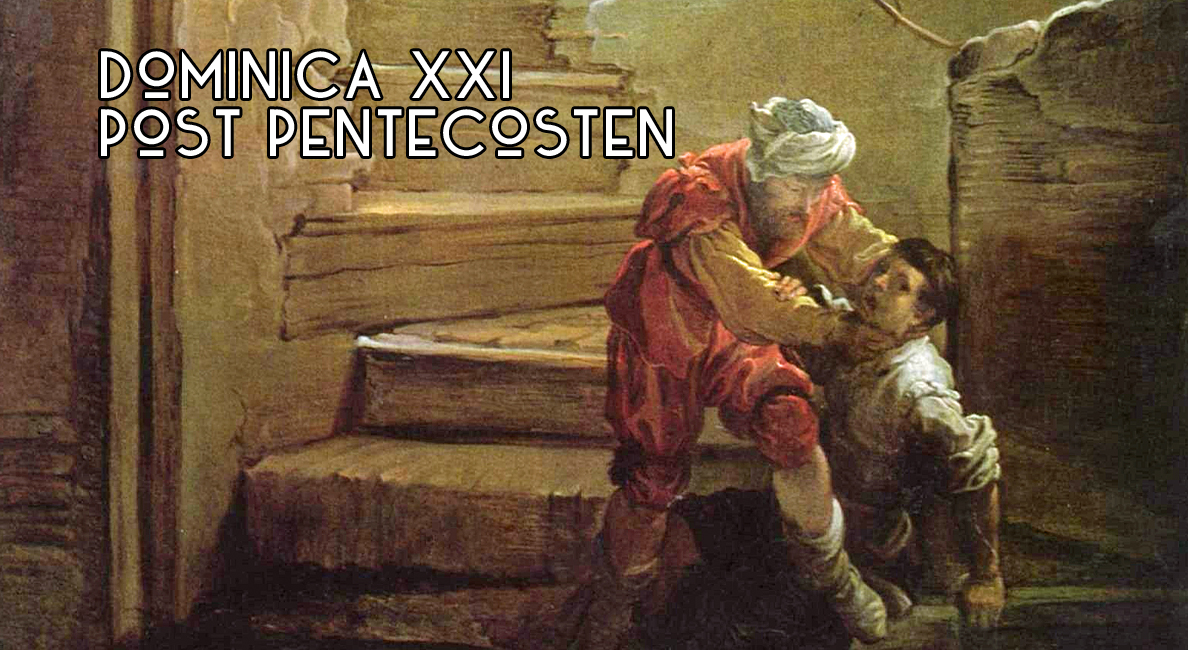
The visual tradition reinforces this. Domenico Fetti’s painting of the merciless servant shows the forgiven man strangling his debtor at the foot of a staircase. The victim’s eyes plead toward the viewer, the vine of John 15 climbing behind them (alas, cut off from the image at the top because of format constraints – look it up):
I am the vine, you are the branches… If a man does not abide in me, he is cast forth as a branch and withers… and the branches are gathered, thrown into the fire and burned.
The imagery binds the themes of family, union, and judgment. Severed from the Vine, one becomes fuel for the fire.
Here the Collect, Epistle, and Gospel converge. God’s pietas guards His family. Our devotio manifests that mercy in works. The armor of virtue keeps the household safe until the Master returns to settle accounts. The Church, at the waning of the year, reads these texts as a mirror of her own condition. She is the guarded family, the soldier under orders, the servant forgiven much.
Bl. Ildefonso Schuster heard the same note in the Offertory drawn from Job: “The Lord gave, and the Lord has taken away; blessed be the name of the Lord.” Job’s cry is the song of the tested faithful. The ancient chant’s repeated ut videam bona, “that I may see good things again,” rises like a heartbeat through suffering, until lament turns to hope.
So too the Church in these final Sundays sings her trust that, beyond trial and purification, she shall see good again.
St. John Chrysostom, preaching on Ephesians 6, comforted his listeners:
This war which we have against them puts an end to another war, that which is between us and God; if we are at war with the devil, we are at peace with God.
The paradox stands: spiritual combat is itself reconciliation. To fight evil is to rest in divine friendship. To forgive the enemy is to strike at Satan’s heart. Thus mercy and warfare are not opposites but two faces of fidelity.
In this light, the parable’s torments are not arbitrary cruelty but justice refused. The “torturers” represent the consequences of unrepented sin: the gnawing worm of conscience, the fire that is “unquenchable” (Mark 9:43). As St. Augustine put it, in comparatione noster hic ignis depictus est: our fire is but painted flame in comparison with Hell’s. The damned experience forever the loss of the Infinite Good; the blessed burn with the fire of transforming, divinizing, love. Between those two fires every soul must choose.
At this point, the Collect’s plea for divine custody acquires apocalyptic resonance. “Guard your family, Lord” is not a polite petition but a battle cry. The familia Dei prays for protection not only from temporal adversity but from the final sifting of the Enemy. To be “free from all adversities” means to be freed from sin, from pride, from the hardness of heart that made the unmerciful servant damn himself. To be “devoted to your name in good works” is to translate faith into charity, armor into action.
The pattern repeats through salvation history. Israel was God’s household guarded in Egypt, armed in the desert, judged for ingratitude. The Church is that family universalized, carrying the cross as Aeneas carried his father — pius Aeneas transfigured into pius Christianus. Her pietas is now God’s, shielding her through centuries of trial; her devotio is the fidelity of martyrs and monks, parents and priests, each fulfilling his duty in the household of faith.
As the liturgical year dies, Holy Church asks whether we still live within that household. Have we remained under the Father’s protection, or have we stepped outside into the darkness where “there will be weeping and gnashing of teeth”? Have we used the armor of God, or left it to rust? Have we forgiven from the heart, or nursed resentment that corrodes mercy? The calendar itself becomes a memento mori. Time wanes. The books will soon be opened… then closed.
The Roman genius of the liturgy is to compress vast theology into a few words. Pietas, devotio, familia — each a world. Together they tell the story of grace: God’s faithful love, our filial response, the communion of the household that marches under His protection. When these words are prayed as the year fades, they sound almost like the final watchword of a garrison before the dawn.
For the dawn will come.
The night is far gone, the day is at hand. Let us then cast off the works of darkness and put on the armor of light (Rom 13:12).
The family guarded by continua pietas will endure the long night of testing and awaken to the eternal morning. The servants who forgive will hear, “Intra in gaudium Domini tui.” The soldiers who have stood firm will lay down their armor before the King. And the fire that once frightened will shine around them as glory.
Be faithful members of the household. Arm for the invisible war. Be merciful as you have received mercy.