When this Sunday comes around, with its snappy Collect, I am minded of the early fourth-century martyr St. Expeditus. The Latin text of the Collect reads:
Omnipotens et misericors Deus,
universa nobis adversantia propitiatus exclude:
ut mente et corpore pariter expediti,
quae tua sunt, liberis mentibus exsequamur.
Translated slavishly:
Almighty and merciful God, having been appeased,
shut out all things opposing us,
so that, equally unencumbered in mind and body,
we may with free minds accomplish what is pleasing to You.
That “quae tua sunt” is a variation of phrases like “quae tibi sunt placita… things which please you” as in the Collect of the 6th Sunday after Epiphany or “quae recta sunt… things which are good, upright, righteous.”
The key word, of course, is expediti—a term drawn from the Roman military, from expedio, meaning “to extricate, disengage, let loose, free up from impediments, liberate any thing entangled.” When applied to persons, it means “to be without baggage, unimpeded, free.” Hence, expeditus denotes “a soldier lightly burdened, a swiftly marching soldier.”
St. Expeditus, whose feast falls on 19 April, is (aptly) the patron of procrastinators and computer programmers, given that he embodies the virtue of immediacy. He is depicted as a Roman soldier holding aloft a Cross inscribed with HODIE (“today”), while beneath his foot a crow onomatopoetically croaks CRAS (“tomorrow”). The saint’s iconography preaches its own sermon: the crow of delay is crushed beneath the foot of decisiveness. In our Collect, expediti points to that same freedom, the release from the entanglements of sin that doom us to spiritual inertia.
God wants our hearts now, not later. Hodie, non cras.
You might not have a tomorrow.
The Earl of Chesterfield once told his son, “Know the true value of time; snatch, seize, and enjoy every moment of it. No idleness, no laziness, no procrastination: never put off till to-morrow what you can do to-day.” The Earl may not have been thinking of confession, but we should.
St. Expeditus is a saint for those who perpetually delay the graces offered for true conversion.
This theme of putting off the old and putting on the new underlies the Epistle for the 19th Sunday after Pentecost:
Be renewed in the spirit of your minds, and put on the new nature, created after the likeness of God in true righteousness and holiness (Eph 4:23–24).
Paul exhorts the Ephesians to lay aside their “old man,” the former manner of life mired in deceit and corruption, and to don the “new man,” recreated in Christ. The Greek verb endúo means “to clothe oneself, to invest,” and it evokes baptism, when the Christian was literally clothed in white garment of the redeemed.
Bl. Ildefonso Schuster noted that this Sunday was anciently called the fourth after St. Cyprian and that its station church was Ss. Cosmas and Damian in the Roman Forum appropriately physician saint twins, given the Collect’s petition for harmony of body and mind. Pius Parsch, in The Church’s Year of Grace, observes that this Sunday begins a series of three devoted to the virtue of Christian hope. In this hope, the faithful must be expediti, free, swift, unimpeded soldiers marching toward the Kingdom.
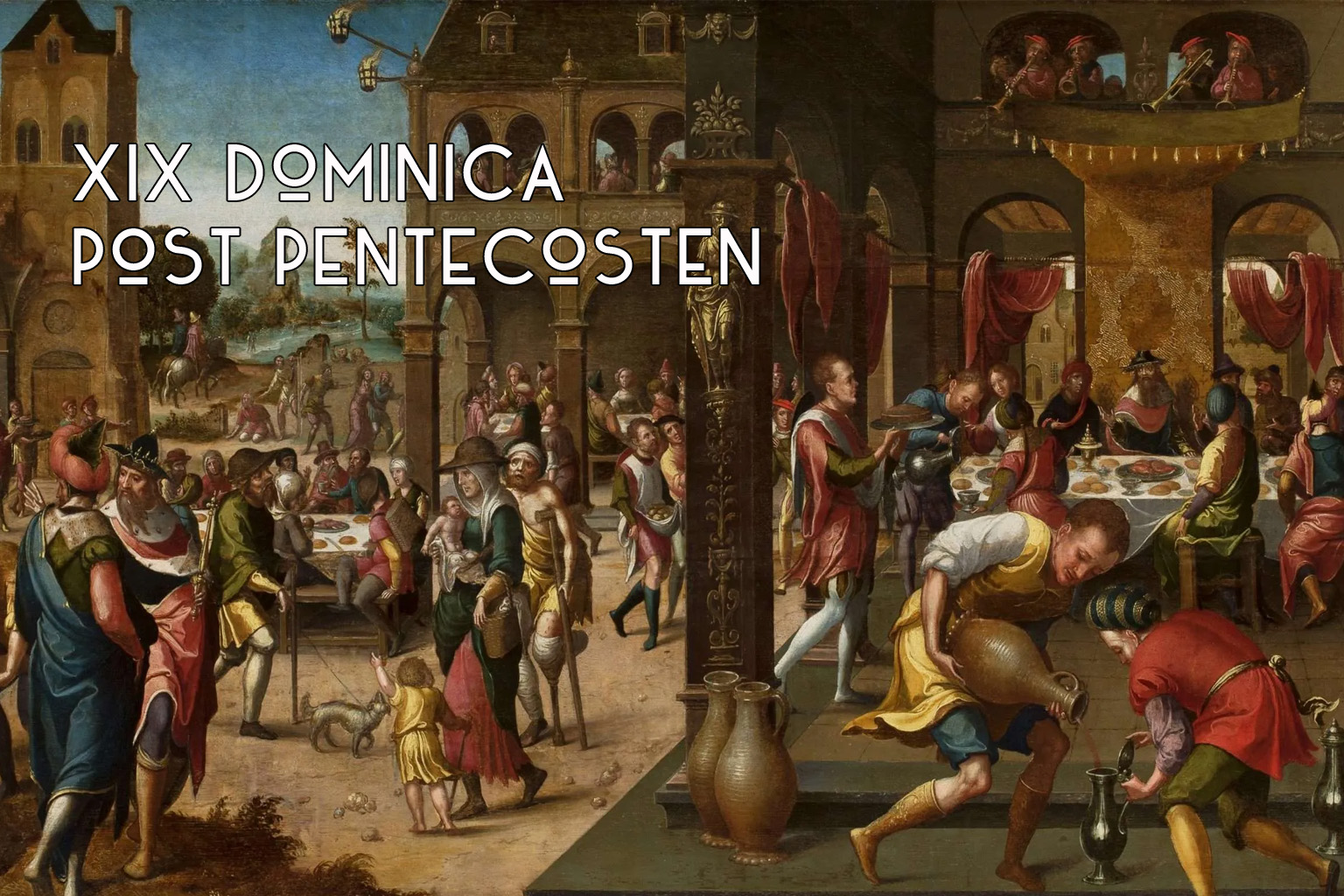
Paul’s metaphor of “putting on” links beautifully with the Gospel’s image of the wedding garment in Matthew 22: the Kingdom of Heaven is likened to a wedding feast prepared by a king for his son. Many are invited but refuse to come; others kill the servants who brought the invitation. The king then invites everyone from the streets, yet when he finds a man without a wedding garment, he casts him out “hand and foot” into the outer darkness. The parable’s twist, as St. Gregory the Great comments in Homiliae in Evangelia (38.9), reveals that the garment signifies love:
What then must we understand by the wedding garment but love? That person enters the marriage feast, but without wearing a wedding garment, who is present in the holy Church. He may have faith, but he does not have love.
Love, then, is the garment that clothes the new man. Without it, even the guest within the banquet hall is lost.
For those close to the altar – servers, sacristans, priests – the imagery of vesture in Ephesians has tangible resonance. The vesting prayer traditionally said when donning the surplice is:
Indue me, Domine, novum hominem, qui secundum Deum creatus est in iustitia et sanctitate veritatis. Amen. … Invest me, O Lord, as a new man, who was created by God in justice and the holiness of truth.
That surplice, derived from the white baptismal robe, recalls that we have “put on Christ.” The alb, likewise, is the baptismal garment in its full form. Every time the Christian dresses for sacred service, he rehearses the baptismal promise, to be expeditus, unimpeded, unburdened by the “old man,” ready to act with the freedom of the children of God.
St. Jerome, commenting on this very passage in Commentarii in Epistulam ad Ephesios (PL 26:540), contrasts the “old man,” aged in wickedness, with the new man vivified by the Word:
The Word of God kills in such a way as to make the dead one come alive. He does not corrupt but kills the old man. … As the outer man decays the inner man is renewed.
This interior renewal echoes the Collect’s phrase mente et corpore pariter expediti—“unencumbered in mind and body equally.”
The harmony of mind and body is the harmony of grace: a life where outward actions mirror inward sanctity.
The Christian’s transformation must be total, not partial; his new life in Christ must integrate intellect, will, and flesh into the single motion of charity.
Paul’s admonitions in Ephesians 4 are concrete:
Putting away falsehood, let every one speak the truth with his neighbor, for we are members one of another… Be angry but do not sin… Let the thief no longer steal, but rather let him labor, doing honest work with his hands (vv. 25–28).
In short: stop lying, stop stealing, stop being lazy. Live as expediti—free from the baggage of vice.
St. Jerome marvels at the dignity of this new creature:
It is a great work of God when it is said that the new person is created by God in Christ. This creature towers over the other creatures. This creature alone is said to have been established in the same way as the world was established, from the beginning of God’s ways (cf. Prov 8:22).
To be baptized, to be remade in Christ, is to partake in a new creation, as magnificent as the dawn of the cosmos itself.
Pius Parsch reminds us that Paul’s moral exhortations are not mere abstractions. The Apostle wrote to a Gentile community in which pagan habits were hard to shed. Conversion is not instantaneous perfection; it is a process of death and rebirth. The Christian must no longer live “as the Gentiles do” (Eph 4:17)—that is, not according to fallen nature but according to grace.
The old Adam clings to us in appetites, pride, and sloth, but we must continually “put off” that old man and “put on” the new.
When Paul tells us to “put away falsehood,” he strikes at one of the most common vices of the old man: deceit. Lies fracture the unity of the Body of Christ. “We are members one of another,” Paul insists. To lie to one’s neighbor is to wound the Mystical Body itself. Likewise, anger, though natural, must be disciplined: “Be angry but do not sin; do not let the sun go down on your anger.” Here Paul cites Psalm 4:5—“Be angry, but sin not; commune with your own hearts on your beds, and be silent.” Anger itself is not sinful; Our Lord Himself was angry when He drove the money-changers from the Temple (Matt 21). The distinction is whether anger is ordered to justice and charity or to vengeance and pride.
As St. Thomas Aquinas will later say, “Ira est …calor appetitus qui nascitur ex ratione…. Anger is … the heat of the appetite arising from reason” (STh II–II, q. 158, a. 1, ad 3).
In this light, Paul’s command “Do not let the sun go down on your anger” (Eph 4:26) is a counsel of charity. Do not let resentment harden into hatred; the devil exploits festering emotions. The Christian may experience anger, but he must master it, not be mastered by it. “Give no opportunity to the devil,” Paul warns, for the devil thrives where charity is lacking.
Our bodies, as Paul and the Collect remind us, can be impediments to spiritual freedom. Concupiscence, the disordered pull of the senses, tethers the mind to fleeting goods.
Angels, being pure spirits without bodily senses, know things immediately in their essence. Appetites don’t pull at them, now one way, now the other. Hence, they cannot change their minds. We, with our senses and appetites, vacillate, easily distracted by passing pleasures. Thus, we must discipline the flesh, lest it impede the soul’s flight toward God. At death, when the soul is separated from the body, it can no longer change its mind. Like the angels, its choice is fixed forever. Thus, the Church’s teaching that after death there is no repentance. “It is appointed unto men once to die, and after this the judgment” (Heb 9:27).
This makes the moral struggle of the present moment all the more urgent. While we live, we can still become expediti, disentangled from sin by repentance and sacramental grace. After death, impediti, bound hand and foot, we cannot. Hence the urgency of confession, the necessity of vigilance.
Some complain that the Church preaches too much about sexual sins, as though these were trivial compared with “sins of the spirit.” But as Paul lists in Colossians 3:9–10, both belong to the old man:
Do not lie to one another, seeing that you have put off the old nature with its practices… put on the new nature, which is being renewed in knowledge after the image of its creator.
The carnal and the spiritual are intertwined. Sins of the flesh may not always be the gravest, but they are the most common, the most habitual, and therefore the most dangerous.
It is an act of charity for the Church to warn her children about the sins that most easily damn them.
Mind exercise: What do you call someone who dies in mortal sin because of lust, rather from the even graver mortal sin of pride? You call him “damned for eternity.” It isn’t complicated.
Returning to the Gospel: the man without a wedding garment is not a passive victim of circumstance; he is one who entered the feast without love. “Many are called, but few are chosen” (Matt 22:14). The king’s judgment, binding him “hand and foot,” mirrors the spiritual reality of mortal sin. The unrepentant sinner is impeditus, bound by his own attachments, incapable of joy. The expeditus soul, by contrast, moves swiftly toward God, clothed in the garment of charity.
Faith alone is not enough. The man without the wedding garment had faith enough to enter the hall, but not love enough to remain. “Not every one that saith to me, Lord, Lord, shall enter into the kingdom of heaven, but he that doth the will of my Father who is in heaven” (Matt 7:21). The garment of the new man is not mere belief but transformed conduct.
Paul’s moral teaching culminates in this synthesis: grace renews, but we must cooperate with that renewal. The Collect’s plea – ut mente et corpore pariter expediti – is not a poetic flourish but a theological precision. We must be unencumbered both in intellect and in body, free from confusion and vice, so that we may accomplish God’s will “with free minds.”
The Collect’s sequence – exclude – expediti – exsequamur – traces a clear ascent of the soul toward divine service. First, exclude marks the initial grace of purification: the merciful removal of all that opposes God’s work in us. Spiritual progress begins with this divine act of clearing the path, for sin and disorder must be expelled before freedom can be found. Next comes expediti which evokes not only detachment but readiness, the eager willingness to pursue “quae tua sunt,” the things that belong to God. The soul, once liberated, becomes light, alert, and prompt to obey. Finally, exsequamur expresses the perfection of this movement: to “follow out” completely what God commands. The prefix ex- in each term carries its perfective force: “thoroughly,” “to the end.” Grace first excludes, then liberates, and at last strengthens us to fulfill God’s will with generous perseverance.
The Christian life is not a static state but a march, a campaign toward the eternal banquet. St. Expeditus, lightly armed and unburdened, leads the way.
In the end, we return to that stark choice between hodie and cras, between conversion now and delay until tomorrow. The soldier-saint tramples the crow of postponement. His cry is the cry of the liturgy itself: Hodie Christus natus est. Hodie salvator apparuit. Hodie nobis de caelo pax vera descendit. Today, not tomorrow.
The call of the Collect, of the Epistle, and of the Gospel is the same: cast off the old man, put on the new, and march swiftly, unimpeded, toward the marriage supper of the Lamb.
Impediti or expediti: it is up to you.