As the northern hemisphere drifts from the fullness of summer into the crisp melancholy of autumn, Holy Church too moves into a season of spiritual harvest. In her ancient cycle of Sundays, formed in the lands where the light fades earlier each day, she begins to turn her gaze toward the final realities – the waning of the world’s daylight and the dawning of the eternal. Our sacred liturgical worship becomes autumnal, charged with the scent of judgment and the rustle of things passing away.
Increasingly, the texts of Holy Mass speak of the end, of the apokalypsis, of the return of the Just Judge. It is no accident that in the modern Novus Ordo, the Epistle once heard on this 18th Sunday after Pentecost – St. Paul’s words to the Corinthians – now resounds on the first Sunday of Advent, the most eschatological of seasons. Even though some bishops amazingly try to curtail ad orientem worship, in both the Novus Ordo and the Vetus Holy Church in her liturgical worship, the warp and weft of our Catholic identity, turns her eyes eastward, ad orientem, to the rising of the true Sun, to the Advent of the Lord who is coming and who has come.
As the fields yield their last fruits, the Church gathers her own: souls recalled to grace, hearts turned again toward the Face that judges and saves.
Our Gospel this Sunday, Matthew 9:1-8, opens in Capernaum, Jesus’ adopted town. However, the fuller story begins, curiously, across the water. We need a wider context for this Sunday’s Gospel. The preceding chapter of Matthew, the eighth, places Our Lord in the land of the Gadarenes (or Gerasenes) in Gentile country east of the Sea of Galilee. There He performs an exorcism and the unnerving miracle of the swine which rush screeching to their death in the sea.
Matthew 8:28–34, Mark 5:1–20, and Luke 8:26–39 each tell the story, with their own brushstrokes. Mark and Luke show us a single demoniac, naked, howling, cutting himself, fierce enough to snap chains, possessed by the demons who name themselves “Legion.” Matthew, however, has two demoniacs, the man possessed by “Legion” and another possessed by an unnamed demon. Discrepancies between the Gospels troubled the Fathers less than it troubles the modern literalist. St. Ambrose observed, “I think we should not idly disregard but seek the reason why the Evangelists seems to disagree about the number. Although the number disagrees, the mystery agrees” (Expos. in Lucam 4.44). Scripture, for Ambrose and his like, is not to be deconstructed but to be read with the mind of the Church. He saw in the unclothed demoniac a figure of fallen humanity: “Whoever has lost the covering of his nature and virtue is naked…. A man who has an evil spirit is a figure of the Gentile people, covered in vices, naked to error, vulnerable to sin.”
When Christ cast out the demonic legion and the man appeared clothed and in his right mind, it was not merely a cure of madness, but an image of grace restored, of the garment of baptism laid again upon the shoulders of a fallen son of Adam.
The exorcism of the Gentile and the forgiveness of the Jew in the next chapter, this Sunday’s Gospel, mirror one another, showing the universality of the Savior’s mercy. The miracle east of the lake prefigures what will occur west of it: from both sides of the human divide – the pagan and the chosen – the Lord draws His new people into one.
Then Jesus crossed again by boat and came “into His own city”, Capernaum. There, a small house, possibly Peter’s own, suddenly became the locus of revelation.
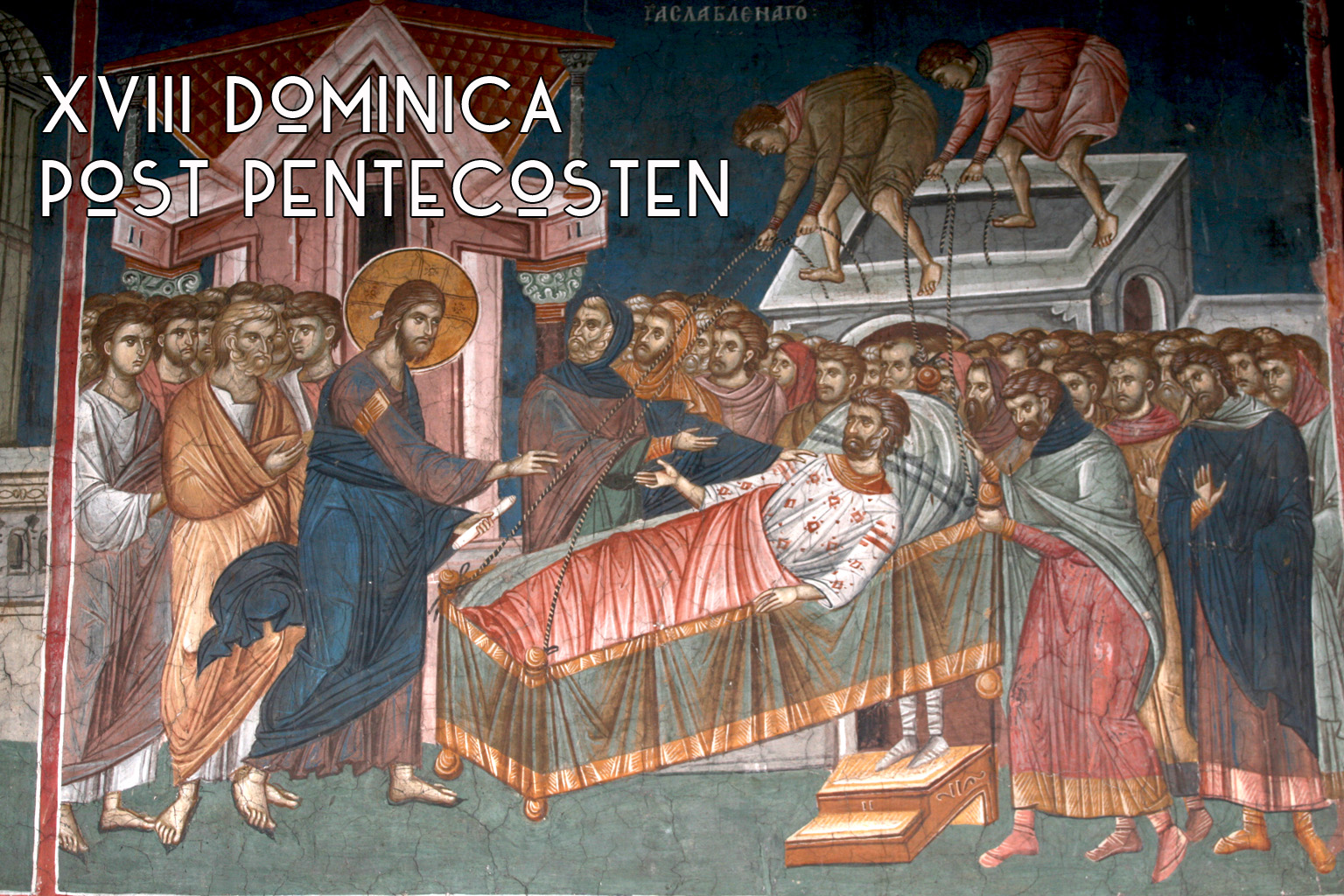
The scene: a crowd so dense that the doorway is blocked, the air thick with dust and expectation. As the parallel passages in Mark 2:1–12 and Luke 5:17–26 report, there would suddenly have been muffled sounds of effort above as the roof is pried apart, tiles clattering down, light piercing the gloom. Several men then lower a pallet with a paralyzed man upon it. One can almost hear the startled shouts and see the upraised faces as daylight pours through the opening.
The scribes are present too, the grammateis, teachers of the Law, experts in the sacred letters. They stand apart, wary eyes narrowing.
Jesus sees the faith of the roof-breakers and the still figure on the stretcher. Instead of simply healing and commanding the limbs to move, He says something more astounding: “Take heart, my son; your sins are forgiven” (v.2).
The paralysis was deeper than muscle and bone; it was the stasis of a soul turned in on itself. The Lord heals first what is within, and only then what is without.
He reads the thoughts of the scribes, their silent charge of blasphemy. The Lord says:
“Why do you think evil in your hearts? 5 For which is easier, to say, ‘Your sins are forgiven,’ or to say, ‘Rise and walk’? 6 But that you may know that the Son of man has authority on earth to forgive sins”—he then said to the paralytic—“Rise, take up your bed and go home.” 7 And he rose and went home. 8 When the crowds saw it, they were afraid, and they glorified God, who had given such authority to men.
A command that fuses heaven and earth: “Rise, take up your bed, and go home.”
At once the man stands, strength flowing through him like grace into dry channels.
This miracle is a miniature apocalypse, a revelation of divine authority.
As Paul wrote to the Corinthians, “You are not lacking in any spiritual gift, as you wait for the revealing [apokalypsis] of our Lord Jesus Christ.”
In the healed man the eschaton is prefigured: sin remitted, the body restored, man returned home – to paradise, to God.
It is a foretaste of the final judgment and resurrection, but also of every absolution spoken in the confessional.
In the confessional, too, the paralyzed soul, carried by the faith of others perhaps, lowered before the Lord through the roof of humility, hears the same words and rises clothed anew in grace.
The confessional is the room of that Gospel house; the priest, alter Christus, speaks.
The sinner enters on a stretcher and departs upright, carrying the very pallet that once bore his weight.
Bl. Ildefonso Schuster, that luminous archbishop of Milan, noted that the ancient Roman Church called this Sunday the “third after the birthday of Saint Cyprian,” the dies natalis of the martyr being his true birth into heaven. In some old calendars it was marked, “Dominica vacat,” that there was no set of readings and prayers for Sunday because the nightlong Ember vigil had replaced the usual Sunday celebration. Yet the Church, unwilling that the faithful go without nourishment, offered the formulary we have now, interrupting the readings from Ephesians to give us instead the opening of First Corinthians – words of thanksgiving that themselves form a kind of autumnal harvest hymn.
“I give thanks to God always for you because of the grace of God which was given you in Christ Jesus, that in every way you were enriched in him with all speech and all knowledge” (1 Cor 1:4).
The Apostle’s tone is generous yet purposeful; he begins with gratitude before moving on to correction. We too, he implies, should begin with gratitude: for existence itself, for the breath that animates us before the grave, for the grace that sanctifies. The soul, form of the body, cannot be extinguished; hence, there must one day be resurrection, when body and soul are knit again. What greater cause for thanksgiving?
Paul says that the Corinthians, and we, their distant heirs, have been “enriched with all speech and knowledge,” so as to lack no spiritual gift while we wait for the Lord’s revealing. This enrichment is not mere eloquence or erudition but the infusion of faith that blossoms into wisdom. Augustine’s adage “Crede ut intellegas… Believe, so that you might understand” (cf s. 43.9) illumines the line like a shaft through stained glass, or through an opened roof. Knowledge (scientia) alone cannot reach the mystery; only wisdom (sapientia) rooted in faith can perceive its form. Isaiah’s words, “Nisi credideritis, non permanebitis… Unless you will have first believed, you will not endure,” link faith and firmness, belief and endurance. To believe is to stand solid on the rock that no storm can move. Augustine makes of this: Nisi credideritis, non intellegetis… Unless you will have first believed, you will not understand” (tr. in Io. 29.6).
“Sin makes you stupid,” as the pithy maxim goes, because sin clouds the intellect. The man paralyzed by sin cannot reason rightly until grace restores him. Faith opens the eye of the mind, the roof of the soul, to the true light.
St. Joan of Arc cried out, “I would rather die than do something which I know to be a sin.”
St. Dominic Savio vowed, “Death, rather than sin!”
They carried their beds and walked.
To “carry the bed” is to turn the emblem of our weakness into the instrument of our witness.
Peter Chrysologus preached (s. 30):
“Carry the very mat that carried you. Change places, so that what was the proof of your sickness may now give testimony to your soundness.”
The burden becomes a badge, the scar a sign of healing.
The very weight of the bed, once unbearable, now measures restored strength.
When you go to confession and receive absolution, your sins are forever removed, washed clean in the Precious Blood of the Lamb, never to be held against you in your judgment. But we remember our past sins. Let our memories also be purified, so that even in the remembrance, we gain confidence in thanksgiving.
The memory scar can be a reminder of the healing love of God.
Imagine the emotions of the houseowner in Capernaum as, much later, he looked up at his once damaged roof and remembered that day.
The Fathers return frequently to this image of taking up the pallet. Hilary of Poitiers saw in the taking up of the pallet the liberation of the body from infirmity and the soul’s return to paradise: “With the paralytic’s return to his home, he showed that believers are being given back the way to paradise from which Adam… had proceeded” (On Matthew 8.7). Ambrose discerned in the stretcher the “bed of pain on which our soul lay sick with the cruel torment of conscience” (Exp. in Lucam 5.24). Yet once Christ has touched the soul, the bed becomes a place of rest: “Through the compassion of the Lord, who turns for us the sleep of death into the grace of delight, that which was death begins to be repose.” The command to go home is the invitation to return to Eden, “to Paradise our true home which first fostered man, lost not lawfully, but by deceit.” Augustine presses further: when healed, the man carries his bed because love must bear the burdens of others. “Your neighbor was carrying you. You have been healed: carry your neighbor.… Take up your bed and walk” (cf. tr. in Io. 17).
The walk is love in motion, charity made visible, the soul advancing toward the Lord by bearing others toward Him.
Augustine warns elsewhere of the opposite: the paralysis of acedia, being a paralytic inwardly. You’re not in control of the bed, the bed is in control of you. This is too good not to quote in Latin (En ps 40.5):
Dominus opem ferat tibi super lectum doloris tui. Portabat te lectus, non tu portabas lectum; sed paralyticus intus eras: adest qui dicat tibi: Tolle grabatum tuum, et vade in domum tuam.
May the Lord bring you help upon your bed of pain. The bed was carrying you; you were not carrying the bed; you were a paralytic inwardly. Now there is one who says to you: “Take up your pallet and go to your house.”
Sloth is the bed mastering its sleeper, the conscience lulled into inertia.
How many Catholics – how many clergy – lie upon that pallet of indifference, content with minimal gestures, asking childishly, “Do I have to?” when charity calls?
The faithful friends who tore open the roof did not count the cost or measure the debris. Their zeal broke through obstacles. Faith breaks roofs; unbelief lolls beneath them.
Challenge. Do you know clergy whose bed is carrying them? Be like the faithful friends at the roof ready to support, to bear his weight, to be helpers in his rising.
And you? And you! GO TO CONFESSION.
In the confessional, the Lord repeats: “Rise. Take up. Walk.”
Every absolution is a small apocalypse, every penitent a microcosm of the last day.
Paul reminds us that we await “the revealing of our Lord Jesus Christ, who will sustain you to the end, guiltless in the day of our Lord Jesus Christ.”
The end and the beginning meet in that phrase. We wait for the revealing, yet every sacrament already reveals.
We look for the Last Day, yet each absolution is a rehearsal of judgment and resurrection.
The Church in her autumn dress whispers that time itself is folding toward its consummation. Leaves fall, but roots deepen. The shortening of daylight is not merely loss but anticipation; the liturgical voice darkens its tones to kindle expectation: “We will go to Him or He will come to us”. Either way the Four Last Things – Death, Judgment, Heaven, Hell – will be summed up. Hence, the Church’s deep and enduring wisdom of turning us bodily, as our Mass rubrics still direct, toward the liturgical East, the direction of the returning Christ.
To face East is to confess hope; to pray ad orientem is to be oriented in truth.
Isn’t St. Paul’s paean of thanksgiving also for us a summons to vigilance? It is we who have been magnificently enriched with faith and knowledge. Consider what we have now, which has been handed down with love through countless generations! We have the treasury of the saints, the witness of martyrs, the splendor of the sacraments. We have ever clarified teaching, the deepening of doctrine, the outward expression of both in our polished and tended and perfected sacred liturgical worship.
To squander these gifts would be a sin against gratitude. To tamper, tinker, and trivialize them would be a crime against God and neighbor.
Paul expected much of his Corinthians who were just in their first steps in this journey called the Church. We, on the other hand, possess centuries of reflection, the accumulated fruit of our forebears’ contemplation, sweat, blood and tears.
Would, therefore, Paul not expect even more from us?