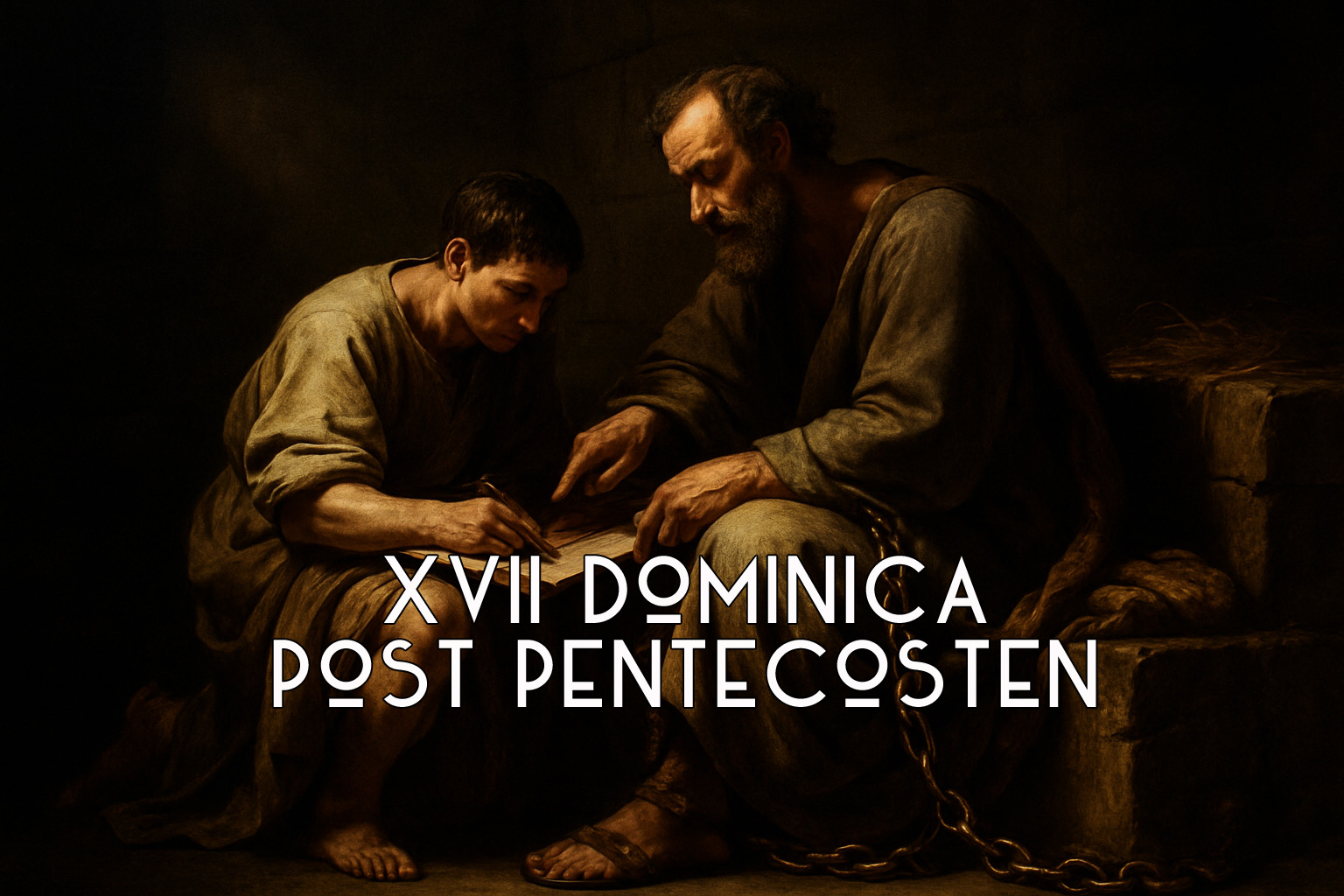
The 17th Sunday after Pentecost in the Vetus Ordo sets before us Paul’s Epistle to the Ephesians, a prison letter written probably from Rome, probably not far from where I sit in Rome writing this, in which he exhorts:
Brethren, I therefore, a prisoner for the Lord, beg you to lead a life worthy of the calling to which you have been called, with all lowliness and meekness, with patience, forbearing one another in love, eager to maintain the unity of the Spirit in the bond of peace. There is one body and one Spirit, just as you were called to the one hope that belongs to your call, one Lord, one faith, one baptism, one God and Father of us all, who is above all and through all and in all.
The Church couples this exhortation with the Gospel from Matthew 22, when Jesus is challenged in the Temple by the Pharisees and Sadducees and responds with the Great Commandment of love of God and neighbor, then asks them the question about David’s son and David’s Lord.
The pairing is not arbitrary. Unity of the Body, for Paul, flows from charity. Charity is the very content of the Great Commandment. Both readings converge on the truth that unity in the Church is possible only through the charity which embraces God and neighbor, a charity that sees in the Messiah not merely a descendant of David, but the divine Lord who unites all in Himself.
Paul, chained for the Gospel, speaks of a calling, klēsis, rooted in baptism. “Sicut vocáti estis in una spe vocatiónis vestrae.” The very word ekklēsía comes from kaleō, “to call, to summon, to name”. Baptism calls us out of the world into unity, one faith, one Lord, one hope. But this unity is fragile, constantly threatened by divisions from within.
Paul knew the pain of division. He suffered persecution from without, but even more the wounds of schism, of brethren betraying brethren. The Mystical Body torn by heresy is more grievous than blows of tyrants. And so he pleads for meekness, humility, patience, ἀνεχόμενοι ἀλλήλων ἐν ἀγάπῃ, “forbearing one another in love”. That agapē is the very same caritas Christ names in the Gospel as the first and second commandments.
The Shema, “You shall love the Lord your God with all your heart, soul, mind,” was well known, recited daily by Israel as a guard against idolatry. Christ weds it inseparably to Lev 19:18: “You shall love your neighbor as yourself.” In that double command He reveals that the unity Paul begs for is not bureaucratic uniformity, nor merely shared rites or creeds, but the oneness wrought by divine charity binding God’s children to Himself and to each other. “Duo sunt praecepta, et una est caritas,” Augustine explains. One love, two commands. To love God is to love neighbor; to love neighbor is to open the way to love of God. And the order is significant: we ascend to God by practicing charity toward the neighbor we see, lest our love of an unseen God remain illusion. “For if you do not love your brother whom you see, how can you love God whom you do not see?” (s. 265).
Thus, the Epistle and Gospel meet. The “ones” of Paul – one body, one Spirit, one baptism – are held together only by the twofold love Christ names as the heart of the Law and the Prophets. To be “worthy of the calling” is to embody the Great Commandment. To break that commandment through pride, rivalry, heresy, or hatred is to tear asunder the unity of the Spirit. Paul’s exhortation is the practical outworking of Christ’s teaching in the Temple.
Bl. Ildefonso Schuster, reflecting on this Epistle, recalls how the Romans resisted Constantius’ attempt to impose an antipope. Their tumult shows how vital unity was, and how bitterly division wounded. Yet their violent passion also shows how unity can be distorted into faction.
In the mid-4th century, the Arian Emperor Constantius exiled Pope Liberius for refusing to compromise on the Nicene faith. In his absence, Rome’s clergy, under imperial pressure, installed Felix as bishop, creating the figure later remembered as Antipope Felix II. When Constantius visited Rome, the people clamored for Liberius, shouting, “one Lord, one faith, one baptism, one bishop.” Though Liberius returned, divisions lingered, and after his death rival elections produced Ursinus and Damasus. Their supporters clashed violently. According to the Collectio Avellana, gladiators and hired mobs fought in the Lateran, leaving corpses littering the basilica. Revered figures like St. Jerome and Rufinus defended Damasus. Others decried the bloodshed. This tragic episode reveals how devotion to “unity” can be weaponized for factional gain.
The cry for one true bishop was true in principle, but without caritas it degenerated into ambition, reminding us today that unity cannot survive apart from charity.
It is not enough to have the right slogans. Without love, unity is a mask for ambition. Paul knew it. Augustine and Jerome knew it. Christ knew it.
And Christ’s dialogue with the Pharisees illumines further. He asks them, “What think you of the Christ? Whose son is he?” They answer, David’s. He quotes Psalm 110(109): “The Lord said to my Lord, Sit at my right hand until I make thy enemies thy footstool.” If David calls him “Lord,” how is he his son?
The crux is the word “Lord”: in Hebrew, Ne’um YHWH la-’doni – “The utterance of Yahweh to my Lord.” Ne’um is “utterance, oracle, declaration.” It is a technical prophetic term, often introducing a divine pronouncement. It’s not simply “said” but “oracle of.” The point is the interplay: YHWH (God) addressing ’Adoni (the Messiah, David’s lord).
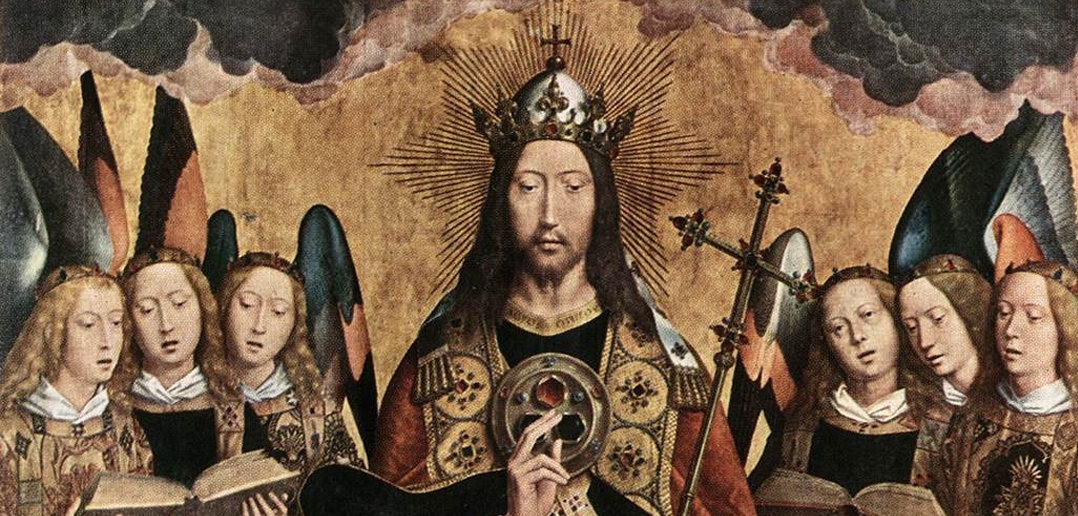
Messiah is not only David’s son, but David’s Lord, God in the flesh. Recognition of His divinity is the foundation of unity. If He were merely a man, a kingly descendant, He would be one factional leader among others. But as God, He is the principle of unity itself, the one Lord to whom all faith is due, who binds all baptized into one body. The unity of Ephesians 4 rests upon the confession of Matthew 22: the Messiah is Lord.
Paul knew how fragile unity is. The ancients rioted over an iota in homoousios versus homoiousios. The Donatists shattered Africa. Jerome and Augustine quarreled over translation. Division is endemic. That is why Paul insists upon meekness and forbearance. That is why Christ insists on love of neighbor. Without that charity, theological clarity only fuels more division.
The unity of the Church is not the absence of controversy but the bond of peace forged by love in the truth of Christ’s divinity.
Cardinal Sarah, in our time, reflecting on Ratzinger, sees the same crisis. In 1966 Ratzinger had urged a “very generous measure of tolerance” within the Church, quoting Ephesians 4 about “bearing with one another.” He knew that only charity could provide soil for authentic renewal. Decades after Ratzinger, Sarah has lamented that impulsive measures like Traditionis custodes have endangered peace, reigniting “liturgy wars.” He warned that Benedict was right: the older rites cannot simply be forbidden as harmful, when they have borne good fruit.
The lesson is perennial, as the people of Charlotte, Monterey and Detroit – to name but a few recently – have learned through bitter experiential knowledge: without charity, “reforms” claimed for unity become seeds of discord.
The liturgy of this Sunday envelops these themes. The Introit sings of the blameless way. The Collect prays to shun diabolical contagion and cleave to God with pure hearts. The Offertory from Daniel is a plea for reconciliation. The Secret asks for sins to be stripped away – exuo – a painful but purifying image. The Communion antiphon proclaims that God checks the pride of princes (aka “bishops”?).
At the threshold of Communion, the priest repeats thrice, Domine, non sum dignus.
In his Enarratio in Psalmum 144.13 Augustine notes the customary reaction (consuetudo) his flock has at the word confessio, which means “praise, acknowledgement, and admission of sin”.
Usque adeo enim hoc putatur, ut quando sonuerit de divinis eloquiis, continuo sit consuetudo pectora tundere… For it is thought to be so much the case that, whenever this word resounds from the divine readings, it is immediately the custom to strike the breast.
The sound of the congregation striking their breasts was like thunder in the church.
Confession and humility.
Recognition that unity and charity come not from us but from the Lord’s mercy.
In the Gospel, Jesus silenced His enemies not by evasion but by manifesting His divinity through Scripture. He did not flatter, He did not “dialogue” in the modern sense of endless negotiation. He loved them with the severity of truth, exposing their hearts for conversion.
Charity sometimes wounds to heal.
Paul too handed blasphemers to Satan, not for revenge but for salvation.
So too in our day, unity requires clarity, and clarity requires courage to say hard things. Love of neighbor is not indulgence of sin, but willing the good, even when it hurts.
Here, Epistle and Gospel converge again. Paul exhorts to lowliness, meekness, forbearance, but never at the expense of truth. Jesus embodies meekness and humility, yet confronts falsehood boldly.
True unity holds both together: humility toward brethren, firmness in confessing the Lordship of Christ. The one Lord, the one faith, the one baptism, the one God above all, is the same Lord who asks, “How is the Christ both David’s son and David’s Lord?” Answer: He is God and man. He is the center who unites heaven and earth, Jew and Gentile, priest and layman, neighbor and neighbor, into one Mystical Body.
The cosmos spins, the seasons turn. Autumn descends, harvest approaches. The liturgical cycle whispers of judgment, of the Second Coming. The faithful are exhorted to walk blameless, to love God and neighbor, to preserve unity. Confession strips away sin, Communion unites us to Christ. “Adorémus in aetérnum Sanctíssimum Sacramentum.” The Epistle reminds us of our vocation, the Gospel of the divine Lord who calls us.
Both readings point to one conclusion: unity in the bond of peace is possible only when the Church confesses Christ as Lord and lives the twofold love.
In 1959 in Ad Petri cathedram Pope John XXIII wrote a phrase about unity and charity often (inaccurately) attributed to St. Augustine. It seems appropriate to conclude with this quote, for he also mentions St. John Henry Newman, whom Pope Leo XIV will declare the 38th Doctor of the Church on 1 November.
The Catholic Church, of course, leaves many questions open to the discussion of theologians. She does this to the extent that matters are not absolutely certain. Far from jeopardizing the Church’s unity, controversies, as a noted English author, John Henry Cardinal Newman, has remarked, can actually pave the way for its attainment. For discussion can lead to fuller and deeper understanding of religious truths; when one idea strikes against another, there may be a spark. But the common saying, expressed in various ways and attributed to various authors, must be recalled with approval: in essentials, unity; in doubtful matters, liberty; in all things, charity. (Cf. J.H. Newman, Difficulties of Anglicans, v. 1, 261 ff.)
In necessariis unitas, in dubiis libertas, in omnibus caritas.
In fact, the phrase appears for the first time in 1617 by Marco Antonio de Dominis the Archbishop of Split in his anti-Papal De republica ecclesiastica (emphasis added):
Quod si in ipsa radice, hoc est sede, vel potius solio Romani pontificis haec abominationis lues purgaretur et ex communi ecclesiae consilio consensuque auferretur hic metus, depressa scilicet hac petra scandali ac ad normae canonicae iustitiam complanata, haberemus ecclesiae atrium aequabile levigatum ac pulcherrimis sanctuarii gemmis splendidissimum. Omnesque mutuam amplecteremur unitatem in necessariis, in non necessariis libertatem, in omnibus caritatem. Ita sentio, ita opto, ita plane spero, in eo qui est spes nostra et non confundemur.
But if at the very root, that is, the seat, or rather the throne of the Roman pontiff, this evil of abomination were purged, and by the common counsel and consent of the church, this fear was removed; most splendid. And let us all embrace one another, in necessary things unity; in uncertain things liberty; in all things charity. I feel so, I wish so, I hope so plainly, in him who is our hope and we shall not be disappointed.
If you will forgive a final digression, Archbishop Marco Antonio de Dominis (1560–1624) started out as a Jesuit. While remaining a believer in the Catholic Church he became convinced that the papacy was leading people astray. Disillusioned by curial politics and the Venetian–Habsburg struggle, he broke with Rome in 1616 and went to England, welcomed by James I. He abjured papal obedience and was made Dean of Windsor. In London he issued De republica ecclesiastica (1617–19), a conciliarist critique of papal primacy. As a naturalist he also offered an early explanation of the rainbow in De radiis visus et lucis. Hmmm… rainbow… Jesuit…. Eventually, he sought reconciliation with the Pope in 1622 and Gregory XV gave him a pension. But Gregory died, the pension ceased, and the irritated prelate relapsed. He was imprisoned by the Inquisition and died in Castel Sant’Angelo in 1624. A trial was held for his corpse in the Dominican Church Santa Maria sopra Minerva. The Inquisition ordered his body to be taken from the coffin, dragged through the streets of Rome, and publicly burned with his books in the Campo de’ Fiori about five minutes from where I type. That’s where my vegetable vendor, butcher and bakery are, along with my favorite evening cocktail place directly across from the statue of another heretic who got himself burned, the weird Giordano Bruno. Just a brief reminder about the Church’s perennial teaching on capital punishment.
Paul calls for unity. Christ commands charity. Both meet in the Church’s vocation: to be one body in the one Lord, sons of David’s Son and Lord, gathered into one harvest at the end of the age.
The leaves fall, the fields are reaped, the gates of heaven close at sunset. Let us not let the sun go down on our anger. Let us be reconciled quickly. Let us be worthy of the calling with which we are called, walking in love of God and neighbor, confessing with David that the Messiah is Lord, and with Paul that there is “one Lord, one faith, one baptism, one God and Father of us all.”