
Is there a vice which God hates more than pride?
It was pride that brought down Satan and the other apostate angels. It was pride that brought down the entire human race in our First Parents. Pride turned angels into devils, turned Paradise into this vale of tears.
What does pride do to your interior landscape? Your soul? Pride is worse than the sins of the flesh, for sins of the soul are of a higher order than fleshly, material failings. It is the beginning of other capital or spiritually lethal sins, for it begets, as the venerable Baltimore Catechism says, “sinful ambition, vainglory, presumption and hypocrisy.” St. Bernard (+1153) taught that pride is the ruin of all virtues and the origin of all vices.
Pride is a spiritual illness more serious than any physical malady, and this week, in the 16th Sunday after Pentecost of the Vetus Ordo, the Gospel confronts us with it in a most striking form.
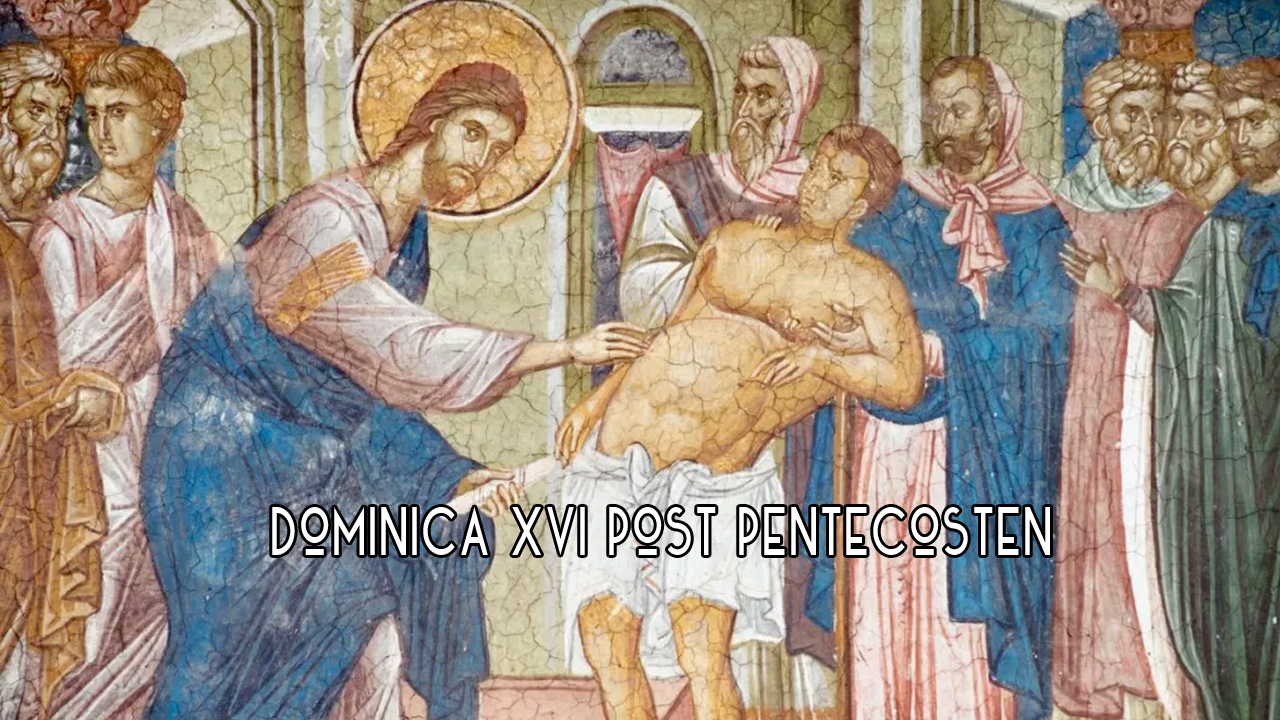
In Luke 14, Christ enters the house of a ruler of the Pharisees for a sabbath meal, and “behold, there was a man before him who had dropsy” (v. 2). Dropsy, or hydropsy, edema, is the abnormal accumulation of fluids in the soft tissues. It makes the limbs and face swell grotesquely, often caused by congestive heart failure. The Fathers and later spiritual writers, noting this swelling, took dropsy as a symbol of pride, that inflation of the heart which cannot be sustained. The Lord heals him and then sends him away, just as He must heal our swelling pride before we can sit at His banquet. Spiritual writers explain that just as a physical heart in failure cannot circulate blood to prevent the seepage of fluid, so a spiritual heart weakened by pride cannot circulate the grace of God and instead swells up with the puffery of self-love.
To heal this requires not just a cardiologist but a Sacred Heart Doctor. If you rush to the emergency room for a failing organ, how much more swiftly should you seek a confessional for a failing soul?
At this sabbath meal, Christ walked straight into a trap, and by triggering it revealed the inner disease of His opponents. The Pharisees and nomikoi, the “lawyers,” “observabant eum… they watched Him.” The Greek undertone is telling: “êsan parapteroúmenoi autón,” a verb that means both to watch assiduously and insidiously, as well as to keep observance scrupulously. They were scrutinizing His every act, hoping He would violate the sabbath by healing. They set the dropsical man before Him as bait, and Christ snapped the trap shut on the trappers.
Jesus healed the man, asked, “Is it lawful to heal on the sabbath, or not?” and when they were silent He pressed the point: “Which of you, having an ass or an ox that has fallen into a well, will not immediately pull him out on a sabbath day?” They could not answer Him.
Cornelius a Lapide (+1637), in his vast commentary, interpreted the ox as the wise Jews under the yoke of the Law and the ass as the foolish Gentiles lacking reason. Whether ox or ass, even child according to some manuscripts, the meaning holds: no one would leave a helpless creature in a pit. Then why would you leave a man trapped in the pit of his disease? The implication is stark: it is always lawful to perform works of mercy. To neglect them, even on pretext of law, is sinful.
From this healing Christ immediately turns to a parable at the same table. Guests were scrambling for places of honor, swollen with the same pride as the dropsical man had been swollen with fluid. He tells them of a wedding feast in which the host humiliates the self-promoted and elevates the lowly. “Ascende superius… Come up higher!” he says to the humble.
The nimshal of the mashal, the lesson, is plain: it is by being genuinely lowly that we are raised to glory. Do not invite the rich and powerful who can repay you, but the poor, the maimed, the lame, the blind, precisely those who cannot repay. Only then will your recompense be from on high.
St. Gregory the Great (+604) listed degrees of pride in his Moralia in Iob: to believe we possess what we received from God by our own efforts; to think we have merited what was given gratuitously; to claim for ourselves a good we lack, such as knowledge we do not have; to prefer ourselves over others and depreciate them. Do these blotches not appear on our own swollen hearts?
The Epistle of the day, from Ephesians 3, is no less direct. Paul, writing from prison around 62 AD, tells his readers not to lose heart.
For this reason I bow my knees before the Father, from whom every family in heaven and on earth is named, that… he may grant you to be strengthened with might through his Spirit in the inner man, and that Christ may dwell in your hearts through faith.
Here is the remedy for pride: Christ in the heart, the Spirit in the inner man. Paul speaks of “breadth and length and height and depth,” dimensions which exceed reason and yet give some sense of the “pléroma toú theoú,” the fullness of God.
The great Pauline scholar Fernand Prat explains that the “inner man” is not merely the soul but the intellectual nature enriched by grace, “the soul inhabited by the Holy Spirit, and in possession of the pneuma.” Without the Spirit the inner man is powerless, captive to the flesh. With the Spirit the inner man is renewed and can comprehend what surpasses knowledge: the love of Christ. This is the antidote to swelling pride. Pride makes us turn inward and inflate; love rooted in faith fills us with the fulness of God and bursts those proud tumors.
Paul’s language of dimensions invites imagery. We can measure a sphere’s radius and circumference, compute surface and volume, muse that “a sphere’s surface is four times greater than the shadow it casts!” But all this measurement only scratches the surface of the mystery.
In liturgy, too, one can measure rites and words, their “breadth and length and height and depth.” But unless one has the Spirit, the indwelling Christ, something always remains hidden, like the part of the Cross buried in the earth. The outward man can measure shadows; the inner man, strengthened by grace, can taste content. Thus the Eucharist, as Schuster says, is “the antidote of the poisonous apple of Eden.” The Post-Communion prayer asks God to cleanse consciences disfigured by Adam’s sin, so that the new life of Christ might succeed the old. Holy Communion is both health of body and eternal salvation of soul, for the forbidden fruit poisoned both.
If pride is swelling of the soul, humility is its cure. Garrigou-Lagrange wrote:
The remedy for pride is to tell ourselves that of ourselves we are not, that we have been created out of nothing by the gratuitous love of God… The remedy for pride is also to tell ourselves that there is in us something inferior to nothingness itself: the disorder of sin and its effects.
Thomas à Kempis echoes:
Do not think yourself better than others lest, perhaps, you be accounted worse before God Who knows what is in man. Do not take pride in your good deeds… The humble live in continuous peace, while in the hearts of the proud are envy and frequent anger.
To examine our consciences is to shine light into the dark corners where pride hides like vermin behind garage clutter or rotting food at the back of the refrigerator. Pride reeks, but the devil spritzes air-fresheners of distraction to keep us from confronting it. Confession is the cleansing, but pride resists.
At the sabbath table, Christ deflated the dropsical man and then the puffed-up Pharisees. He admonished them that true honor comes not from grasping at the high place but from hearing, “Ascende superius” from the host.
Pride is a swelling heart, humility a healed heart.
Paul bows his knees in prayer for his flock that “Christ may dwell in your hearts through faith.”
Christ Himself says, “Learn from me, for I am meek and humble of heart.”
The proud heart swells, the humble heart rests in peace.
Dante calls Mary “the humble daughter of her Son.” Her Magnificat is the manifesto against pride: “He has put down the mighty from their thrones, and exalted the humble.”
St. Michael’s cry, “Quis ut Deus? Who is like God?” is the eternal antidote to Satan’s proud “non serviam”.
Our hearts are healed by listening to the beating of the Immaculate and Sacred Hearts, not the drum-thumping of our own.
And here is the last admonition: “Humble yourselves therefore under the mighty hand of God, that in due time He may exalt you” (1 Peter 5:6).
Pride brought down angels and Adam, puffed up Pharisees, and swells our own hidden corners. But humility, learned from Christ, measured in the dimensions of His love, makes the inner man strong.
When Paul knelt in his prison and prayed, he prayed for us too, that we might comprehend the incomprehensible, that our swollen hearts might be healed and filled with the fullness of God.