We come now to the 15th Sunday after Pentecost, known in older Roman reckoning as Quinta post Sancti Laurentii, the fifth Sunday after St. Lawrence, so beloved by the Romans. In the ancient system, most Sundays of the year had station churches, not only the Sundays of Advent or the days of Lent. Blessed Ildefonso Schuster, the twentieth-century liturgist and Archbishop of Milan, explains:
“This is the last of the stations named after the Cross-bearer of the basilica on the Via Tiburtina [St. Lawrence outside-the-walls]. The cycle of the Sundays following the feast of St Lawrence was succeeded at Rome by those grouped around the feast of St Cyprian, and later around that of St Michael. These feasts really served in regard to the Sunday cycle as so many milestones, to mark the succession of the different weeks, and had no special connection with the saint whose name they bore.”
So the Roman Church divided its year not only by Lent and Advent, but also by the succession of martyrs and archangels. These names served as milestones in the long green season after Pentecost, a time that can be thought of as Mother Church’s classroom. In these weeks, she teaches her children the practical wisdom of living Christian life, sowing seeds of virtue that will ripen in the harvest of eternity.
The Epistle of this Sunday, Galatians 5:25–6:10, sets the tone. It is not found in the modern three-year Lectionary, but in the Vetus Ordo it is read every year. Paul addresses the Galatians, troubled by Judaizing interlopers who insisted that circumcision and the works of the Mosaic Law remained necessary for Christians. To such error Paul responds with a fervent appeal to freedom in Christ, a freedom not of the flesh but of the Spirit.
“If we live by the Spirit, let us also walk by the Spirit. Let us have no self-conceit, no provoking of one another, no envy of one another” (Gal 5:25–26).
The Apostle immediately places Christian liberty within the context of charity, humility, and mutual correction.
“Brethren, if a man is overtaken in any trespass, you who are spiritual should restore him in a spirit of gentleness. Look to yourself, lest you too be tempted. Bear one another’s burdens, and so fulfil the law of Christ” (6:1-2).
This lex Christi is not a new code of regulations but the living law of love written in the heart.
Paul warns against pride: “For if any one thinks he is something, when he is nothing, he deceives himself” (6:3). He exhorts each one to test his own work, dokimázo, to scrutinize whether it is genuine and worthy, and then to bear his own load (vv. 4-5). The Apostle touches again upon works of mercy: “Let him who is taught the word share all good things with him who teaches” (v. 6). The verb koinonéo signifies partnership and communion: the disciple must care for his teacher, even in material things, just as “the Lord commanded that those who proclaim the gospel should get their living by the gospel” (1 Cor 9:14).
The passage culminates in agricultural imagery:
“Do not be deceived; God is not mocked, for whatever a man sows, that he will also reap. For he who sows to his own flesh will from the flesh reap corruption; but he who sows to the Spirit will from the Spirit reap eternal life. And let us not grow weary in well-doing, for in due season we shall reap, if we do not lose heart. So then, as we have opportunity (kairós), let us do good to all men, and especially to those who are of the household of faith” (6:7-10).
Here Paul presents two fields: the field of the flesh and the field of the Spirit. From the one comes corruption and damnation; from the other, eternal life. The imagery emphasizes not only consequences but also time: there is a season for sowing and a season for harvest. Kairos is not only the opportune moment, but also a limited time. Our sowing cannot be postponed forever.
Pope Benedict XVI, in Deus caritas est, reflected on this Pauline teaching. Against the ideological reduction of charity to political activism, he wrote:
“Works of charity—almsgiving—are in effect a way for the rich to shirk their obligation to work for justice and a means of soothing their consciences, while preserving their own status and robbing the poor of their rights” (26).
Yet authentic charity, born of faith, transcends ideology:
“They must not be inspired by ideologies aimed at improving the world, but should rather be guided by the faith which works through love (cf. Gal 5:6). Consequently, more than anything, they must be persons moved by Christ’s love, persons whose hearts Christ has conquered with his love, awakening within them a love of neighbour” (33).
Two people may perform the same exterior work, but one may sow in the flesh while the other sows in the Spirit. Only works performed from true sacrificial love, rooted in Christ, will yield the harvest of eternal life. Paul’s admonition rings down through the centuries: “God is not mocked.” To those who teach error, who sow ideology and sentimentality rather than the Word of God, this verse should be an admonition. Clergy and laity alike must give and receive “the real deal,” not world-infected, flesh-redolent, ideology-laced, platitude-riddled, sentimentality-tainted gobbledygook.
From the Epistle we turn to the Gospel, Luke 7:11-16, the raising of the son of the widow of Nain.
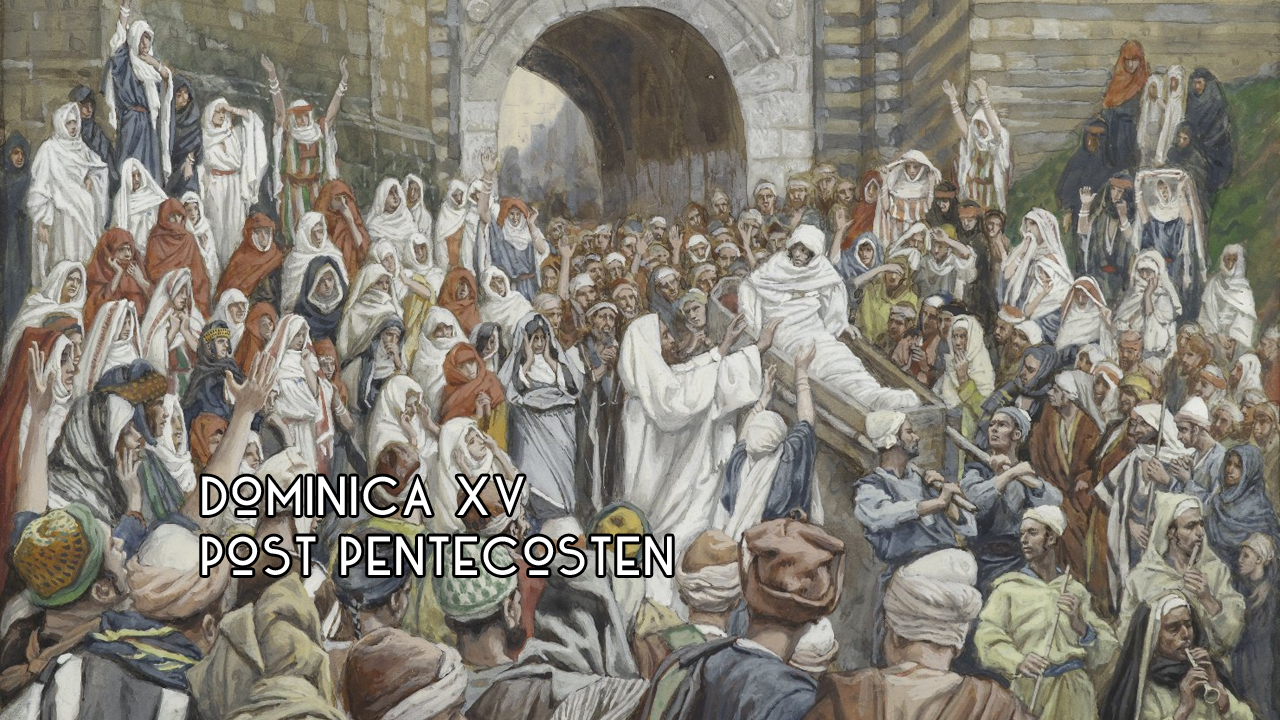
“At that time, Jesus went to a city called Na’in, and his disciples and a great crowd went with him. As he drew near to the gate of the city, behold, a man who had died was being carried out, the only son (monogenes) of his mother, and she was a widow; and a large crowd from the city was with her” (vv. 11-12).
The scene is poignant. With the death of her only-begotten son, the widow of Nain becomes one of the most vulnerable of the anawim, the “cast-down.” In that culture, without husband or son, she faced poverty, marginalization, and despair. Shakespeare’s line from Hamlet fits her plight: “When sorrows come, they come not single spies, but in battalions” (IV.v).
The Evangelist uses the word monogenes, the same word John uses of Christ Himself (Jn 1:14). The widow’s son thus mirrors the Only-Begotten of the Father.
Patristic commentators saw in the widow a figure of Mother Church, mourning her children dead in sin. St. Ambrose wrote:
“Although your sin is grave, and you cannot wash it away with the tears of repentance, let Mother Church weep for you, who, like a widowed mother, intervenes in favor of each of us, as if we were her only children; for she suffers for us with a pain evidently spiritual, but proper to her nature, when she sees that her children are driven to death by their fatal vices” (Exp. Lucam 5.92).
The Lord’s response is immediate and tender:
“When the Lord saw her, he had compassion on her and said to her, ‘Do not weep.’ Then he came and touched the bier, and the bearers stood still. And he said, ‘Young man, I say to you, arise.’ And the dead man sat up, and began to speak. And he gave him to his mother” (vv. 13-15).
Alfred Edersheim described the moment: “One word of power burst through the sluices of Hades, and out flowed once again the tide of life”.
The parallels with Elijah and Elisha are striking. In 1 Kings 17, Elijah meets the widow of Zarephath, tells her “Fear not,” and later raises her son. In 2 Kings 4, Elisha raises the son of the Shunammite woman. Nain lies near ancient Shunem, and the connection would not have been lost on those who witnessed the miracle. Yet whereas Elijah and Elisha prayed and stretched themselves upon the child, Christ raised the dead with a mere word of command.
Luke’s phrase “the next day” (tê hexês) carries weight. Christ had been in Capernaum, where He healed the Centurion’s servant. The next day, He was at Nain, thirty miles away, six hundred feet below sea level to seven hundred feet above, a steep uphill climb, perhaps partly in the dark. This arduous journey suggests Christ’s determination. He wanted to be there at that precise moment when the funeral procession met Him at the gate. Nothing was accidental. He who holds all things in His hand opened His hands to the Cross. Even here He foreshadows that ascent. His march uphill to Nain prefigures His march uphill to Calvary to face down the death of an only son for the sake of the bereft.
The people exclaimed: “A great prophet has arisen among us!” and “God has visited his people!” (v. 16). The first reaction saw Christ as a new Elijah; the second recognized something greater. that in Him God Himself had come. The miracle prepared the ground for John the Baptist’s disciples, who soon after were sent to ask, “Are you he who is to come?” Christ’s answer was not a simple “Yes,” but a catalogue of messianic signs:
“The blind receive their sight, the lame walk, lepers are cleansed, and the deaf hear, the dead are raised up, the poor have good news preached to them” (Lk 7:22).
By citing Isaiah 35, He revealed Himself not only as Messiah but as God renewing creation. “Blessed is he who takes no offense at me” (v. 23).
His claim to divinity, manifested in raising the dead, would lead to His Passion.
Pius Parsch observed that this Sunday marks, in the northern hemisphere at least, a turn toward “harvest time” in the liturgical year, a reflection on the Parousia. The widow’s son raised to life anticipates the general resurrection, the harvest of the just. Paul’s imagery of sowing and reaping dovetails with this Gospel: we must sow in the Spirit if we hope to be reaped for eternal life.
The pastoral application is clear. If you are weighed down by mourning, anxiety, or sin, recall the Lord’s resolute tenderness. He marched uphill to console the widow of Nain; He marched uphill to Calvary to redeem us all. Seek His compassion in the sacraments, where He raises the spiritually dead. If you bear the memory of unconfessed sin, lay it before Him in penance and He will say, “Young man, I say to you, arise.”
Nor should we neglect our vocation to console others. As Paul said, “Bear one another’s burdens, and so fulfil the law of Christ” (Gal 6:2). We may be called to be Christ’s consolation to some modern widow of Nain, striving uphill in the dark ourselves, yet bearing His wounded Heart to those in sorrow.
Paul warns that we will answer not only for our own sins but also for those we have led into sin. To teachers of error, a solemn warning: adopt silence, examine your conscience, and correct your ways, lest you reap corruption for eternity. To the faithful laity: support those who teach you the Word, with gratitude both spiritual and material. “God is not mocked.”
St. Thérèse of Lisieux said: “I will spend my Heaven by doing good on earth.” In our short kairos, let us sow in the Spirit, doing good above all for the household of faith. One day the harvest will come, and may it be said of us: “God has visited his people.”
On the 15th Sunday after Pentecost, the Epistle exhorts us to walk in the Spirit, bear one another’s burdens, and sow works of charity that yield eternal life. The Gospel shows Christ’s compassion in raising the widow’s son at Nain, revealing His divinity through Isaiah’s prophecy fulfilled. His uphill march prefigures His ascent to Calvary. Our time is short (kairos): let us sow in the Spirit, console others, so we one day reap the harvest of eternal life in Christ.