The onset of Hansen’s Disease, known in antiquity under the broad rubric of “leprosy,” comes with patches of skin that change color, grow numb, and progress toward ulcerations, paralysis, even the absorption of extremities back into the body. Untreated, it may bring blindness, disfiguration, and social ruin. Though today we know that the cause is the microscopic nerve-attacking Mycobacterium leprae, and that treatment consists in months of multi-antibiotic therapy, the ancients could only see with horror the deforming march of the disease. They knew nothing of microbial causes. What they knew was that leprosy was terrifying, isolating, and ritually contaminating. They knew the Scriptural association of such afflictions with sin and divine punishment.
In the Old Testament, the Hebrew tsara’ath, commonly translated “leprosy”, refers to a wide range of conditions, sometimes dermatological, sometimes as incidental as mildew on a wall. The book of Leviticus devotes two entire chapters to the subject. In chapter 13, the priest is the appointed examiner, diagnosing afflictions that ranged from contagious skin disorders to eruptions on garments. In chapter 14, the Law prescribes rites for purification once the person is healed: sacrifice, sprinkling, the offering of birds, shaving of hair, ritual washing, the application of oil and blood. The person’s readmission to the community was contingent not merely on physical healing but on liturgical reconciliation.
The state of uncleanness (tumah), absence of holiness, was seen as flowing outward, like contagion. Contact with corpses was the worst form, avi avot hatumah (“father of the father of uncleanness”). Other sources—bodily excretions, sores, menses—were avot hatumah (“fathers of uncleanness”), passing on impurity. Because fluids were linked to loss of life, they symbolized “un-life.” Tumah diminished by degree, yet contact with objects (chairs, cups) used by the impure still transmitted it. Even being under the same roof as a corpse defiled. Laws of tumah and restoration to taharah were intricate.
What if, in the days of the Lord, you were declared leprous? Leviticus 13:45–46 legislated: “The leper who has the disease shall wear torn clothes and let the hair of his head hang loose, and he shall cover his upper lip and cry, ‘Unclean, unclean.’ He shall remain unclean as long as he has the disease. He is unclean. He shall live alone. His dwelling shall be outside the camp.” The outward disfigurement was amplified by outward signs of alienation—torn clothing, matted hair, isolation, and the dreadful cry that repelled others. A man was made into a walking sacrament of exclusion. St. John Chrysostom, commenting on the misery of such sufferers, remarked, “They are dead while alive, more pitiable than the dead” (Hom. in Matt. 25.2).
Lepers lived apart, often in colonies, yet they were not always absolutely ostracized. Since tsara’ath included many non-lethal or curable ailments, families sometimes cared for their afflicted kin. In modern Burqin, between Samaria and Galilee, archaeologists found an early Christian shrine called the Church of the Ten Lepers, near a cave where tradition holds the sick were secluded, food passed down to them through openings in the ceiling.
The unclean were forced to live apart, and usually in groups or colonies. And they couldn’t advertise Masses in the Vetus Ordo in their parish bulletins either. Those in the ancient world with true leprosy, Hanson’s Disease, generally didn’t recover. Hence, their being cured was instantly recognizable as miraculous.
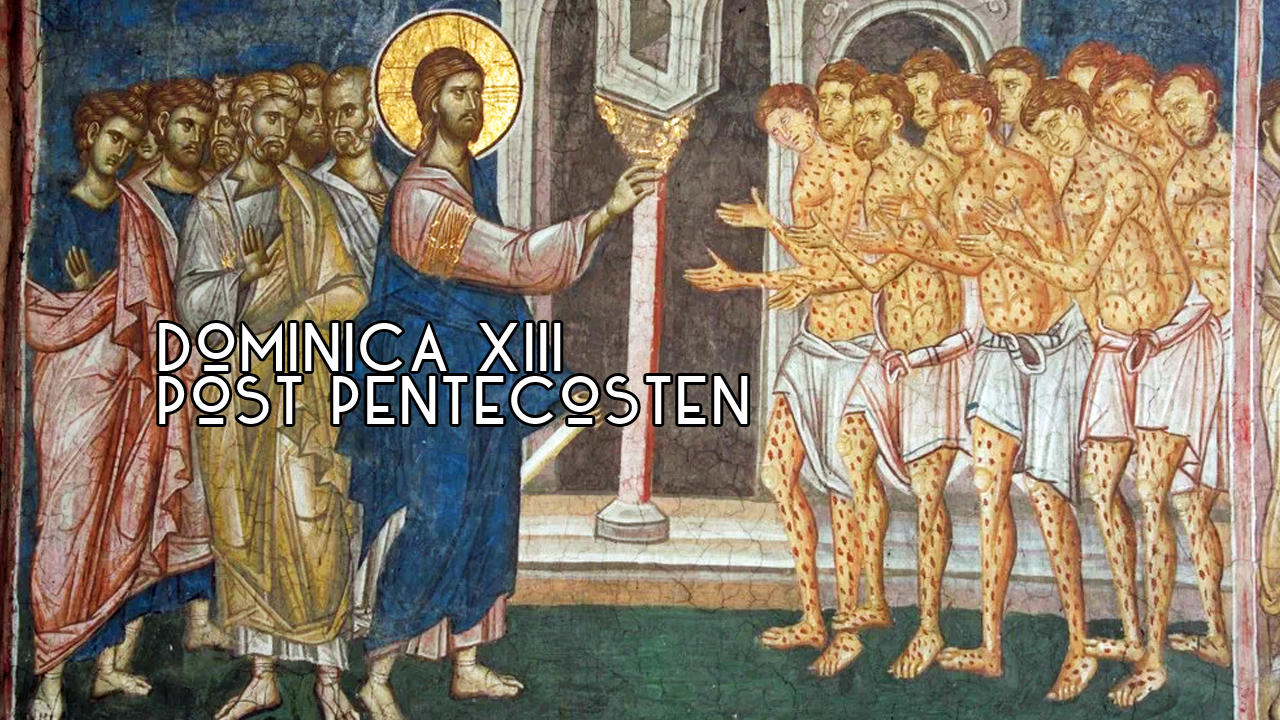
It is within this context that the Gospel for the 13th Sunday after Pentecost (Luke 17:11–19) is set. The evangelist situates Jesus “on the way to Jerusalem, passing between Samaria and Galilee.” There He is met by ten lepers, who, observing the Law, stand at a distance. They lift up their voices in a plea: “Jesus, Master, have mercy on us.” He commands them: “Go, show yourselves to the priests.” As they obey, they are cleansed. Of the ten, only one, upon perceiving his healing, returns. With a loud voice glorifying God, he falls prostrate at the feet of Jesus, giving thanks. And, St. Luke adds with emphasis, “he was a Samaritan.”
The Samaritan’s presence is no accident. Only a few chapters earlier, in Luke 10, the Lord had told the parable of the Good Samaritan. We had that Gospel last week. Now a flesh-and-blood Samaritan becomes the exemplar. Jews despised Samaritans, descendants of the northern tribes mingled with Gentile settlers after the Assyrian conquest (cf. 2 Kings 17:24). They had erected a rival sanctuary on Mount Gerizim and recognized only the Pentateuch. To Judeans, they were both ethnically impure and religiously heretical. How much more scandalous, then, that of ten lepers healed, the only one to glorify God and return to the feet of Christ is this allogenés, this “foreigner.” The word ἀλλογενής occurs only here in the New Testament. It is the same term found inscribed on the Temple balustrade, fragments of which have been recovered, warning: “Μηθένα ἀλλογενῆ εἰσπορεύεσθαι ἐντός … Let no foreigner enter within the parapet.” Josephus records the same prohibition (Bell. Iud. 5.193; Ant. 15.417). To cross that threshold was to incur the death penalty.
In calling the Samaritan “allogenés” and in saying that his faith saved him, we see that Christ’s mission as not to the Jews merely, but to all peoples. A Samaritan is like “all peoples” in this event in Luke 17, just as the Samaritan in the parable was like all true believers regardless of their heritage.
Cardinal Schuster, in his Liber Sacramentorum, meditates on this miracle and sees in it the foreshadowing of the Church’s universality: “The Samaritan, healed together with the others, alone returns to give thanks, a figure of the Gentiles who would accept the Gospel with gratitude, while Israel, though healed, would remain ungrateful”. Pius Parsch likewise stresses the liturgical undertones: “The thanksgiving of the Samaritan is a Eucharistic thanksgiving; his posture at the feet of Christ is the adoration of the Church in the Mass”.
Indeed, the narrative unfolds almost liturgically. First, the assembly: ten sufferers gather in expectant hope. Then the Kyrie: they cry out for mercy. The Lord commands them in the manner of a liturgical proclamation, “Go, show yourselves to the priests.” A miracle occurs, hidden at first, but manifest in obedience. The Samaritan, realizing the gift, returns, singing his Gloria aloud. He falls prostrate, euchariston, eucharistically, in thanksgiving. Finally, the dismissal: “Rise and go your way; your faith has made you well.” The sequence of actions mirrors the Holy Mass, from the penitential cry to the dismissal.
St. Augustine, commenting on this passage, underscores the contrast between the nine and the one: “Ten were cleansed, but only one was saved. Bodily health all received; but he who was thankful received salvation of soul” (s. 176.2). The lesson is clear: miracles may heal the body, but faith and gratitude heal the soul. Gratitude is not an ornament but the very substance of salvation.
The Samaritan’s prostration is telling. To fall on one’s face before another is the gesture reserved for divinity. Here is more than gratitude; here is adoration. The Levitical priests could diagnose and ritually reconcile, but they could not confer true healing. The Samaritan recognizes in Christ the true High Priest, the fulfillment of the Law. “Think not that I am come to destroy the Law or the Prophets,” says Christ, “I am not come to destroy, but to fulfill” (Matt 5:17). The Law commanded lepers to present themselves for inspection; Christ commands the same, but when the Samaritan returns, he surpasses the Law, falling at the feet of the One who is Lord of the Law.
The connection to the Eucharist is more than incidental. The active participle εὐχαριστῶν used by Luke signals the deep link between thanksgiving and worship. The Mass is the supreme act of thanksgiving, not primarily for utility but for the rightness of adoration. As Scott Hahn has observed, “The Eucharist is not just a meal; it is worship, sacrifice, thanksgiving; it is heaven on earth” (The Lamb’s Supper, p. 82). The Samaritan’s gratitude is eucharistic in nature, anticipating the Church’s worship.
Is one allowed to be a bit mordent when offering a reflection on this moment in Christ’s earthly ministry? Can we call the Samaritan the first “backwardist”? After all, the otherwise doubly-reviled, still ritually impure Samaritan, was the one who went back in order properly to worship Jesus from his whole mind and heart and strength. How did he do it? He “doxázon theón… glorified God”, “megáles phonês… with a loud voice”. He did it “prósopon parà toùs pódas”, his “face at the feet” of Jesus. He did it “eucharistôn… giving thanks” (v.16). I catch a whiff of liturgy in this moment. Right after the Samaritan’s “eucharistic” moment in which he is saved, Christ says “Rise and go your way” (v. 19). What does the priest say at the end of Mass? When making your confession, have you heard Father say, “Go in peace”?
A point to take away is “be a loud, kneeling, praising, God-worshipping humble backwardist”.
Another point to take away is that cleansing of sin is a greater miracle than the miraculous healing of leprosy. You can die a leper and be in the state of grace bound for Heaven. No matter how physically healthy you are, you cannot die in mortal sin and be other than damned.
But let’s get back to it.
The narrative also speaks to us today about utility versus rightness in worship. The nine lepers, intent on the utility of healing, obeyed and received what they sought. Only one returned for the sheer rightness of glorifying God. Parsch captures this distinction: “We must not come to Mass merely to seek our own benefit, but to give God glory; yet in glorifying God, we find our greatest healing”.
The spiritual application is sharp. Mortal sin is far more dreadful than Hansen’s Disease. “The soul that sins shall die” (Ezek 18:20). Yet the cure is near at hand: confession. “Go, show yourselves to the priests.” St. Ambrose reminds us, “What is said to them is said to us also, that we may show ourselves to the priests, that is, to the Church, for the judgment is with the priests” (Expos. Evang. sec. Lucam 8.87). In a few minutes of contrition and absolution, the rot of sin is cleansed more swiftly than years of antibiotics.
Consider, too, the resonance with our own time. Just as the Samaritan was doubly outcast—leper and foreigner—so today many faithful attached to the Vetus Ordo feel marginalized, viewed as peculiar or suspect. Yet often it is precisely they who return in gratitude to the feet of Christ, drawn not by utility but by the sheer splendor of worship. In the words of Schuster, the old liturgy “is like the Samaritan: despised, yet it alone returns to give thanks with full heart.”
The miracle of the ten lepers holds a mirror held up to us. Do we approach Christ from afar only for utility, for what we can gain? Or do we return in gratitude, prostrate at His feet, glorifying God because He is God? The nine received their health but did not worship. The one received both health and salvation, for he believed and adored.
As Ildefonso Schuster concluded, “The Church places before us this Gospel, that we may learn to be grateful for the gifts of grace, and to show our gratitude not only by words but by returning again and again to the feet of Christ in the Eucharist”. Gratitude is at the heart of salvation, and the Eucharist is gratitude made flesh.
Is there a connection between the Epistle reading for this Sunday and the Gospel? It hardly seems possible. Running the risk of making this too long, let’s see what can be done with the Epistle which is from Paul’s Letter to the Galatians 3:16-22 in which he writes about the purpose of the Law:
Now the promises were made to Abraham and to his offspring. It does not say, “And to offsprings,” referring to many; but, referring to one, “And to your offspring,” which is Christ. This is what I mean: the law, which came four hundred and thirty years afterward, does not annul a covenant previously ratified by God, so as to make the promise void. For if the inheritance is by the law, it is no longer by promise; but God gave it to Abraham by a promise. Why then the law? It was added because of transgressions, till the offspring should come to whom the promise had been made; and it was ordained by angels through an intermediary. Now an intermediary implies more than one; but God is one. Is the law then against the promises of God? Certainly not; for if a law had been given which could make alive, then righteousness would indeed be by the law. But the scripture consigned all things to sin, that what was promised to faith in Jesus Christ might be given to those who believe.
What’s up with this? St. Paul insists that the promises were spoken “to Abraham and to his offspring”. So translations have “seed”. Paul says not “to offsprings/seeds, as of many; but as of one, ‘And to thy offspring/seed,’ which is Christ” (v. 16). The Law, given 430 years later, does not annul the covenant, but was “added because of transgressions” until the coming of the promised Seed. The Law could diagnose sin, as the priest could diagnose leprosy, but it could not give life: “for if a law had been given which could make alive, then righteousness would indeed be by the law” (v. 21). Instead, “Scripture consigned all things under sin, that the promise by faith in Jesus Christ might be given to them that believe” (v. 22).
Let’s head back to the Gospel, Luke 17:11–19. The ten lepers stood afar, crying out for mercy. Christ directs them to the priests, fulfilling the Mosaic legislation of Leviticus. The priests could certify cleansing but could not heal. The Law was necessary, but provisional. Only Christ, the true Seed, heals. Paul stresses that the Law’s role was to confine, to reveal sin and uncleanness, but salvation comes through faith in Christ.
The nine lepers who obeyed and went to the priests received bodily healing, analogous to the Law’s external observances. But the Samaritan, returning to Jesus in faith and thanksgiving, received something greater: salvation. Christ says, “Your faith has saved you” (Luke 17:19). The Law points. Only Christ gives life. The Samaritan becomes a figure of the Gentiles, indeed all peoples, excluded by the Law’s boundaries yet inheritors of the promise through faith in the Seed.
Thus Galatians 3 and Luke 17 converge: the Law confines, diagnoses, and prepares, but the promise is fulfilled only in Christ, the true Healer, to whom faith and thanksgiving must return.
If you are aware of anything out of order, “Go, show yourselves to the priests.” Go to confession.