
For this 12th Sunday after Pentecost the readings in the Vetus Ordo places before us, from Paul’s second letter to the Corinthians (2 Cor 3:4–9), a meditation on the surpassing glory of the New Covenant, and from Luke 10:23–37, the parable of the Good Samaritan, provoked by a nomikos who wished to test the Lord. Together they form a diptych: Paul, conscious of detractors and rival claimants, defends his apostolic mission and points to God as the true source of authority and grace, while Christ in the Gospel exposes the limits of legalism and expands the commandment of love to include even one’s enemies. Both lessons converge in showing that the Christian life is not a matter of external conformity to code but of an interior transformation wrought by the Spirit, expressed in concrete charity.
Luke’s tenth chapter sets the stage with Christ sending forth the seventy-two disciples two by two, armed with authority and with strict instructions about detachment and dependence on divine providence. Upon their return, they recount with awe how even demons were subject to them. Christ, revealing His divine majesty, declares, “I saw Satan fall like lightning from heaven” (Lk 10:18). He rejoices “in the Holy Spirit” and exclaims: “All things have been delivered to me by my Father; and no one knows who the Son is except the Father, or who the Father is except the Son and any one to whom the Son chooses to reveal him” (Lk 10:22).
Such words inevitably provoked opposition. When the Lord so openly associated Himself with the Father, implying His divinity, controversy followed. Hence the appearance of the nomikos, the “lawyer,” who “stood up” to test Him. Luke’s Greek is precise: ἐκπειράζων (ekpeirazō), “to put to the test, to tempt” the same verb Christ used to repel Satan in the desert: “You shall not tempt the Lord your God.” (Lk 4:12). Paul, too, had warned the Corinthians, “We must not put the Lord (some manuscripts have ‘Christ’) to the test (ekpeirazō), as some of them did and were destroyed by serpents; (1 Cor 10:9). Thus, Luke signals that the lawyer’s intention is less than pure.
The dialogue begins with the lawyer’s question (v. 25): “Teacher, what shall I do to inherit eternal life?” Christ responds not evasively but in rabbinic fashion: “What is written in the Law? How do you read?” Here the Lord underscores that fidelity to the Law depends upon correct reading and interpretation. As Hebrew was written without vowels or punctuation, the sense of a word could vary greatly depending on vocalization. For instance, מלך (M-L-KH), when read as melech, means “king,” but as Moloch, it denotes the idol associated with child sacrifice. Christ, by asking “How do you read?”, pushes His interlocutor to self-examination.
The lawyer answers by combining Deuteronomy 6:5, the Shema, namely, “You shall love the Lord your God with all your heart, and with all your soul, and with all your strength, and with all your mind”, with Leviticus 19:18b (the second part of that verse), “You shall love your neighbor as yourself.” Christ affirms: “You have answered right; do this, and you will live.”
Yet the lawyer, wishing to justify himself (δικαιῶσαι ἑαυτόν, dikaiōsai heauton), presses (v. 29): “And who is my neighbor?” His question exposes his narrow interpretation of “neighbor” as limited to “the sons of your own people” (Lev 19:18a, the first part of the verse). He wants the comfort of boundaries. Christ demolishes them with a parable.
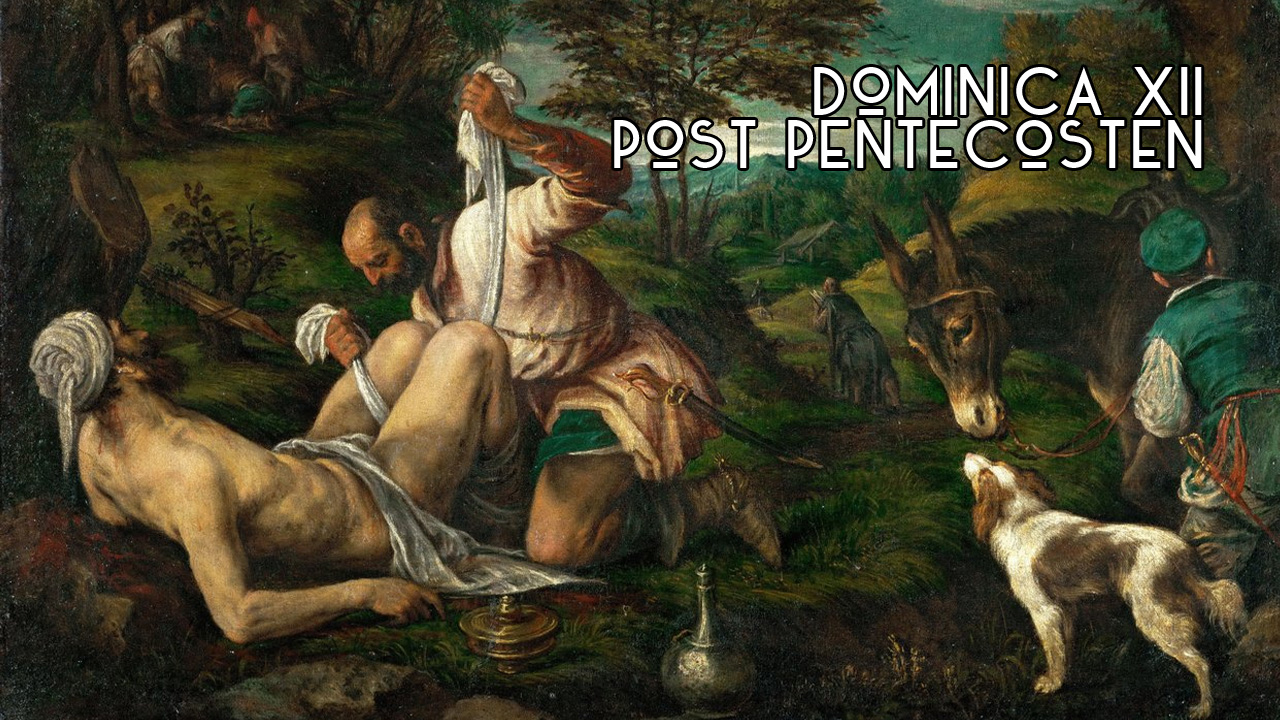
The parable unfolds on the treacherous road descending from Jerusalem to Jericho, a site notorious for ambushes. A man is set upon by robbers, beaten, and left “half-dead” (ἡμιθανής, hēmithanēs). Three passersby encounter him. First, a priest, then a Levite (men associated with the Temple, men like the lawyer himself) see the victim and pass by on the other side of the road. Some excuse their behavior by ritual purity laws forbidding contact with corpses (cf. Lev 21:1–3). If they were ritually impure, they would be forbidden from Temple service. But Christ undercuts this: the priest and Levite were leaving Jerusalem, going down and away not going up and towards for service. Moreover, the man was not dead but alive. Additionally, rabbinic tradition required that a a corpse not be neglected where others could by defiled by its contact. Thus, the priest and Levite are condemned by omission, and their piety is exposed as hypocrisy.
Then comes the parable’s twist: a Samaritan appears. The Samaritans were a mixed people, descendants of Israelites left in the Northern Kingdom after the Assyrian conquest (8th c. B.C.) and of foreign settlers. They accepted only the Pentateuch, rejected Jerusalem’s Temple, and worshipped on Mount Gerizim. By the 1st century, Jews regarded them as ritually impure, ethnically tainted enemies. Josephus records that Samaritans once desecrated the Temple by scattering bones during Passover (Antiquitates Judaicae 18.30). Such was the enmity. Yet this Samaritan is “moved with compassion” (σπλαγχνισθεὶς, splagchnistheìs from the delightful verb σπλαγχνίζομαι, splagchnízomai, in turn from σπλάγχνον, splágchnon, “internal organs, guts, viscera, bowels”). Splagchnízomai, as fun to type as to say, is a delightful verb often used of Christ Himself (cf. Mt 9:36; Mk 6:34). Splágchnon is where we get English “spleen” and “splenic”. In ancient times and into the Medieval period, according to the theory of humorism, no joke, the spleen was considered the seat of emotions, for it excreted “μέλαινα χολή, melaina kholé or black bile”, which when dominating made one melancholy. But I digress. While I am not sanguine about avoiding additional digressions, we must keep moving lest you become bilious or phlegmatic.
So, the splendid splenic Samaritan approaches the Jew, tends his wounds with oil and wine, lifts him onto his own beast, and provides for his care at an inn, pledging to return and repay any further expense.
When Christ asks, “Which of these three, do you think, proved neighbor to the man who fell among the robbers?” the lawyer replies only, “The one who showed mercy”, as if he cannot bring himself to utter the word “Samaritan.” The Christ concludes with the imperative: “Go and do likewise.”
The theoretical becomes concrete. The Law is fulfilled in active charity.
St. Augustine interprets the parable allegorically: the wounded man is Adam, humanity fallen among thieves (the devil and his angels), stripped and left half-dead. The Samaritan is Christ, who, though rejected, tends to the sinner’s wounds with oil and wine (sacraments), places him on His beast (His own flesh in the Incarnation), and brings him to the inn (the Church) for healing (cf. s. 171 and 179A). Thus, the parable is both moral and mystical: we are called to imitate the Samaritan, yet first we must recognize Christ as the true Samaritan who heals our wounds and entrusts us to the care of His Church.
The Epistle this Sunday is taken from 2 Corinthians 3:4–9. Paul, beset by rivals who flaunt letters of recommendation, asserts that his true credentials are the Corinthians themselves, living testimonies inscribed not on stone tablets but on hearts by the Spirit: “You show that you are a letter from Christ delivered by us, written not with ink but with the Spirit of the living God, not on tablets of stone but on tablets of human hearts” (2 Cor 3:3).
Paul contrasts the old covenant, mediated through Moses, with the new covenant of the Spirit. When Moses came down from Sinai, his face shone with reflected glory, so bright that he veiled it (Ex 34:29–35). Yet that glory faded. Paul calls it “the dispensation of death, carved in letters on stone” (2 Cor 3:7), and argues a minore ad maius: if the old covenant, destined to fade, came with splendor, how much greater is the glory of the new, permanent covenant in Christ.
Paul insists that “our competence is from God, who has made us competent to be ministers of a new covenant, not in a written code but in the Spirit; for the written code kills, but the Spirit gives life” (2 Cor 3:5–6).
The Law, though holy, reveals sin and condemns; the Spirit renews the heart and grants life.
Blessed Ildefonso Schuster, and I write this on his feast day, remarks that this reading harmonizes with the Offertory antiphon from Exodus 32, where Moses intercedes after the Golden Calf. The chant recalls Moses invoking Abraham, Isaac, and Jacob to turn aside God’s wrath. As Paul intercedes for the Corinthians, appealing to the fruits of his ministry written on their hearts, so Moses pleaded for Israel, invoking the patriarchs. Both stand as intercessors: Moses for a stiff-necked people, Paul for his wavering converts. Both succeed because God’s fidelity surpasses man’s infidelity..
The juxtaposition of Moses and Paul highlights a deeper Catholic truth: the communion of saints. Moses invokes the patriarchs, long dead, yet efficacious before God. Paul points to the Corinthians themselves, living saints-in-the-making, as witnesses of grace. In both cases, the holy—whether triumphant in heaven or militant on earth—intercede for others.
The Epistle and Gospel converge. The Samaritan shows mercy by helping the wounded; Paul and Moses show mercy by intercession. All three point to Christ, the true Mediator, who in His flesh bridges Jew and Gentile, law and Spirit, death and life. Pius Parsch, in The Church’s Year of Grace, remarks that the Mass of this Sunday is “a living mosaic of intercession and mercy, uniting Old Testament pleading, apostolic defense, and Christ’s own command to active charity” (vol. V, p. 131).
The Christian is not merely a hearer of the Law but a doer, one who, healed by Christ, becomes Christ’s letter to others.
The allegory of the Samaritan and Paul’s teaching illuminate each other. The man left half-dead is humanity under the condemnation of the Law: the “dispensation of death, carved in letters on stone” (2 Cor 3:7). The Samaritan (Christ) brings oil and wine, sacraments of healing, and entrusts the wounded to the inn, the Church. There the Spirit, giver of life, inscribes charity upon hearts. Christ made Himself neighbor to us, that we might be made neighbors to others.
Paul, minister of the Spirit, writes not on stone but hearts. The Samaritan inscribes mercy not in theory but in action. Both overcome boundaries: Paul, accused of lacking credentials, shows that true authority is Spirit-wrought; the Samaritan, despised outsider, embodies divine compassion.
At the close of the Gospel pericope, Christ commands: “Go, and do likewise”. The imperative is practical. Sacrificial love is not sentimental but costly, as revealed by the Samaritan’s expenditure of time, first aid skill (talent), and treasure. Likewise, Paul’s ministry cost him dearly, yet he claimed no competence of his own: “Our sufficiency is from God” (2 Cor 3:5).
Moreover, the parable warns against leaving the inn, the Church. Augustine notes that one who abandons the inn exposes himself again to thieves. So too, those who reject apostolic authority, as Paul’s detractors threatened to, risk falling back into death.
The Church is the sole place of soul healing, where the oil and wine of the sacraments are applied, where the saints intercede, where Christ continues to be neighbor through His members.
The Epistle and Gospel of this Sunday together teach that true life is not in letters or externalities but in the Spirit who gives life, and that the measure of life in the Spirit is mercy shown concretely, even to one’s enemy. Paul appeals to the Corinthians as his living testimony; Christ commands His hearers to become living testimonies by merciful action. The Law is fulfilled not by boundary-setting but by self-giving.
Go, then, and do likewise: become Christ’s letter, written on the heart, for neighbor and for enemy alike.