Pius Parsch noted that the 11th, 12th, and 13th Sundays after Pentecost form a triad on sacramental grace: baptism, healing, and gratitude for purification. The context of summer, with its harvests, provides the natural analogy. Just as zucchini overflow gardens with comic abundance, so grace superabounds. The cycle of Sundays after Pentecost is like a vast verdant garden in which the faithful are nourished by the fruits of God’s word and grace. Holy Church, Mater et Magistra, provides in this green season not only lofty mysteries but their practical application, guiding her children in the everyday labor of sanctification.
Blessed Ildefonso Schuster, writing of this 11th Sunday after Pentecost, saw the Mass as a summer morning in the Roman Campagna, the hillsides heavy with clusters of grapes ripening in the warmth of the sun: “now the heavy clusters are taking on luscious color upon the smiling hills of the Roman Campagna.” In this setting, we are invited to savor the Epistle’s catechesis and the Gospel’s healing, as if harvesting from the abundance of Christ’s vineyard.
The Epistle gives us the foundational catechesis, the túpos of doctrine, while the Gospel dramatizes the sacramental action of Christ, opening and loosing, cleansing and empowering.
St. Paul addresses the Corinthians with words that still thunder through the centuries:
I would remind you, brethren, in what terms I preached to you the gospel, which you received, in which you stand, by which you are saved, if you hold it fast—unless you believed in vain (1 Cor 15:1–2).
Here Paul emphasizes tò euaggélion, the Gospel, not “a gospel.” The definite article makes clear that what he handed on was not opinion or improvisation, but a definite pattern of teaching: tradidi quod et accepi. He recounts the death, burial, and resurrection of Christ, all “in accordance with the Scriptures,” confirmed by witnesses from Peter and the Twelve to more than five hundred brethren, to James, and last of all to Paul himself, “as to one untimely born.” In these concise strokes Paul sketches what Ferdinand Prat called the primitive catechism, the túpos of Christian doctrine that all preachers taught with uniformity. “Whether then it was I or they, so we preach and so you believed” (1 Cor 15:11). The Latin has the same hammer-blow force: Sive enim ego, sive illi, sic praedicamus et sic credidistis.
The Resurrection stands at the core of this proclamation. “If Christ has not been raised, then our preaching is in vain and your faith is in vain” (v. 14).
Paul, once the persecutor of Damascus, has become by grace the tireless herald who can say with a holy pride: “Abundantius illis omnibus laboravi… I worked harder than any of them, though it was not I, but the grace of God which is with me” (v. 10). Schuster comments:
The faithful are saved by means of this faith, which must not, however, be sterile and dead, but must be fruitful in good works in imitation of St Paul, in whom the grace of God did not remain inactive and lifeless.
Augustine too perceived in Paul’s conversion a special victory: “the enemy suffers a worse defeat when he loses a man whom he had the greater hold of” (conf. 8.4). Grace, stronger than sin, transforms the persecutor into the Apostle, and his abundant labors become a living testimony to resurrection power.
Here we glimpse the catechetical function of the Epistle. The Corinthians, tempted by doubts about resurrection, needed to be reminded of the standard teaching. As Hebrews 6 notes, the arché tou Christou, the “first word of Christ,” included instruction on ablutions, laying on of hands, resurrection, and judgment. Paul did not leave communities to invent doctrine; he handed on a definite rule of faith.
How far this is from the lax notion that one may preach “whatever keeps people happy.” Instead, catechesis ought to be uniform, concise, and demanding: a foundation upon which the whole edifice of Christian life and morality was to be built.
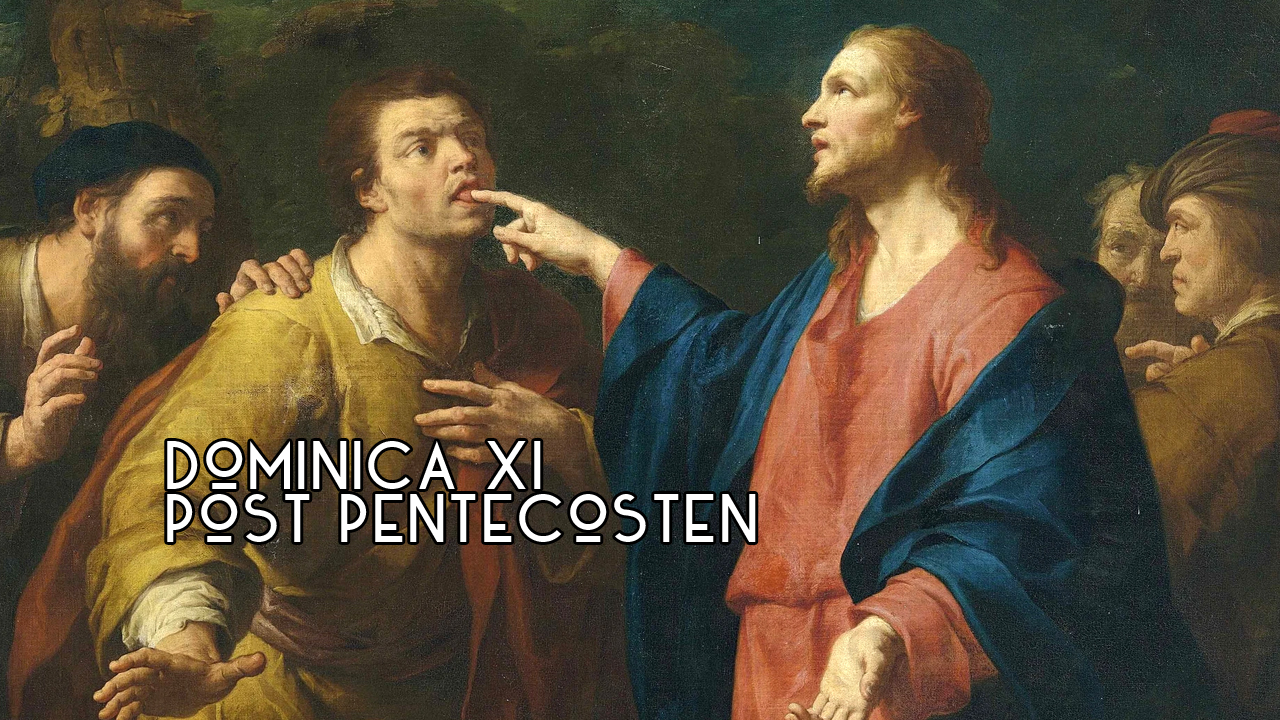
From this Epistle of Paul, Holy Church leads us to the Gospel of Mark 7:31–37, the healing of the deaf man with the speech impediment. Jesus had been in Gentile lands: He fed the five thousand in the wilderness, recalling by the symbolic numbers the pagan nations once inhabiting the land of promise, hinting that all would be gathered into Himself. He crossed the sea to Gennesaret, walking upon the waters, and then healed even those who touched the hem of His garment. He encountered the Syrophoenician woman, who begged crumbs of mercy for her daughter. Finally, in the Decapolis, He is asked to lay His hand upon a man cut off from speech and hearing.
The account of the healing of the deaf man who is also in Greek mogilálos (having a harsh or thick voice, having a speech impediment, a stammer) is striking for its concreteness, marked by the Aramaic Ephphatha, “be opened,” preserved by the Evangelist. This word of the Savior, like “Talitha koum,” carries the force of an eyewitness, perhaps Peter, who remembered the detail.
Christ takes the man aside in relative privacy, away from the crowd. He touches his deaf ears. He moistens the impeded tongue with the touch of His own saliva. He looks to heaven, and “sighed” (Greek stenazo, a deep groan). No word of prayer is recorded, only this sigh of compassion, a rush of ruach, Spirit-breath, that spoke volumes of divine pity communicating more than any syllables could. Then the command: Ephphatha … Dianoíxtheti, Greek aorist passive imperative, second person singular – “let you be opened.” And so “his ears were opened, his tongue was released, and he spoke plainly.”
Not simply the ears, not only the tongue, but the whole man was commanded into openness. The great commentator Cornelius a Lapide wrote that
when Christ opened the ears and unloosed the tongue of the body, He opened also the ears and tongue of the soul, that they might listen to His inspiration, and believe that He was the Messiah, and that they might ask and obtain of Him pardon of their sins. (The Great Commentary, vol. 3).
The touch of the tongue with the saliva, from the mouth of the Word made flesh to the mouth of the wordless flesh-entombed soul, hearing no word, speaking no word, was a communion with liberating logos, Meaning, Reason. He restored the man’s connectivity, social and transcendent.
How mysterious is that organ of speech, the tongue. It is mighty indeed. It can be employed for good and the benefit of many, or to their detriment and own’s own destruction.
St. Gregory Nazianzen had warned that
half of all vices may be charged to the account of the tongue. It would be better for many persons to have no tongue and to be dumb from their birth, for then they would be miserable only for this life, whereas owing to the sins of their tongue they plunge themselves into eternal damnation (Orat. 2.62).
The tongue is powerful for good or ill. St. Francis de Sales, too, desired “buttons” upon his lips to gain time before speaking, that speech might be deliberate and charitable. St. Alphonsus Liguori, in his warnings to women religious about silence, noted that “the greater number of sins arise from speaking or from listening to others” (Practice of the Love of Jesus Christ, ch. 13). These warnings echo the Epistle of St. James: “The tongue is a world of iniquity” (Jas 3:6).
Gregory’s warning about the tongue should prompt examination. How many quarrels, how many broken friendships, how many heartaches could have been spared if words had been restrained? Silence is not cowardice when speech would be destructive. It is wisdom.
Yet silence is not always virtue; one must speak when justice or duty demands. Discernment is needed, and prayer supplies it. As Alphonsus counseled, “endeavor to recollect yourself a little and you will see how many defects you have committed by the multitude of your words.”
A recollected soul learns when to be silent, when to speak, and above all how to speak in the lingua caritatis… the language of sacrificial love.
The miracle of the deaf man’s healing is for us a parable of moral life. Christ touches and opens not only the organs of sense but the deeper man, cor hominis. Pope Benedict XVI, in a 2012 Angelus, taught that
[the Word] became man so that man, made inwardly deaf and dumb by sin, would become able to hear the voice of God, the voice of love speaking to his heart, and learn to speak in the language of love, to communicate with God and with others.
Sin deafens. Sin binds. Grace opens. Grace loosens.
The “Ephphatha” is the a Gospel in a word.
In the traditional Roman ritual (optional in the post-Conciliar ritual) for baptism, as a preparatory opening and exorcism the priest touches the ears and nostrils with his saliva, saying: “Ephpheta, quod est adaperire, in odorem suavitatis. Tu autem, diabole, effugare; appropinquabit enim iudicium Dei.” The gesture, primordial, incarnational, recalls God’s own touch upon humanity back to his shaping from clay. The symbolism is profound: the baptized is opened to faith, virtue, and the communion of saints. Benedict XVI saw Ephphatha the summation of Christ’s mission: to open humanity to God’s gifts, to open the heart to hear and to love. This echoes the insight of Gaudium et spes 22: Jesus, the Word made flesh, reveals man more fully to himself. In turn, how do we reveal Christ in us to others?
How often are our ears closed, not to sound but to the Word? There is a terrible amount of sound in the world, “signifying nothing”. The Word is the ultimate sound signifying everything. How often are our tongues loosed, not for plain truth but for gossip, complaint, detraction, parroting the passing world’s clamor?
Nature herself, as Epictetus quipped, gave us two ears and one mouth so that we may listen more than we speak. To listen is hard labor; to speak rashly is easy.
Consider also the context of sacred liturgical worship. Active participation is first of all receptive openness, attentiveness, watchfulness. Each moment of Mass is an Ephphatha opportunity, a commanding invitation to receive more deeply and express more fully.
In the end, the “Ephphatha” is addressed to each of us. It is not only a past miracle, nor only an element in the already celebrated baptismal rite. It is a present imperative: “Let you be opened.”
Try a pious exercise. Upon entering church, touch the holy water, recalling baptism, recalling Jesus’ personal “holy water” for the deaf man, and whisper “Ephphatha.” Before the readings begin, whisper “Ephphatha.” Before the consecration, “Ephphatha.” Approaching for communion, “Ephphatha.” Thus, join a faith sigh to Christ’s ruach sigh and His “holy water” for our openness to His gifts.