We have come to the 10th Sunday after Pentecost in the Usus Antiquior, the Vetus Ordo.
In this Sunday’s Epistle, Paul confronts the Corinthians with the issue of idolatry, reminding them that “when you were heathen, you were led astray to dumb idols” (1 Cor 12:2). To serve idols is to turn from the living God, to say in effect “Anathema” to Jesus Christ, cutting oneself off from the Spirit who alone enables us to confess, “Jesus is Lord” (1 Cor 12:3). This sharp contrast between idolatry and true worship sets the stage not only for his discourse on the Spirit’s manifold gifts but also for the Gospel lesson of the Pharisee and the Publican, which presents in miniature the essence of right and wrong prayer. To offer prayer “toward oneself” is in its way a species of idolatry, for whatever is not directed to God is offered to not-God. Thus, Paul’s warning about idols illumines Christ’s parable: self-referential piety is but another mask of idolatry, a subtle offering to the self as one’s own god.
St. Augustine, in his great struggle against Pelagianism, knew well that the heart of sin is to attribute salvation to one’s own powers, thereby displacing the Creator with the creature. He writes in his Enarrationes in Psalmos: “Hoc est ergo, fratres, idolum in corde habere, si quis in se ipsum spem point …To have an idol in the heart, brothers, is nothing else than for a man to place his hope in himself” (en. 39, 8). This diagnosis could be written across the forehead of the Pharisee in Christ’s parable, for though he is standing in the Temple, his words are spoken πρὸς ἑαυτόν, “toward himself” (Luke 18:11). The Latin rendering, apud se, conveys the same: his prayer is self-contained, a soliloquy of self-congratulation offered not before God but before his own image. Hence, idolatry returns in an unexpected guise: not bowing before carved idols of wood and stone, but fashioning an idol out of one’s own righteousness.
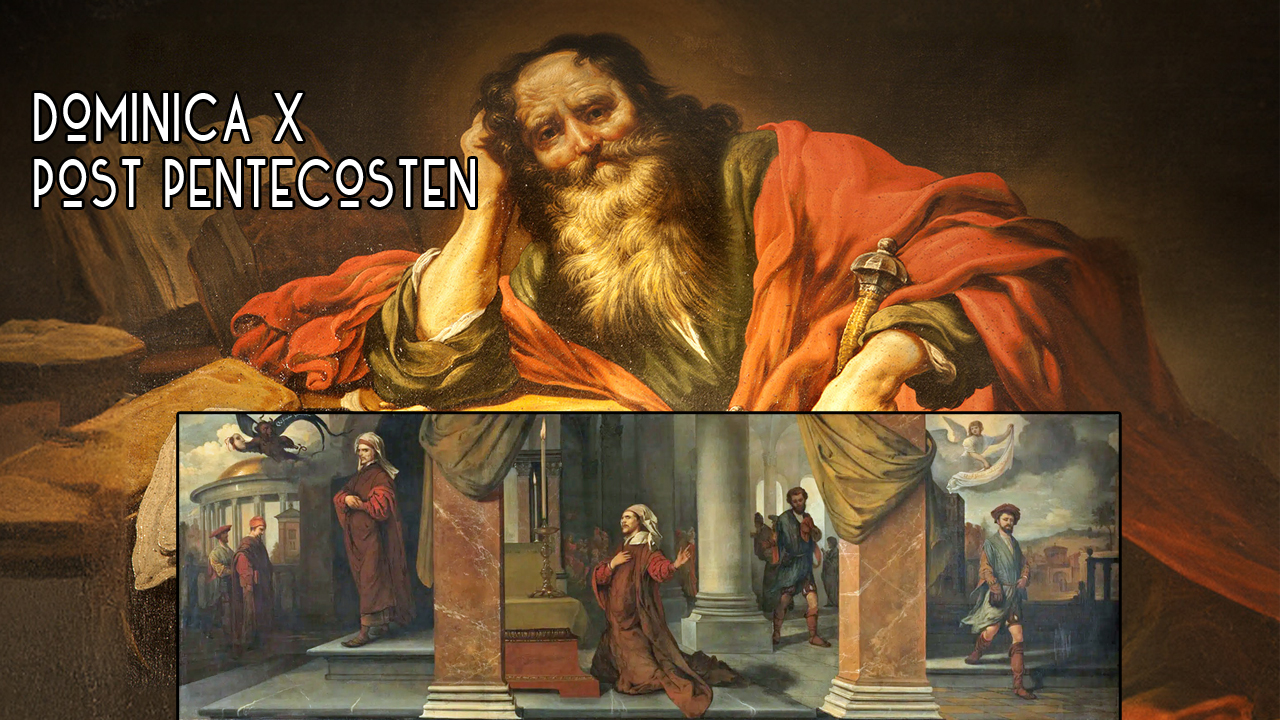
The parable itself unfolds with a dramatic irony. Christ’s audience would have regarded the Pharisee as the pious exemplar and the Publican as the compromised sinner, a ritually unclean traitor to his people who collaborated with the occupying Romans to gouge money by taxation. Josephus, the Jewish historian, testifies that the Pharisees were “held in great admiration among the people” (Antiquities 13.10.6). Yet Christ overturns this expectation by presenting the Pharisee as condemned and the Publican as justified. The Pharisee rehearses his fasting, tithing, and separation from sinners. All of these are laudable works in themselves, even commanded in the Law. As Catholic tradition affirms, fasting, tithing, and avoiding sin are indeed obligations: the Church enjoins them as commandments, the nuns of any parochial school in days of yore would insist upon them, and common sense recognizes their goodness. Yet what condemns the Pharisee is the inward turn, the self as reference point. Augustine again provides the lens: “Non ad seipsum respiciat homo, sed ad Deum; quia si ad seipsum respexerit, in seipso cadet … Let man not look to himself but to God; for if he looks to himself, in himself he will fall” (s. 131.6).
The Publican, meanwhile, stands afar, scarcely daring to lift his eyes, striking his breast and pleading: Deus, propitius esto mihi peccatori (Luke 18:13). This gesture and cry resound daily in the Mass. At the beginning of Holy Mass in the Vetus Ordo, before the priest ascends to the altar, he bows and strike his breast, confessing sin and begging mercy. The prayers at the foot of the altar are patterned on the humility of the Publican:
“Aufer a nobis, quaesumus Domine, iniquitates nostras: ut ad Sancta sanctorum puris mereamur mentibus introire … Take away from us our iniquities, O Lord, we beseech Thee, that we may be worthy to enter with pure minds into the Holy of Holies.”
Holy Church, expert in humanity’s frailty, sets us always at the gate with the Publican, not the front with the Pharisee, for only thus can we ascend rightly to the altar of God who gives joy to our youth: ad Deum qui laetificat juventutem meam.
Yet Paul’s Epistle presses further. After his reminder of idolatry, he expounds the diverse gifts of the Spirit: wisdom, knowledge, faith, healings, miracles, prophecy, discernment, tongues, and interpretation. Each is distinct, yet all come from the one Spirit, the same Lord, the same God who works in all. The Greek text uses διαίρεσις thrice to describe the “varieties” of gifts, ministries, and workings. As a great Pauline scholar Fernand Prat comments, it “signifies ‘division’ rather than ‘difference’… the difference results from the division. The Greek commentators regard these words as synonyms, applying to the same objects.” Paul insists not on a competitive diversity but on a harmonious distribution, like the members of the body functioning together. Later in the same chapter he will elaborate: “For the body does not consist of one member but of many” (1 Cor 12:14). The Spirit apportions gifts “to each one individually as he wills” (v. 11), but always for the common good.
Here the teaching resonates with the parable. The Pharisee, claiming to possess gifts (fasting, tithing, righteousness) hoards them as his own and turns them inward. The Publican, confessing his utter need, opens himself to receive mercy as gift. As Pius Parsch observes, the lesson of this liturgical season is that the kingdom of God grows not through self-assertion but through humble reception of grace: “The Spirit apportions His gifts to each one, but their purpose is the upbuilding of the one Body. As in the human body, so also in the mystical Body of Christ, diversity is not opposition but harmony”.
Pride isolates; humility integrates. Idolatry fragments; charity unites.
Paul’s exhortation to “desire the higher gifts” (1 Cor 12:31) leads directly into his great hymn to love. Caritas is superior to all charismata, for without it, even the greatest works are empty. “If I speak in the tongues of men and of angels, but have not love, I am a noisy gong or a clanging cymbal” (13:1). The Pharisee’s prayer is precisely such clanging: eloquent in words, void of charity. The Publican’s groan, though inarticulate, is filled with love, for it is directed to God in truth. As Augustine says, “Amor ipse orat, amor ipse gemit; si tacueris, amor clamat … Love itself prays, love itself groans; if you are silent, love cries out” (en. 85, 7).
Love is the true voice of prayer, not the cataloguing of one’s works.
The Collect of the Mass deepens this theme. Parsch says that “it is the Publican’s prayer in classic Latin phraseology”.
Deus, qui omnipotentiam tuam
parcendo maxime et miserando manifestas:
multiplica super nos misericordiam tuam;
ut, ad tua promissa currentes,
caelestium bonorum facias esse consortes.
I love the cursus and assonance of the last two cola:
promíssa curréntes
ésse consórtes
Hey! There’s also alliteration and homoioteleuton! Sweet. And hear the alliteration of the first part, the protasis. A master composed this.
LITERALLY
O God, who manifest Your omnipotence
especially by sparing and being merciful,
multiply Your mercy upon us,
so that You may make us,
rushing toward the things You have promised,
to be partakers of the heavenly benefits.
God manifests His omnipotence most of all by mercy and pardon. We find in Wisdom 11:23 (LXX) “ἐλεείς δέ πανταs, ότι πάντα δύνασαι … misereris omnium, quia omnia potes… for You are merciful to all, for You can do all”.
In To us, hurrying toward His promises, He grants to be consortes, sharers in heavenly goods. The Pharisee boasts in his own strength, the Publican begs for mercy. Yet in truth, omnipotence is revealed not in feats of power but in forgiveness.
St. Ildefonso Schuster, in his Liber Sacramentorum, comments on this Collect and the Sunday’s readings with characteristic insight: “It is precisely in pardoning and showing mercy that God reveals the infinite power of His divinity, since He thus overcomes the most invincible obstacle to His glory, namely the malice of the sinner. Mercy is the crown of omnipotence, because it restores to God what sin had taken away.” Schuster sees in the Pharisee and Publican not merely two contrasting figures but the drama of divine omnipotence in action: the proud remain unhealed, the humble are made whole.
The Fathers frequently return to the theme of humility as the foundation of prayer. St. John Chrysostom, preaching on this parable, exhorts: “Do you see how the Publican spoke humbly? And for this he was justified. The Pharisee lost all the merit of his fasting by the haughtiness of his tongue” (Hom. on Luke 5). For Chrysostom, pride nullifies the good of works, whereas humility redeems even a broken prayer. This explains why the Church, wise physician of souls, teaches us to strike the breast, to confess aloud, to kneel, to bow: bodily gestures that express humility, lest pride creep unperceived into our hearts.
Pope St. Leo the Great declared: “Maius est peccata delere quam elementa condere … It is greater to blot out sins than to create the elements” (s. 95). Thus, mercy is God’s highest work, and to receive it is to partake of divine omnipotence. The Pharisee’s prayer leaves him empty; the Publican departs justified (Luke 18:14).
Scott Hahn, reflecting on 1 Corinthians, highlights Paul’s insistence on the Spirit as source of mortification and life. “The choice facing every believer is between life and death, final justification and final condemnation. Paul’s use of the present tense of θανατόω indicates that mortification requires continual exertion over time. Believers can successfully mortify the flesh only by the Spirit—in conscious reliance on God’s indwelling presence”. Hahn’s words illuminate both Epistle and Gospel: the Pharisee, presuming on his own strength, attempts mortification without the Spirit; the Publican, acknowledging his death-bound state, opens to the Spirit who alone brings life.
The liturgical action itself, then, becomes the living commentary on these texts. At the start of Mass, we take the Publican’s place, confessing sin and striking the breast. The priest ascends the altar, whispering prayers of purification. The readings proclaim the call to flee idols and receive the Spirit’s gifts. The Collect invokes God’s omnipotent mercy. The Eucharist itself unites us as one Body, distributing to each the supreme Gift of Christ Himself. In all this, the question remains ever before us: are we turned toward self, or toward God?
Quis sedet super thronum cordis mei? Who occupies the throne of my heart?
In daily life as well, the parable and the Epistle converge. Neglect of prayer, fasting, and worship is as self-referential as boastful piety. Both say in different ways, “I do not need God.”
Omission joins commission in the indictment.
To omit prayer is to turn inward, to live “apud se.” To perform prayer for self-display is equally to live “πρὸς ἑαυτόν.” Only the humble cry, “Lord, have mercy,” breaks the circle of the self and opens to the Spirit.
As the liturgical year rushes toward its goal, Mother Church places these lessons before us her children as preparation for judgment.
The Pharisee trusted in himself and was condemned; the Publican trusted in mercy and was justified. The Corinthians, once idolaters, are now sanctified by the Spirit’s gifts, but only if they use them for the common good in charity.
Idolatry is never merely a temptation of the past; it lurks whenever the self displaces God. Charity is never merely an adornment; it is the indispensable heart of all gifts.
As Augustine concludes: “Humilitas fundamentum est omnium virtutum… Humility is the foundation of all virtues” (ep. 118.3).
Upon this foundation alone can the temple be built wherein true prayer ascends.