
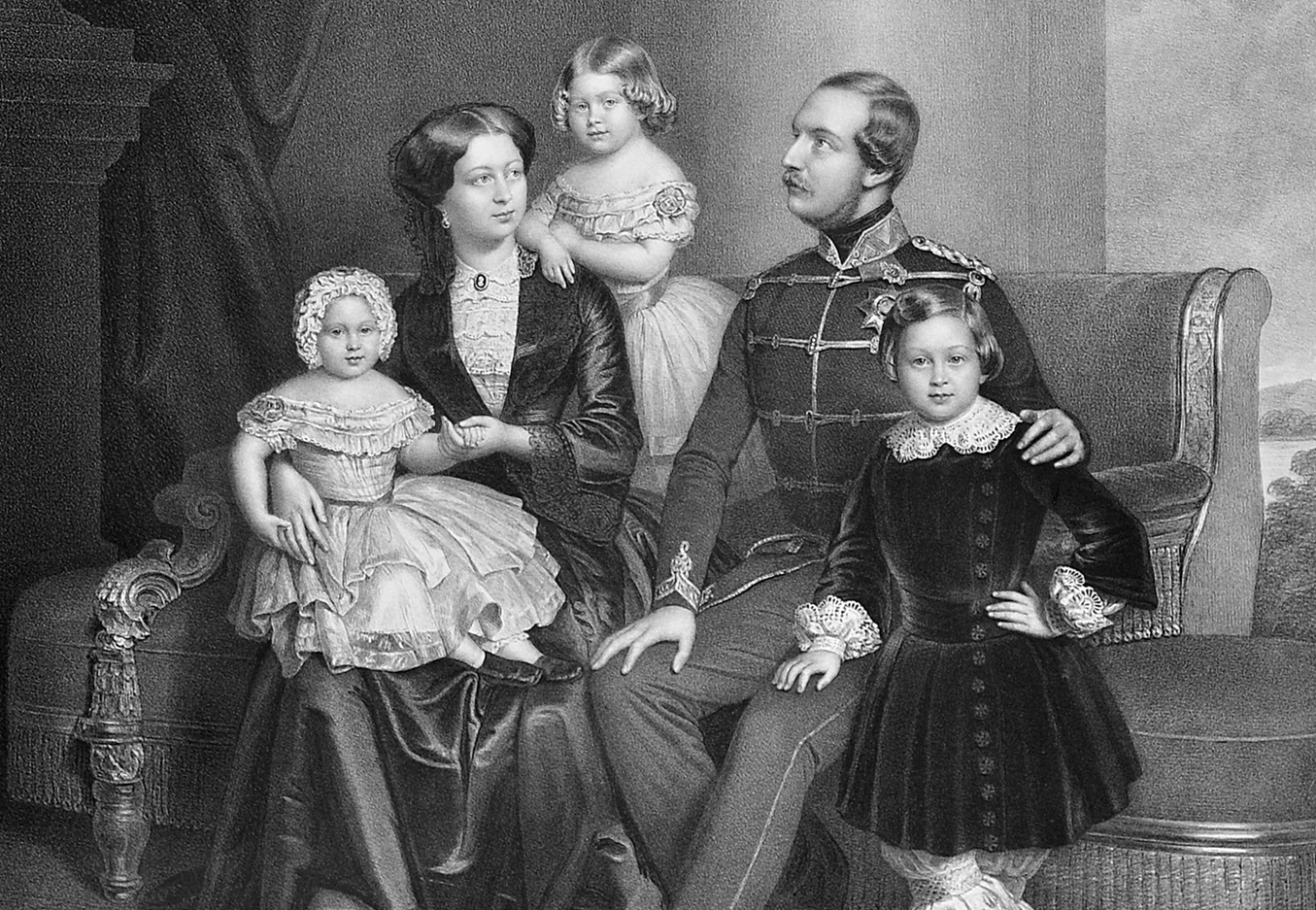
Above: Duchess Marie of Saxe-Alternburg (1818-1097) with her husband, King George V of Hanover and children.
The grim reality of a world dominated by contraception is visible to the naked eye without any difficulty. There is no need for statistics: the empty pews—painfully visible especially in small churches—as well as the predominance of parishioners over sixty years old, are signs that speak for themselves.
Both contraception and abortion are the result of the abandonment of motherhood. Unfortunately, like the vast majority of modern women, many Catholic women refuse the irreplaceable value of Christian motherhood. To leave no room for ambiguity, I will say what this means: Christian motherhood means accepting allthe children that Holy Providence chooses to bring into the world through a married couple.
When a couple, despite the difficulties of a large family, accepts all their children, this clearly shows that the spouses trust in God’s providence. Concretely, they believe that if God creates people in this world, He will ensure that the family does not lack “their daily bread”—which literally means the minimum necessary for subsistence. Not a 300–500K villa, expansive clothes and cars, vacations, or schools costing 40K per year. It needs only this: a piece of bread for each member. The Litany of Saint Joseph, where he is called “lover of poverty,” seem nowadays inconceivable. Without hundreds of thousands of dollars, even the raising of just two children is considered impossible. I will not begin listing all the reasons invoked today for not having children.
What I wish to present in this article, however, is the (probably) deepest answer to the only question that matters: why have so many Catholic families abandoned accepting, with full trust in Holy Providence, all the children God might entrust to them? The answer is offered by a brilliant writer belonging to the German Catholic aristocracy: Countess Christine Gräfin von Brühl. In Noblesse Oblige, a book written and published in Germany in 2009, she reveals all aspects of life in a traditional family of Catholic counts. Reading it, I discovered with amazement that what the countess presents is, in fact, simply the life of that “little holiness” we know from the life of Saint Thérèse of Lisieux (1873–1897). And at the center of this life stands supernatural faith in Holy Providence, manifested through the acceptance of all the children God chooses to entrust to Catholic spouses.
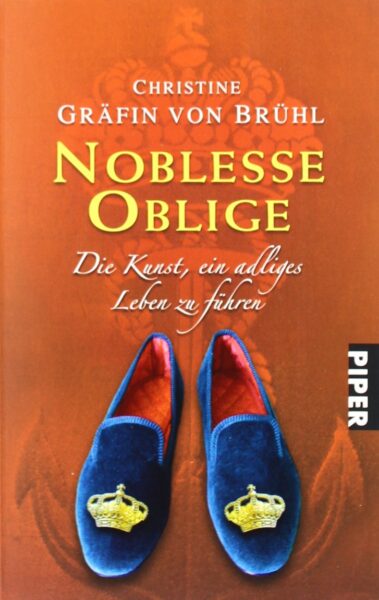
The life scenes described by Countess Christine Gräfin von Brühl in Noblesse Oblige are wonderful. Through them, the countess (indirectly) offers key answers. She does so by describing the condition of a young aristocratic family. Here are her words, not without a good dose of humor:
Once the marriage is successfully concluded, one immediately proceeds to nesting, brooding, and hatching ‘chicks.’ What good is a wedding and a marriage befitting one’s rank, recognized by the Gotha, if it does not result in a multitude of children of rank, also worthy of the Gotha? A marriage from which no children result is as though it did not exist. And it can be annulled by the Pope, which is not without significance. The Pope remains one of the few nobles who have the final say.
Nobles do not simply have children—they have many children, and in rapid succession. Those who do not follow this rule are considered petty bourgeois or are pitied. Catholic nobles, in particular, have very many children. Four is considered natural, six still normal; only from eight or nine onward do they stop or begin to worry about the mother. But such worries are always intertwined with admiration.
Those who bring only one or two children into the world are pitied almost as much as those without heirs, unless it is done deliberately—which is again considered a petty-bourgeois attitude. As the mother of a school friend used to tell me, aristocrats and the poor—they are the ones who have the most children. Nobles because they have enough money to raise them, the poor because otherwise they would have nothing. Children remain their only wealth. But these are prejudices. One thing remains certain: in noble families, there truly reigns an extremely benevolent attitude toward having as many descendants as possible. And it has nothing to do with political programs or desperate subsidy attempts launched by some minister of family affairs in order to increase the birth rate. Nobles care very little about such things. One generally keeps a distance from the paternalistic state. Even noble families without much money or space follow the same motto: be fruitful and multiply!
Obviously, the motto reflects the divine command addressed to Adam and Eve: “Increase and multiply, and fill the earth, and subdue it” (Genesis 1:28). If you read the quote carefully, you may have already noticed a crucial notion: admiration. Admiration for the mother who gives birth to children—all her children. In many other pages of the book, we find exactly the same thing: a supreme respect, a deep admiration for the woman as mother. For example, when you visit an aristocratic family, the first person greeted is the lady of the house—the mother. Only afterward come the master of the house and the rest of the family. Thus, we always notice the same supreme respect, filled with admiration, for the mother.
Undoubtedly, this is always accompanied by the appreciation of children themselves. In other words, according to the Countess Christine Gräfin von Brühl, at the heart of the traditional Catholic aristocratic family are the mother and the children. This can be directly related to the admiration and veneration of the famous statues and icons of the Holy Virgin Mary carrying the baby Jesus at her breast: Virgin Mother and Divine Child. The right of mothers to the appreciation they deserve is denied in a world where Feminism, Marxism, and so many currents indebted to hedonism and the cult of bodily pleasures reject and mock motherhood. And the denial of the respect due to such an irreplaceable role is accompanied by the loss of self-respect among those who are treated as though the work of motherhood is always inferior to any other kind of work. This type of special sacred respect—everyone’s for the mother and the mother’s for herself—is something that no political agenda can properly restore with any financial incentive. But how the exceptional value of motherhood can be restored is a crucial theme that requires all our moral, intellectual, and practical resources.