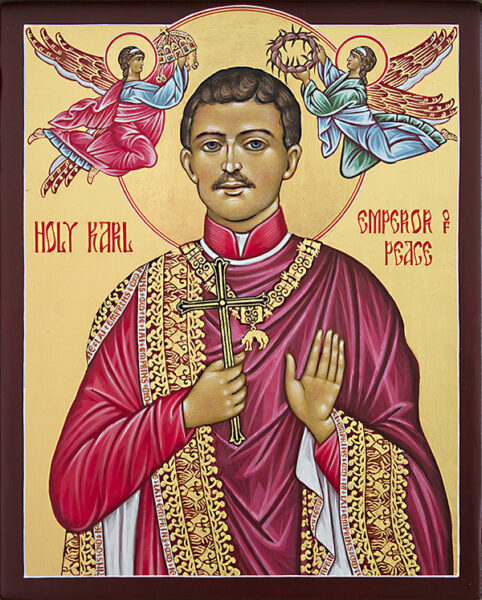

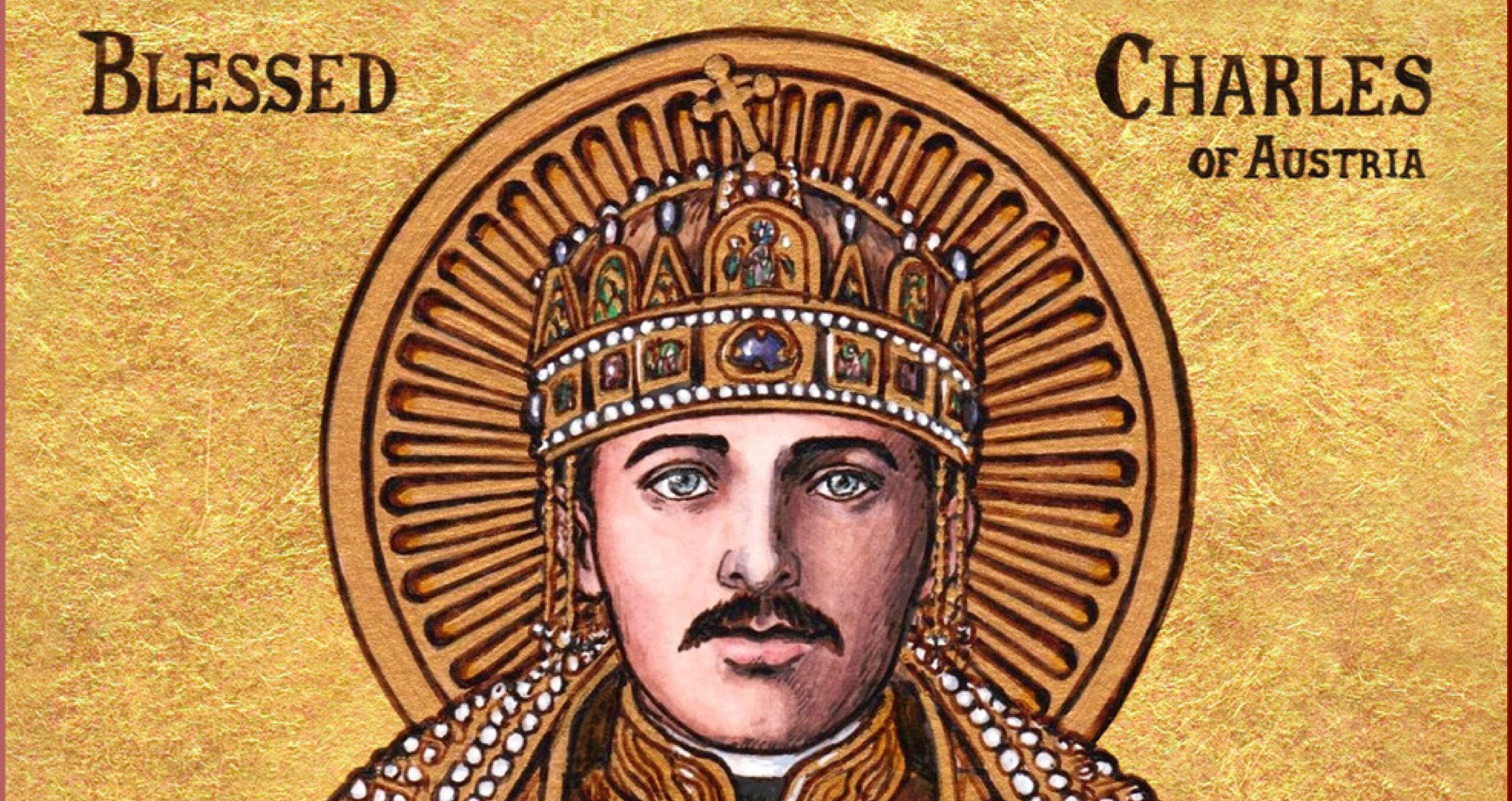
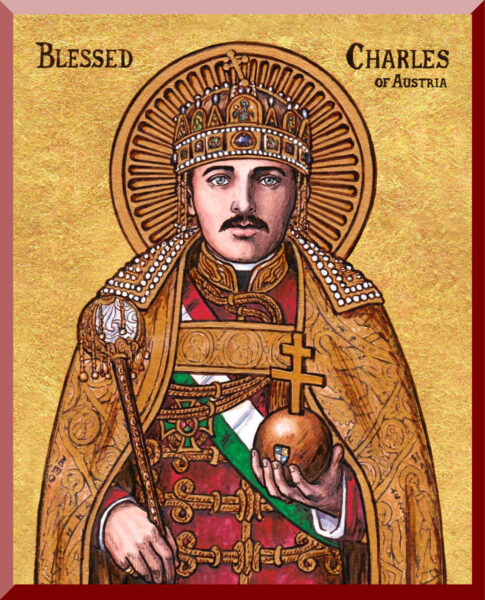
For those who cherish his life and memory, Blessed Charles of Austria conjures up a mixture of emotions. A cheerful devotee of the man will never fail to experience nostalgia for a Catholic empire long since passed and reminisce about the glorious achievements of Charles’s ancestors. However, a more honest observer cannot ignore the melancholy reality: not a single one of those splendid accomplishments can be identified with the efforts of Blessed Charles.
Blessed Charles of Austria was the last ruling member of the august House of Habsburg, a royal family that had served the Church and her interests for over 700 years. Charles ascended the throne of Austria during World War I at a young age and tried his best to extricate his country from the war. His peace efforts failed, Austria lost the war, and Charles lost his crown. All of his efforts came to naught, and Charles died in exile soon thereafter. He was, by almost any metric, a miserable failure. So why was he beatified by the Church? Why in the world is he celebrated for anything?
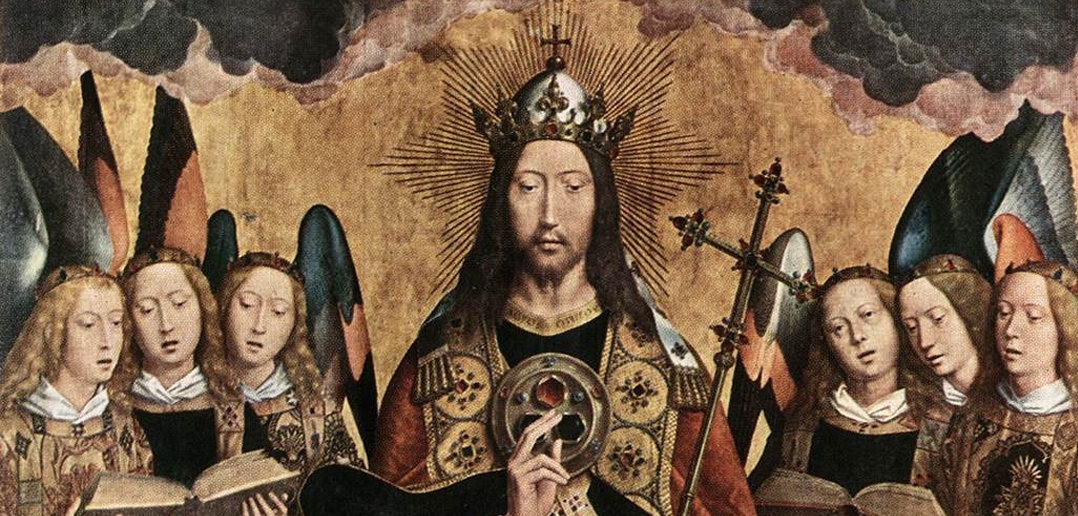
To answer these questions, we have to consider what makes a man holy and what makes a man celebrated in the Catholic mind. To understand the Catholic mind, the truly Catholic mind, we must look at its center, its focus, its very life. We must look at the person of Jesus Christ. For what makes Blessed Charles holy and beloved to Catholics is his likeness to Jesus Christ. Like our Savior, he walked the way of the cross, and, like Christ, he emerged victorious.
Blessed Charles was made to be king. He was born, not perhaps to the royal line of David, but to the next best thing: the unshakably Catholic line of Habsburgs. While his childhood was pleasant, there was no mistaking the destiny that God had prepared for the young boy. An Ursuline nun who had been blessed with the stigmata predicted the trials that the future emperor would have to undergo: “One has to pray for him a lot, because he will become emperor and he will have to suffer greatly. He will be a special point of attack for hell.” Like Isaiah’s prophecy of the Suffering Servant or Simeon’s prediction of a wounded heart, the words of Mother Vincentia forewarned Charles that, like Our Lord, he would have to be made “perfect though suffering” (Heb. 2:10).
After the silent years of his youth and adolescence, Charles was thrust into the public eye in the midst of a global conflict. The assassination of his uncle, Franz Ferdinand, had set off an unfortunate series of events that had culminated in the outbreak of World War I. Charles was forced, upon the death of Franz Josef in 1916, to take up the crown, and he embarked upon his public duties, much like his Savior before him, to rapturous applause. As Christ was hailed at his entrance into Jerusalem by the people who were to condemn him in a manner of days, Charles was hailed during a magnificent coronation ceremony in Budapest hosted by the very same people who would soon betray him. He rode his horse, as Christ rode his colt, all the while hats were being waved in uncomprehending mimicry of the Jews waving their palm branches.
The peace emperor, as Charles is now known, sought, much like the Prince of Peace, to end the meaningless death that plagued his people. He pled with the Allied nations for what they had claimed they wanted all along: cessation of the inexcusable slaughter. Once upon a time Jesus had pled with the Pharisees to abandon their hypocrisy, to live what they taught. However, then, as now, there was a Caiaphas to despise God’s servant and to plot his destruction. Clemenceau, the bitter, vindictive president of Allied France, was more than happy to play the high priest in this drama. He betrayed Charles’s offerings of a separate peace to the Germans who then forced Charles into a humiliating retraction.
However, Clemenceau wasn’t content to just humiliate Charles; he wanted to destroy him. For this he needed a Judas. Fortunately for the old man, the Czech traitors Tomas Masaryk and Edvard Benes were more than happy to sell their king for thirty pieces of silver. In the tranquil halls of Allied diplomacy, miles away from the bloody trenches of war, these two Czech subjects of Blessed Charles, who owed their sovereign undivided loyalty in this time of crisis, conspired for his overthrow. They convinced Britain and France to recognize their leadership of an independent Czechoslovakia in exchange for a civil upheaval on Charles’s home front. Masaryk and Benes bought their Potters Field sure enough. But in 1945, Nazi Germany would turn that cursed country into a veritable Field of Blood.
By 1918, as the battlefield losses started to mount, it became evident that Charles’s enemies would emerge victorious. Charles could sense his betrayers tightening their noose, so he turned to his most faithful disciple. The night before his passion, Jesus was assured by Peter, the leader of the apostles, that he would never be abandoned. Charles, on the eve of his exile, was promised by his most dutiful servant, the Hungarian Admiral Miklos Horthy, that “I will never rest until I have restored your Majesty to his thrones.” Charles could not foresee, as Jesus could foresee, but that same Admiral Horthy would deny Charles his throne three times during his exile.
Before he was officially declared an outlaw by his own country, however, the life and throne of Charles were left one final opportunity at preservation. As Caiaphas could not destroy Jesus’s life without the assent of Pontius Pilate, so Clemenceau could not fully realize his aim of Austrian dismemberment without the assent of American President Woodrow Wilson. Wilson, a foreigner to European politics, never really understood what it took to create lasting peace in Europe. He wanted to please both his Roman emperor and the Jewish crowds, but he could not do so without condemning innocent blood. Clemenceau demanded death for the empire. The crowd of Czech, Austrian, and Hungarian nationalisms clamored for death. Wilson, lacking fortitude, a slave to his fears, surrendered to the tumults. He gave Blessed Charles up to his persecutors and authorized the dissolution of the empire in the name of peace. Both Palestine, in the aftermath of Pilate, and Europe, in the aftermath of Wilson, would be drenched in sanguinary floods during the wars of Titus and Hitler. Peace, they realized only too late, can only be found in justice.
And so, Charles was exiled. Yet despite all this sad spectacle, the betrayals, lies, and treachery, there was one bright light, one person in Charles’s life who had accompanied him on this long trial from the beginning. Charles may not have had someone to match the Blessed Virgin, but he did have his wife, Zita. Zita’s faithfulness and compassion helped Charles endure all his sufferings and gave him something, even when all had abandoned him, something to fight for. Now, at the end, having withstood all the pains and sorrows that God had foreordained for him, Charles had this one friend left to him to comfort him in his last moments.
Having contracted pneumonia in the unhealthy conditions of his exile, Charles, on his deathbed, showed, not just his family, but the world how a Catholic man is supposed to die. Clutching his crucifix, Charles forgave his enemies because surely, as the next two decades were to show, “they know not what they do.” Turning to his wife, Charles whispered, “Let’s go home, let’s go home together.” Then, with one final attempt to lift his crucifix, he uttered his last words, “Thy will be done… Jesus.”
“If they persecuted me, they will persecute you” (John 15:20). For us here, looking at the life of Blessed Charles with the eyes of the world, all we will see is abject failure. After all, the whole world, on the first Good Friday, saw Christ as a failure. But we are not told to see with the eyes of the world. “If you were of the world, the world would love its own; but I chose you out of the world, therefore the world hates you” (John 15:19). The world hated Charles because Charles was not of the world. The world, our world, was never his true home. He was never meant to enjoy a long and happy reign on earth, but no Christian with any sense would look for happiness on earth. “Unless a grain of wheat falls into the earth and dies, it remains just a single grain, but if it dies it bears much fruit” (John 12:24). Charles needed to die with Jesus on the cross if he were to see the resurrection. Our faith tells us this and we know it to be true. Indeed, the melancholic devotee of Charles is no true devotee at all. “If you loved me, you would have rejoiced, because I go to the Father; for the Father is greater than I” (John 14:28). A true lover of Blessed Charles, a true lover of Christ, will rather take the Master’s advice: “Be of good cheer, for I have overcome the world” (John 16:33).