Mon 29 June SS. Peter & Paul, Ecône journal
The hot sun glistened on Lake Geneva as I flew into the French-speaking Swiss city on Sunday, 28th June. Described by the economic historian R.H. Tawney as Calvin´s “City of Glass”, because of the theocratic police state that he introduced here in the 1540s, the American historian William Thomas Walsh called it a “mystical city of revolt” when he considered its subsequent revolutionary history. This “Protestant Rome” sent out preachers across Europe, disturbing the tranquillity of Catholic societies with heresy while sheltering numerous foreign Protestant exiles such as John Knox. This was a city so Protestant that Voltaire remarked: “for more than two hundred years there was not a single musical instrument allowed in the city.” Another maître a penser of the Antichrist French Revolution, Jean Jacques Rousseau, was born here and Vladimir Lenin would also find it a place of exile while the proto-globalist League of Nations was later established here.
How interesting then, that across Lake Geneva and up the valley of the Rhone River this week will take place an event that, its defenders will claim, constitutes one of the most important counter-revolutionary moments in recent decades. However, today’s battleline between the Revolution and Counter-Revolution is not only to be found in the temporal sphere, where the former is hegemonic, but in the Church Herself. As Jean Madiran has noted and Miguel Ayuso has confirmed:
the dividing line between counter-revolution and revolution does not concern the Christian faith itself [at least historically] but rather the faith’s chief temporal work: Christendom, understood as the social morality of Christianity taught by Catholic tradition and inscribed in political institutions.
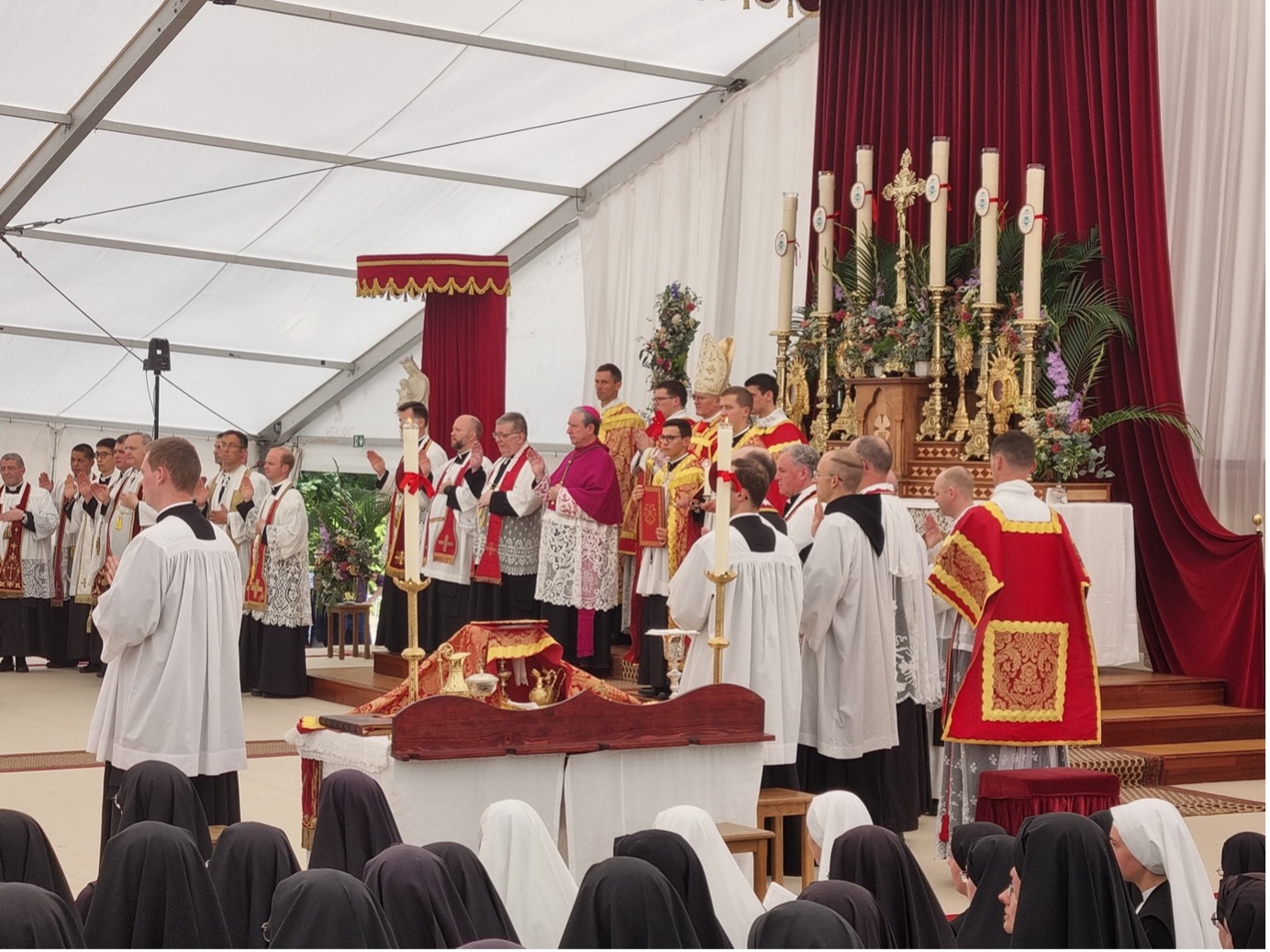
This theme was to be emphasised in the peroration of Bishop Fellay’s sermon during the ordination of five new priests and three new deacons for the Society of St. Pius X on Monday 29th June, the Feast of Saints Peter & Paul.
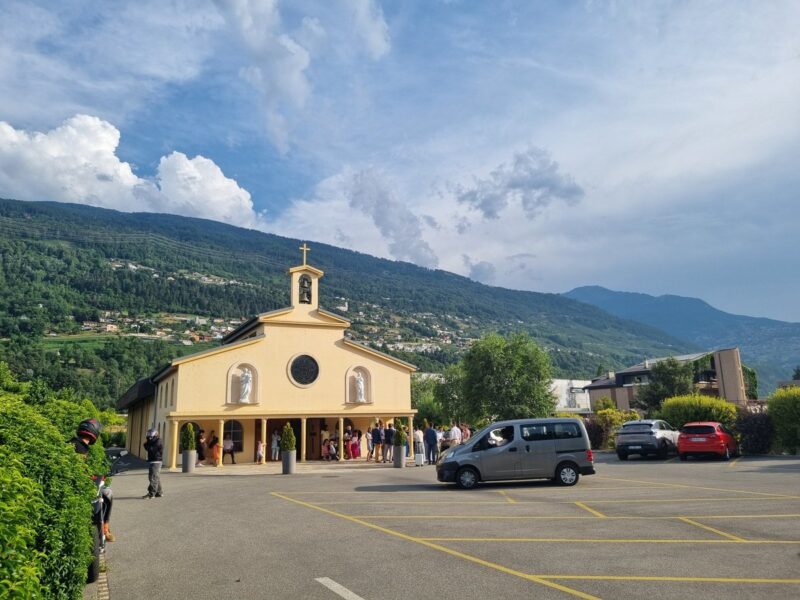
Switzerland has been a pleasant place to stay so far. Generally quiet, clean and orderly, the prices can be rather like the mountains that surround you. However, at least the wine is cheap in this once Catholic land! I heard Holy Mass on Sunday evening at the Eglise de la Sainte-Familie. As a local satellite chapel to the seminary there was a particular excitement amongst the faithful. Visiting Catholics to France and Switzerland that attend Society Masses in the Anglo-Saxon world, like myself, may be surprised to discover that the Society’s Masses in these districts are “Dialogue Masses” where the congregation make the responses of the server to the priests.
As I made my way on the excellent Swiss public railway down the Rhone valley from the town of Sion to the Society’s seminary at Ecône the next day, I began to spot the signs of an impending gathering of traditional Catholics with the multiplying appearance of men in Panama hats, ties and linen jackets and ladies in long dresses. There must have been well over a thousand faithful in attendance once gathered. Dozens of languages and flags testified to the Society’s presence across the world.
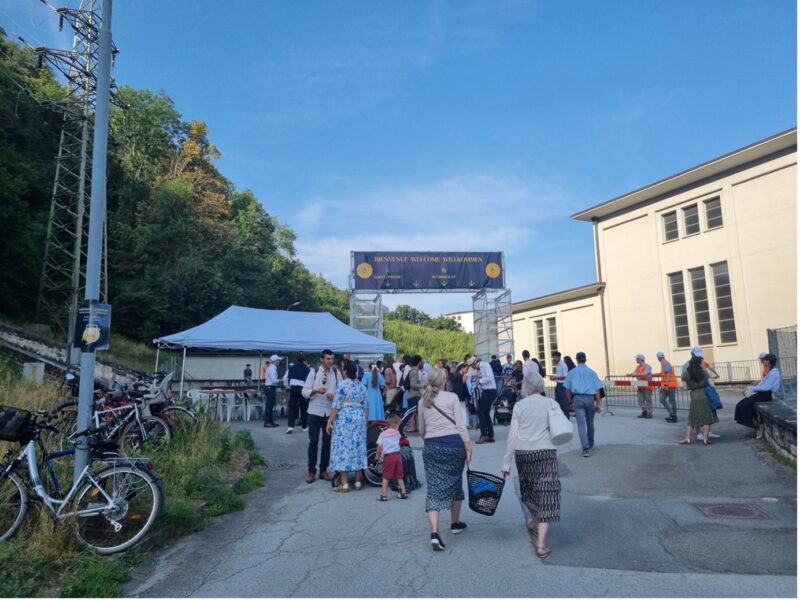
Following a picturesque walk from the train station through sloping vineyards and past the electrical power station once managed by Bishop Fellay’s father for the Canons of Saint Bernard, I arrived at the seminary. With the large crowds today, and especially expected on Wednesday, the ceremonies were to take place on a sloping field next to the seminary with a spectacular mountain backdrop.
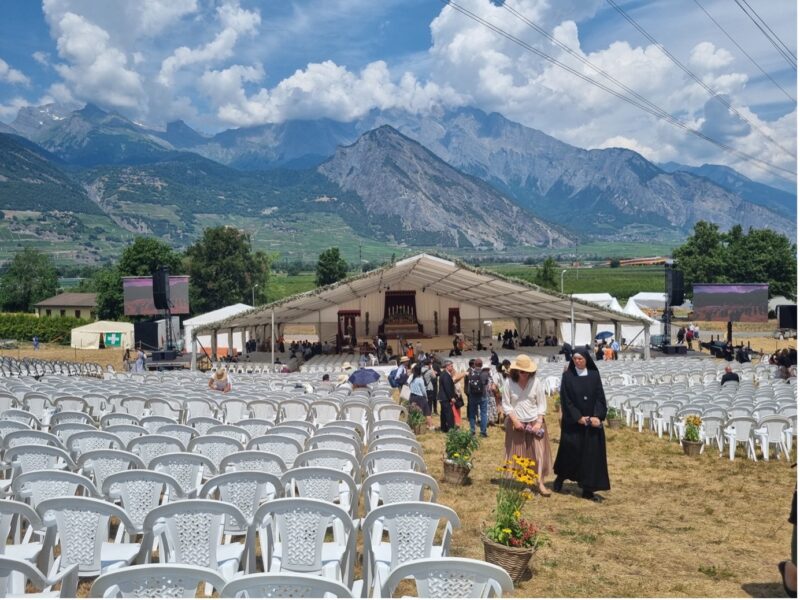
The day was warm and sunny but thankfully nothing like the recent heatwave. An occasional merciful mountain breeze passed through the mass tents. Readers that have attended a traditional Roman ordination will be familiar with the breadth and beauty of the rite.
In his sermon, the consecrating bishop, Bishop Fellay recalled fifty years of such ordinations at Ecône. On this Feast of SS. Peter & Paul and the foundation of Catholic Rome, he shared how Archbishop Lefebvre always instilled in his seminarians a love of Rome. Incidentally, this is something that would allegedly surprise Pope Paul VI following the infamous apostolic visit of the Archbishop’s seminary in 1974.
Bishop Fellay’s sermon took for its central theme the mystery of the Cross. He recollected how Cardinal Castrillón Hoyos once showed Bishop Fellay and an SSPX delegation around an empty St. Peter’s Basilica. Cardinal Hoyos showed them the very cross that Christopher Columbus had first planted in the New World. The first thing that the Spanish did in the New World was plant the cross.
Bishop Fellay repeatedly exhorted the new deacons and priests: “The cross is everything. The cross is contradiction.” Drawing the parallel between Our Lord’s divine mission to the apostles and the divine mission of the new deacons and priests he said:
Immediately we enter into battle, against the prince of this world, against the world of sins. There is no other salvation than the cross of Our Crucified Lord… The entire message [of the Gospel] is contained in the crucifixion, in the death of Our Lord on the cross. The Church knows that bringing the cross is bringing a sign of contradiction… God reigns through the wood of the cross. Only those who accept and embrace this cross will be saved (unofficial English translation).
At the climax of his sermon Bishop Fellay turned to the present crisis and the reasons why the eyes of the Catholic world will be on this Swiss valley this week:
Our Lady in recent centuries has always given the same message; prayer and penance… Deacons, notice how in the modern Church preaching is done. Do you hear a ‘call for penitence’ anywhere?… The cross is not something merely theoretical. As a priest you carry it within you… It is this death that sets you free…
It is a great mystery, a truly profound mystery, to see our dear Mother Church in this state. Currently, it really feels like we’re no longer getting along. What we are saying is no longer understood in Rome. We do nothing else than what the Church has done and said throughout the centuries. This is not a small moment; it is the whole tradition. And today this language is no longer understood. ‘You will be thrown out of the synagogue. The day will come when killing you will be thought to be doing God a service.’ In a way we’re there. It is a kind of white martyrdom. Perhaps bloody martyrdom will come as well.
In the discussion with Rome there was a small incident that I would like to report to you, that happened in front of all the ‘bigwigs’ of the Congregation of the Faith. The prefect, the secretary, the undersecretary, they were all there. We try to tell them what we are doing – we are trying to win souls for Our Lord Jesus Christ, to pull them from the clutches of the devil of the world, to bring them to Our Lord and salvation, and to continue by saying, ‘but since Our Lord is the creator, it is not only individuals, but also societies that we are trying to win over.’
The response from these princes of the Church – those responsible for faith in the Church – ‘Good luck!’… If you ask them if they believe, yes, in theory, they will answer you. But as for practical application, as for the implementation they no longer believe it. Do they still believe Our Lord that all power has been given to Him in heaven and on earth? Do they still believe that all authority on earth, civil and ecclesiastical, all authority comes from Our Lord Jesus Christ, to Whom all authority must answer to? One wonders how far their faith goes. One wonders where the fruits of this faith are…
May Our Lady make us live deeply this mystery of the cross, that in a few days the Good Lord will allow us to carry this cross in a way that is a little more visible.