
Ecône Diary: Tuesday, 30th June, Commemoration of St Paul
Swiss wine may not be the first accompaniment one would turn to for a roast beef garni but the southern Canton of the Valais is the most notable wine region in the country. The deep Rhône Valley is sheltered by the surrounding Alps, creating one of Switzerland’s driest and sunniest climates – ideal for viticulture. The Valais merlot I enjoyed with my dinner on Monday evening had all the mellowness, and slight jamminess of summer red fruits, that one would look for in a red wine on a balmy evening. Unfortunately, Brazil were playing Japan in the football World Cup meanwhile and, seeing immodestly clad supporters of the former team dancing in the street after their team scored a goal (how could there be so many Brazilians in this Swiss valley?), this Catholic had the familiar experience of feeling like living in a completely different world to the secular crowds. Truly two cities.
Next morning began early for my train journey to the Ecône seminary. This feast day of the Commemoration of St Paul, the newly-ordained Society priests were each offering their first masses in the meadow tent, crypt and seminary church, respectively. I was able to attend the first mass of Fr Bunge in the church as the morning sun filled the spectacular valley.
Despite the early hour, the church was full to capacity and many other faithful, priests and seminarians were to be found on the seminary site. Fr Pagliarani, Superior General of the SSPX, gave the sermon in Italian.
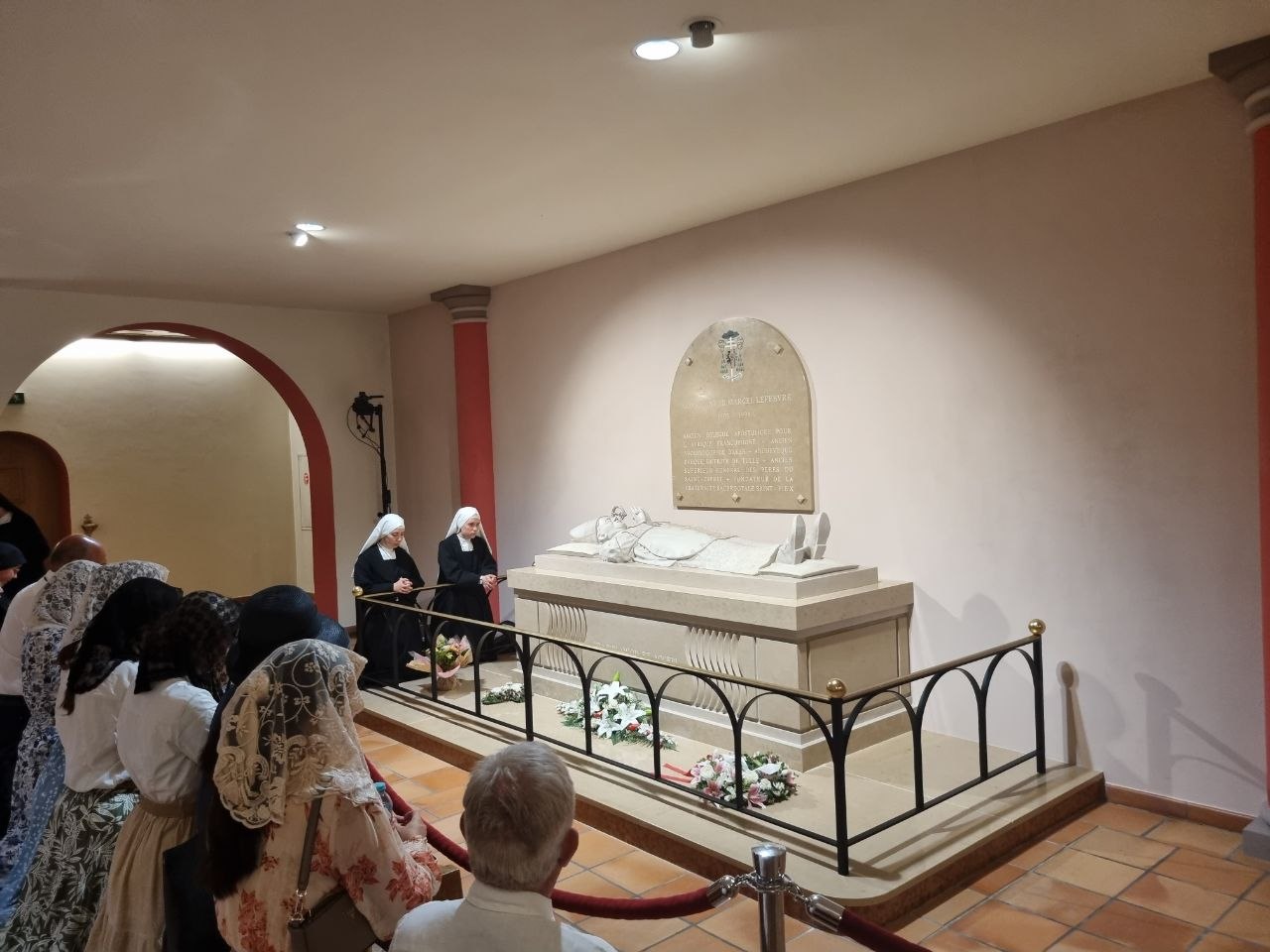
Following Holy Mass, I went to visit the crypt of the church where the first Mass of Fr Gandia was to be offered. Here was the tomb of the founder of the Society, Archbishop Marcel Lefebvre – a marble sarcophagus and a recumbent stone effigy in full episcopal garb.
The question presented itself: will this final resting place of the Archbishop, undoubtedly the central figure of the traditionalist “movement” in the postconciliar decades, become a future place of pilgrimage for Catholics from across the world?
For those Catholics who attend the Traditional Roman Rite offered by diocesan parishes or Ecclesia Dei communities, a strange tension is presented in the person of Archbishop Lefebvre. It is easy to condemn him as a schismatic, and many do, principally for what he did exactly thirty-eight years ago today and what the Society intends to repeat tomorrow. However, the uncomfortable fact that cannot be dismissed is that very few non-sedevacantist traditional Masses would be celebrated today were it not for this man.
The origins of the FSSP in splitting from the SSPX as a result of the 1988 consecrations are well known. There is also the Institute of the Good Shepherd, established by another breakaway group of Society priests in 2006. But the significance of both these ancestrally ‘Lefebvrist; congregations is superseded by the wider championing of the traditional liturgy that Archbishop Lefebvre represented and which led to a gradual series of concessions from Rome, culminating in the 2007 motu proprio of Benedict XVI.
Some Catholics point to other groups of priests who kept the Traditional Roman Rite alive like those English priests who were granted permission via the ‘Agatha Christie’ indult by Paul VI in 1971. Such priests, however, were always restricted in number, as they depended on the ordinary’s willingness to give permission in each case. As Pope Francis made clear, the intent of the liturgical reform was to replace the Traditional Roman Rite with the Novus Ordo Missae (already perfectly clear from the behaviour of the postconciliar hierarchy). Any concessions granted were intended, at least by the revolutionaries, to anaesthetise the withering away process.
In the revolutionary turmoil of the 1970s, the survival of the traditional Mass throughout the world was thus due to the actions of small groups of laity and priests erecting non-canonical chapels, without reference to their ordinaries, and continuing to practice the pre-Vatican II liturgy and Catholic life as peacefully as they could. More often than not, these small traditionalist chapels began to attach themselves to the growing Society of St Pius X.
As John Lane has pointed out, Catholics who today condemn Archbishop Lefebvre and the Society may be wont to argue that Providence would have arranged matters differently to ensure the survival of Tradition had everyone been holy and obedient, but the fact is this path of “disobedience” was the route by which the traditional mass was saved and Catholics were able to hold fast to that which they had received. To subsequently condemn those Catholics who took such measures, often at significant personal cost, and nearly always in the face of the hostility of their hierarchy, while simultaneously benefitting from the fruits of their stand, is to implicitly take the side of the Modernist persecutors and would represent a particularly egregious hypocrisy.
Sooner or later, all Catholics who today attend and love the traditional mass must ask: What was the right reaction to the de facto prohibition of this Mass in the 1970s? Perhaps this question would be one that comes to mind at the tomb of Archbishop Lefebvre.
Later in the day the news of Pope Leo’s warning letter to the Society, that the consecrations tomorrow will constitute ‘a schismatic act’, ‘tear the seamless garment of Christ’ and be ‘a sin of extreme gravity’ did not seem to disturb the serene atmosphere here at Ecône. Perhaps there is a sense that something like this was inevitable. Of course, Leo declined to meet with the Society in the preceding months and has left his response to the last minute. Older traditional Catholics will recall that Leo’s argument is essentially the same as that of Paul VI, John Paul II and Benedict XVI since the beginning of this agony of the Church – faithful Catholics must “obey” but manifest heretics like the German bishops remain in good standing with the Pope.
The contrast between Leo’s statement declaring himself “already one” with the schismatic-heretical pseudo-archbishop of Canterbury during a homily closing the 2026 Week of Prayer for Christian Unity in January and today’s threatened excommunication (which effectively declares ‘we do not have unity with’) the SSPX couldn’t be clearer, if only Catholics care to remember.
How long the glaring irony of the modern Church’s subjectivist “medicine of mercy” conciliation towards false religions, Protestant sects and Eastern schismatic churches (not to mention Liberal and revolutionary secular groups) – while resorting to preconciliar objectivity and discipline solely towards faithful traditional Catholics (inside and outside the SSPX) – can continue before something gives, remains to be seen.
St Paul, Apostle of the Gentiles, ora pro nobis!