

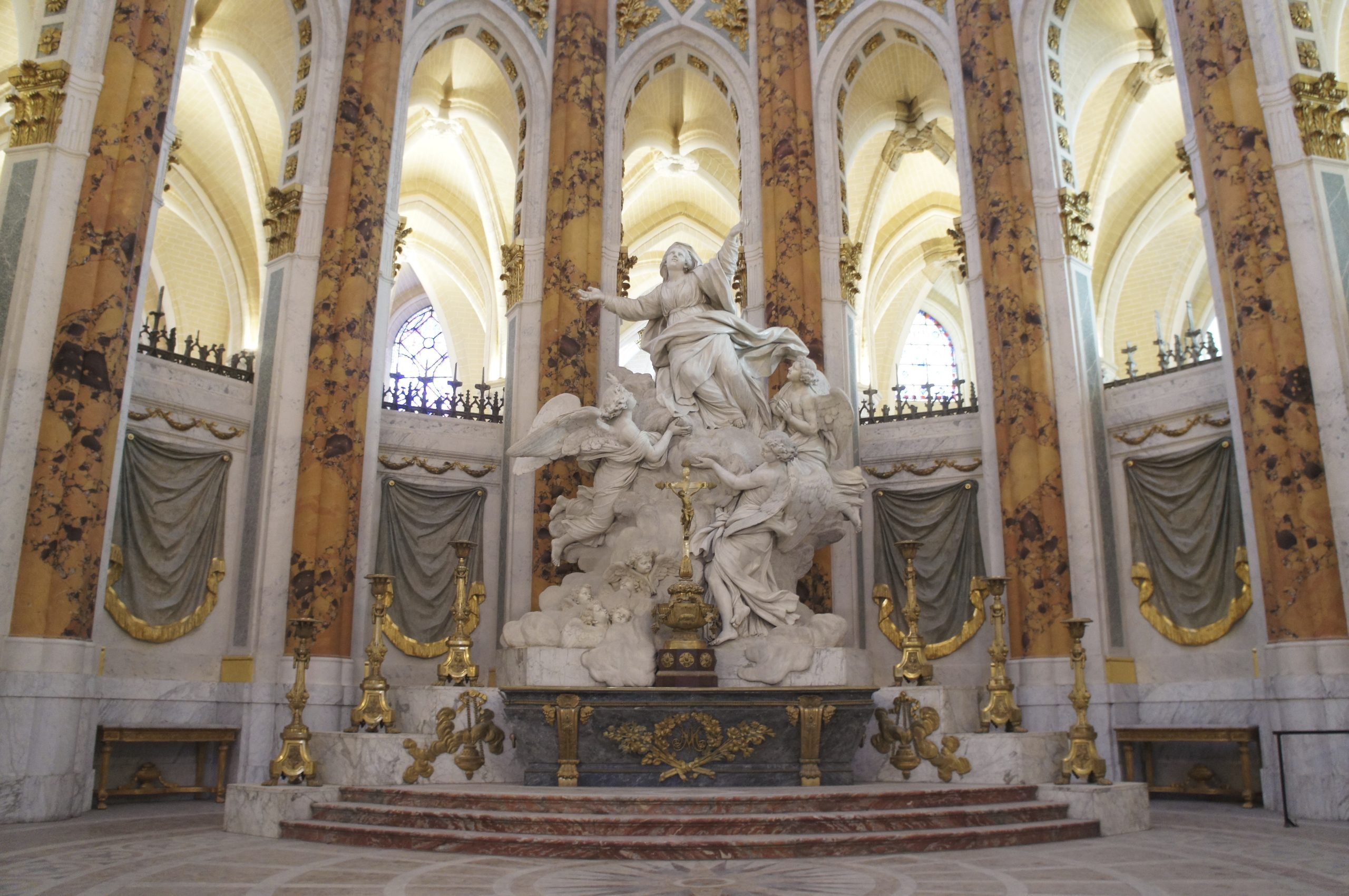
Above: the high altar at Chartres Cathedral.
It is probably impossible for a Catholic who attends Holy Mass, even only occasionally, not to have noticed the two altars—one new, one old, with the former placed in front of the latter—in churches built before the Second Vatican Council. In Romania, where I experienced my first conversion, as well as in the United States, Scotland, and, finally, Italy, where I am enjoying the fruits of my second conversion, almost all the churches I have visited or currently attend have two central altars: the old one, typically built against the back wall of the sanctuary or backed by a reredos (a decorative screen or altarpiece), and the new one, usually in the form of a simple table and positioned in front of the old one, as close as possible to the faithful.
Passionate about the meanings of Christian sacred art in general, and ecclesiastical architecture in particular, and an admirer of Cardinals Borromeo—Charles and Federico—true masters in this field, I have already written several articles on this subject. Here, however, I will explain nothing. Nor will I mention the old and often tiresome polemics between mainstream Catholics—fervent supporters or merely passive followers of post-conciliar changes—and the so-called Traditionalist Catholics. No, I will discuss neither the criticisms of Romano Amerio, Dietrich von Hildebrand, Michael Davies, or Roger-Thomas Calmel, O.P. (to mention only a few renowned “classic” authors), nor the arguments elegantly developed by today’s lay Doctors of the Church, such as Joseph Shaw and Peter Kwasniewski, nor the defense of Tradition offered by Archbishop Marcel Lefebvre or Bishop Athanasius Schneider. So, no, I will speak of none of these things. I will limit myself to asking a single question: Why?
A simple and sincere “Why?” We have all seen, see, and will continue to see the duplicated altar at the heart of pre-conciliar churches. And yet, why? Why was it necessary to change the old altar? Why was a new altar needed? If you have already grown suspicious, you are right: my question is indeed somewhat rhetorical. For I cannot help developing it into a chain of successive, logical questions.
If a new altar was necessary, does this not imply that the old one was either inadequate or erroneous? No one replaces something old, tested over millennia, with something new without a serious reason. Yet the old altar was not replaced because of physical deterioration: the stone from which old altars are made is far more durable than the wood, and sometimes glass and metal, used for the new ones. So it is clear that the reasons had nothing to do with the durability of the materials. Nor were they aesthetic reasons. For, just as often, the old altars are more beautiful, more imposing, and more impressive than the new ones, which can easily be mistaken for simple tables on which we might serve lunch or dinner. I ask again: why?
Was the old altar inadequate? Was something wrong with it? Let me reformulate: why is its position no longer considered appropriate? Why was everything perfectly acceptable for dozens, even hundreds, of generations of Catholics, while for us, the Catholics of the past half-century, the position, form, and perhaps even the meaning of our old altars have become so unacceptable that they had to be replaced?
I admit that I do not expect to receive answers from those I am primarily addressing: the theologians and liturgists who support the Second Vatican Council. I have grown accustomed to being ignored. Being almost unknown, I am hardly surprised. Having observed that truly significant authors have never received any response, I take the silence of those I address as a given fact. I am therefore content with the answers I discover, most often by chance, in various publications. One such answer seems to contain the following explanation concerning the position of the altar in Chartres Cathedral:
In the bishop’s eyes, what mattered most was the visibility of the altar, its obligation to attract the eye. Monseigneur Perrier was very sensitive to the desire to apply the directives of the Second Vatican Council with the utmost solemnity—the altar facing the people, in the center of the cathedral. But he also understood—a contrario, perhaps – that the momentum of the edifice led to the back of the choir, in a tension proper to architecture, since the plans had originally been conceived in this way. He was also determined to give priority to this axis—a key component of the liturgical act—and to ensure its continuity. Everything had to be done to ensure that the dynamics of the celebration were in line with the dynamics of the Gothic space.
Gradually, the concept of ‘superimposing’—visually, that is—the two altars began to take shape. The newly created altar was to be articulated with the altar in the background, an integral part of the 18th-century ensemble. Contrary to the logic that had prevailed until then, where the Vatican II altar stood in the way—perpendicularly—of the architecture’s vanishing line, the aim was therefore to defend this ‘linear’ perception of the cathedral, and to create a kind of ‘fixing point’—advanced, all the more inevitable as its positioning would be controlled by the logic of the entire edifice. The new altar was to follow the longitudinal logic of the Eucharist: offering procession, elevation.
Hmm. I have spent two decades studying the documents of the Second Vatican Council, and yet I have found no statement requiring the addition of a new altar “facing the people.” So this is an interpretation by His Excellency Bishop Jacques Perrier, who understood the Constitution Sacrosanctum Concilium on the Sacred Liturgy in this way. In fact, there are two post-conciliar documents—Inter Oecumenici (1964, Sacred Congregation of Rites) and the Institutio Generalis Missalis Romani (1969/2002)—that address this interpretation. Here, indeed, we are talking about celebrating versus populum (facing the people). Very well.
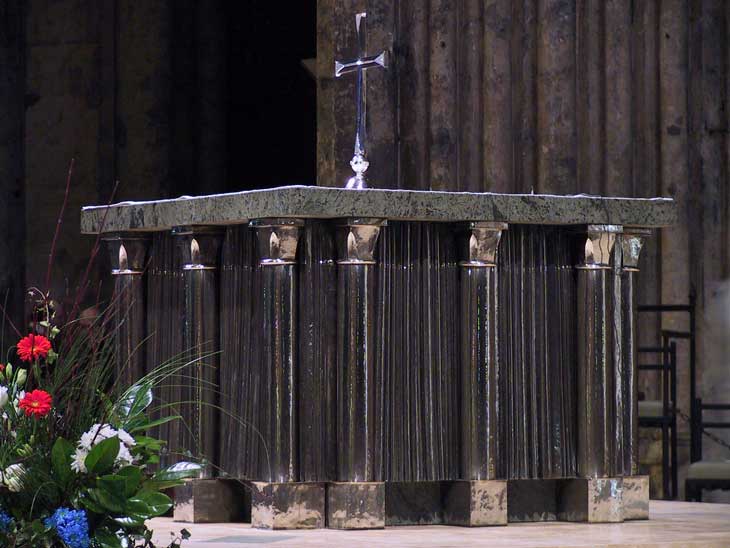
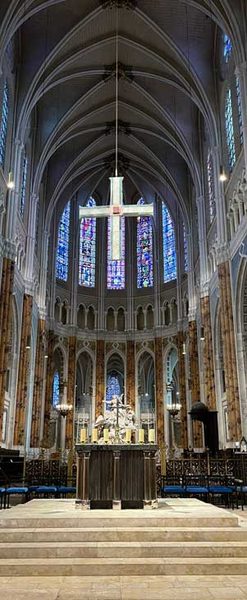
I insistently ask again: Why was this change necessary? I would like—although I know I will not receive one—an answer along the lines of: “The old orientation of the altar was inadequate” or, more radically, “The old orientation was wrong.” I would not be satisfied, under any circumstances, with an answer such as: “In keeping with the development of culture and theology, a new interpretation is needed…” and so on. For the latter answer not only makes any development possible, but also eliminates the possibility of asking any question in clear and precise terms.
But let me return to the bishop’s answer. The altar should be facing the people. This essentially determines the position of the priest during the celebration of Holy Mass. Once again, I ask: why? Why is what was considered appropriate for almost two thousand years no longer appropriate, no longer sufficient, or perhaps even wrong, today?
I have answers of my own. All of them center on the crucial notion of “sacred symbol”—today completely abandoned or understood in an erroneous and relativistic way. But, as I have already said, I will not set them out here. I will say only that an unused altar, abandoned like a useless piece of furniture in a place of worship specially built around it, marks the beginning of the end of that church. For the entire meaning of the church, and all the significance invested in sacred architecture, “hangs” upon the position of the holy altar. And if it is replaced, even if the old altar is left in the background for practical reasons, sooner or later everything else will be replaced as well. Unless, of course, this has already happened without us even realizing it.