
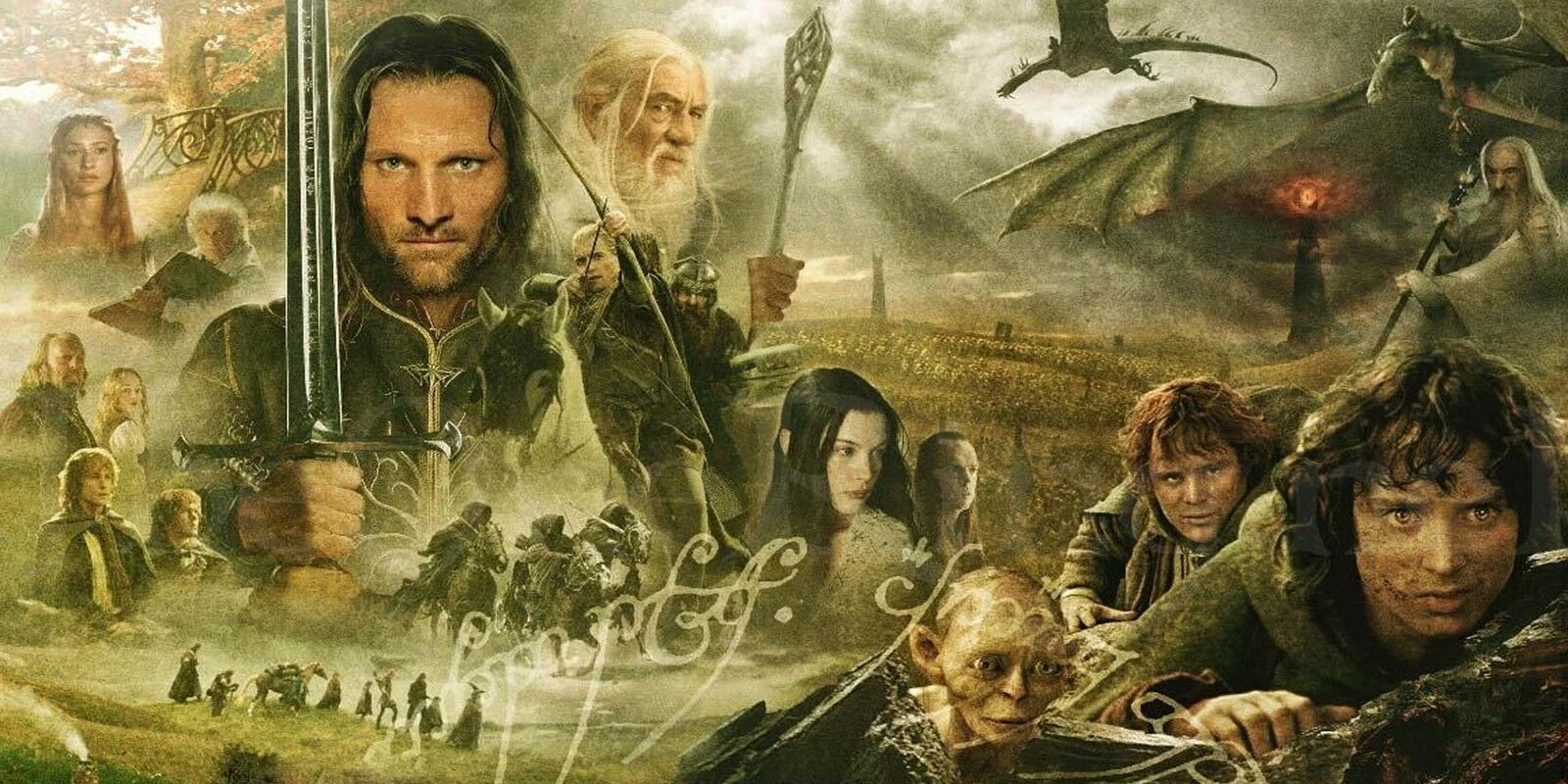
The title of an interview with Christopher Tolkien published in 2012 by the French newspaper Le Monde immediately succeeds in instantly attracting our attention: “Tolkien, l’anneau de la discorde” (“Tolkien, the Ring of Discord”). This is all the more striking given that most readers know him to be the most authoritative interpreter of the works of the author of The Lord of the Rings, the man who tirelessly edited his father’s literary creations. The most significant part of the interview, which also brings it to a close, concerns the famous films made by Peter Jackson. Christopher Tolkien’s two strong statements about them spare none of our cinephile passions.
The first briefly and categorically describes their nature as the writer’s son, very critically, understands it:
They eviscerated the book by making it an action movie for young people aged 15 to 25, and it seems that The Hobbit will be the same kind of film.
I admit that when I read the words above, I smiled with satisfaction. This is exactly how I had described Jackson’s film, in a single sentence, in conversations I had after watching the first part of The Lord of the Rings (2001): an action film that shortened and completely transformed the epic of Middle-earth. I have always accepted the fact that you cannot adapt the entire contents of a monumental novel even into a film whose extended version runs for approximately twelve hours. Adapting literary works necessarily involves transformations. I have agreed, and continue to agree, with these necessary “accidents.” What troubled me, however, just as acutely as it did Christopher Tolkien, was the film’s style. From a sweeping story—comparable to the famous historic trilogy written by the Polish Nobel prize winner, Henryk Sienkiewicz—the director transformed everything into an action film with dark overtones. Tolkien’s narrative rhythm is entirely different.
In terms of Eastern Christian asceticism, the rhythm of the stories featuring hobbits, wise men, and dragons is “hesychastic” (from the Greek word “hesychia” [ἡσυχία] “stillness,” “quiet,” “silence,” or “rest”). Battle scenes are kept to a minimum, while the description of landscapes, and especially of the inner struggles of the heroes, is substantial. There can be no doubt about the beauty of the New Zealand locations where the films were shot. From this point of view, the director’s decision was as inspired as it could have been. The stylistic treatment of the content, however, with its emphasis on war and its numerous battles—collective or face-to-face—is questionable. Young people between the ages of fifteen and twenty-five may, of course, be delighted by them. Yet Christopher knows all too well that one of his father’s great innovations concerns precisely the audience he had in mind: if The Hobbit is indeed for children and adolescents, The Lord of the Rings is, as one of Romania’s most distinguished writers, Nicolae Steinhardt, described it, a story for adult readers. And this does not mean action, but wisdom and the right decision at the right moment.
The criticism of the film becomes even more pronounced in the second and final passage of the interview devoted to Peter Jackson’s creation. Christopher’s words are full of bitterness:
[J.R.R.] Tolkien has become a monster, devoured by his own popularity and absorbed into the absurdity of our time. The chasm between the beauty and seriousness of the work, and what it has become, has overwhelmed me. The commercialization has reduced the aesthetic and philosophical impact of the creation to nothing.
What this quotation tells us touches the heart of the matter. For the interviewee has uttered two key words: beauty and seriousness. If the first word suffers from being devalued and distorted through inflation, the second suffers through rarity. In our frivolous times, it is increasingly difficult to say what “seriousness” is. Plato regarded it as such an important notion that he attributed this quality to the intellect—the essential cognitive faculty of the soul. If we nevertheless want a spontaneous understanding of seriousness, I would mention another word: solemnity.
Even The Hobbit possesses a kind of solemnity comparable to the musical harmony of a Bach concert. The Lord of the Rings, which introduces us into the atmosphere of the royalty and aristocracy of Middle-earth, is all the more serious because the philosophical and ethical questions woven into the fabric of the story are monumental. Although it may be classified among tales of elves and dragons, its manner of execution is that of a history from long ago, with kings and queens, virtues and vices affecting characters caught up in a cosmic conflict resembling that described in the Apocalypse of Saint John.
Christopher also says that the films are ugly. I am sure he is not referring to the magnificent landscapes or the sets—which are, for the most part, very successful. What he is targeting is the moral beauty of the characters, and above all the baroque beauty of his father’s writings.
In terms of the art of the word, Professor John Ronald Reuel Tolkien was a true aesthete. And a Catholic one at that, for whom there is no divorce between morality and beauty. From the very beginning of his academic career, he repeatedly drew attention—as in his famous lecture The Monster & the Critics—to the fact that Beowulf, for example, is not merely a valuable archaeological artifact for philologists and historians of Anglo-Saxon culture, but a genuinely beautiful poetic creation. Let us not forget that, before anything else, Tolkien was—like all great writers—a true poet. In terms inspired by the Romanian poet and writer Vasile Voiculescu, this means that he was a hunter of beauty.
Is the beauty of J.R.R. Tolkien’s literature to be found in the film adaptations of his works? Seriously, try to reflect quietly on this uncomfortable question. Accustomed to the kitsch of Marvel superheroes, we have forgotten to consider today’s films from the perspective of beauty. This should not surprise us: bombarded continuously with advertisements and manipulative creations, our eyes have been blinded by a glittering ugliness presented to us as beauty.
Yet the problem of adapting the stories of Middle-earth is neither merely a question of means nor a strictly aesthetic one. It illustrates the conflict between the means of drama—which extend into cinema as well—and those of literature. Tolkien developed an entire philosophy of fantasy stories in which he clarified, among other things, this highly important issue. The text in which he did so is entitled “On Fairy Stories.” If you have not read it yet, do not hesitate. You will discover profoundly insightful reflections on the works belonging to this genre inaugurated by our author.
Of all these ideas, the one I will dwell on here concerns the radical distinction between literature and every other kind of art. For literature (which includes poetry) is the art of the word, which gives birth to worlds in the imagination of the reader. All other arts, however, leave far less room for the subjectivity of the person who looks or listens to manifest itself. The reader is himself a sub-creator, a collaborator with the author. He is invited to imagine what he reads in a strictly personal way. Tolkien captures this quality of literature in an epoch-making sentence:
Literature works from mind to mind and is thus more progenitive.
He does not say “the only progenitive art,” but merely that it is “more progenitive” when compared with the other arts. Then, through the examples he offers in the extended quotation from which I have extracted the sentence above, he gives us a surprise that would have delighted the great Greek philosophers:
The radical distinction between all art (including drama) that offers a visible presentation and true literature is that it imposes one visible form. Literature works from mind to mind and is thus more progenitive. It is at once more universal and more poignantly particular. If it speaks of bread or wine or stone or tree, it appeals to the whole of these things, to their ideas; yet each hearer will give to them a peculiar personal embodiment in his imagination. Should the story say ‘he ate bread,’ the dramatic producer or painter can only show ‘a piece of bread’ according to his taste or fancy, but the hearer of the story will think of bread in general and picture it in some form of his own. If a story says ‘he climbed a hill and saw a river in the valley below,’ the illustrator may catch, or nearly catch, his own vision of such a scene; but every hearer of the words will have his own picture, and it will be made out of all the hills and rivers and dales he has ever seen, but especially out of The Hill, The River, The Valley which were for him the first embodiment of the word.[1]
From particular representations of a certain hill, or a certain river, Tolkien advances, like a metaphysician of the word, toward the essence behind them: The Hill, The River, The Valley. Here he shares with Pythagoras, Plato, and all their successors the idea concerning the intermediary status of numbers: the images that form in the minds of readers bring them closer to the invisible world of ideas, while leaving them free to adapt what they have read to their own experience. Films, with very, very rare exceptions, do not do this. For they give us the director’s vision, compelling us to look through his eyes. The passivity—or even the laziness—to which they invite us is another troubling symptom of a culture in decline.
A friend who had watched the first film in The Lord of the Rings series out of pure curiosity confessed to me that he regretted going to see it. Why? Because he could no longer, except with great difficulty, imagine the beings of Tolkien’s world in any way other than the way Peter Jackson had imagined and presented them to us. Without knowing it, my friend had intuited Tolkien’s ideas and conception perfectly. Tolkien categorically privileged literature, the written word, over drama and visual forms of art.
In practice, when you watch a film, you see the author’s world as the director imagines it—the freedom to be a co-creator, imagining it as you wish, is greatly diminished, if not entirely eliminated. This is a particular feature that represents the greatest challenge for viewers: how can they preserve the freedom of their own imagination when confronted with the fantasies of directors? And what can directors themselves do to avoid depriving viewers of their capacity to be sub-creators?
As for filmmakers, I confess that I can name only very few who have managed both to maintain exceptionally high aesthetic standards and to give viewers the opportunity for unconstrained imaginative participation. Most, however, possess neither the genius nor the patience required for such creations. Pressured by the temptation of commercial success, they sacrifice the possibility of creating a beautiful film on the altar of Mammon. This is why they prefer the easy formulas of violence, action, and eroticism in all its degrees.
When you make adrenaline surge through perpetual action scenes and battles, or when you arouse sexual passions through “hot” scenes, you know perfectly well, as a director, that most viewers will completely disregard the demanding requirements of seriousness and beauty. Caught up in the whirlpool of vulgar and grotesque spectacles, they will lose the opportunity to discover what is truly good, true, and beautiful.
This is why we must never treat films, cartoons, or electronic games superficially, but must persistently ask ourselves whether they awaken in us the desire to become better, holier, and more just. Professor Tolkien always sought to awaken in his readers the desire to embrace the spirit of the chivalric code of the glorious Middle Ages. How many films today truly do this?
[1] J.R.R. Tolkien, The Monster & the Critics and Other Essays, Edited by Christopher Tolkien, Harper Collins Publishers, 1997, pp. 159-160.