
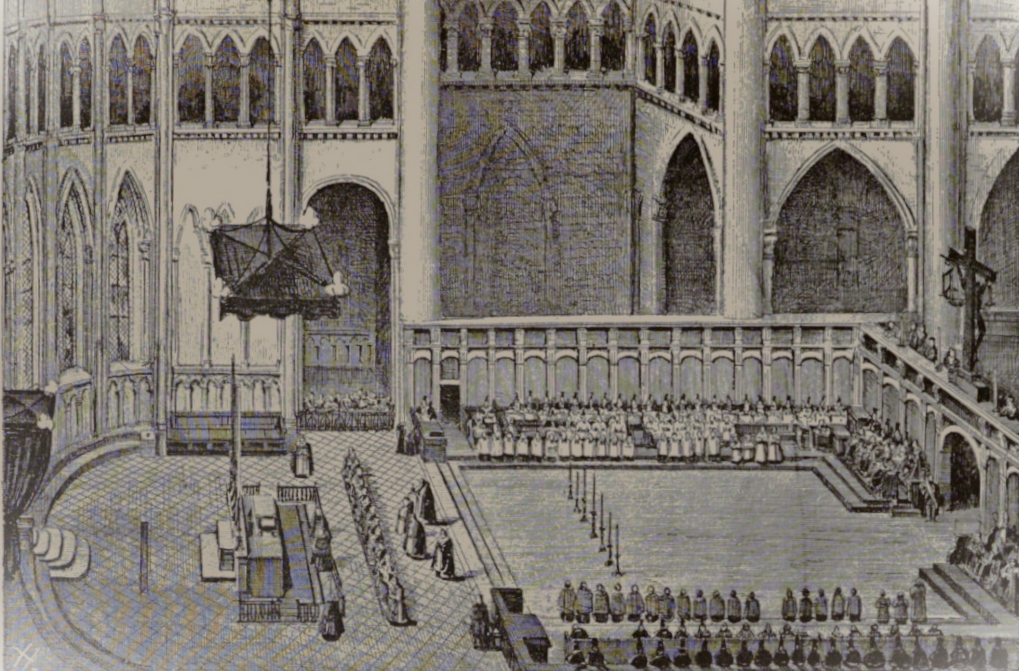
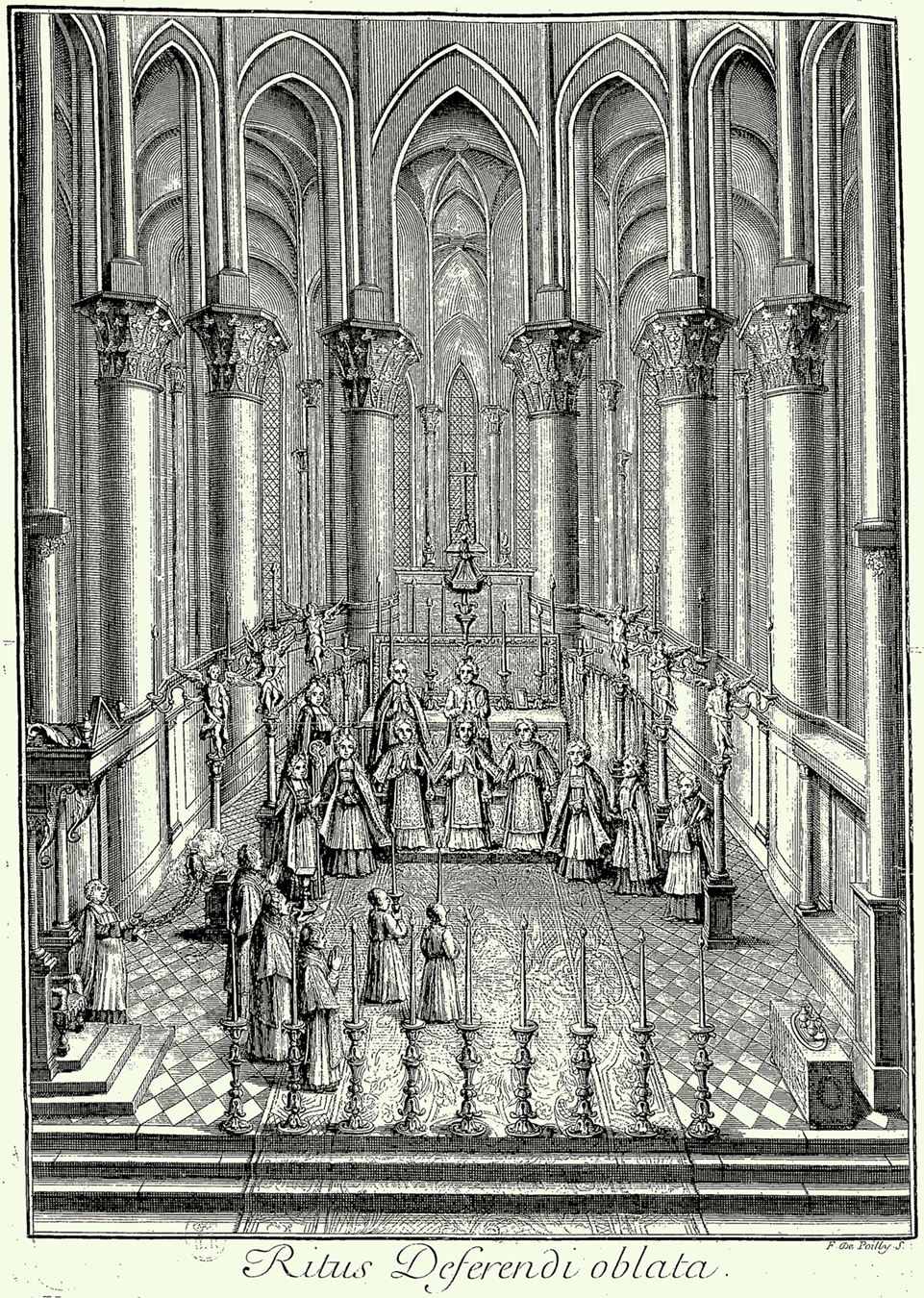
Above: Plate 13 from Liturgical Travels through France. Pontifical Mass in St-Jean of Lyon, initial prayers and Confiteor (reproduced in Sachet, Le grande jubilé).
We’ve all been warned against “Liturgical Tourism.” Wary traditional priests caution us not to bounce from church to church or from rite to rite. We ought not, they tell us, seek thrills, exoticness, or novelty (even, of course, when that novelty is actually antiquity), for such curiosity and wanderlust disturbs the soul and may lead a restless traveler right out of the fold.
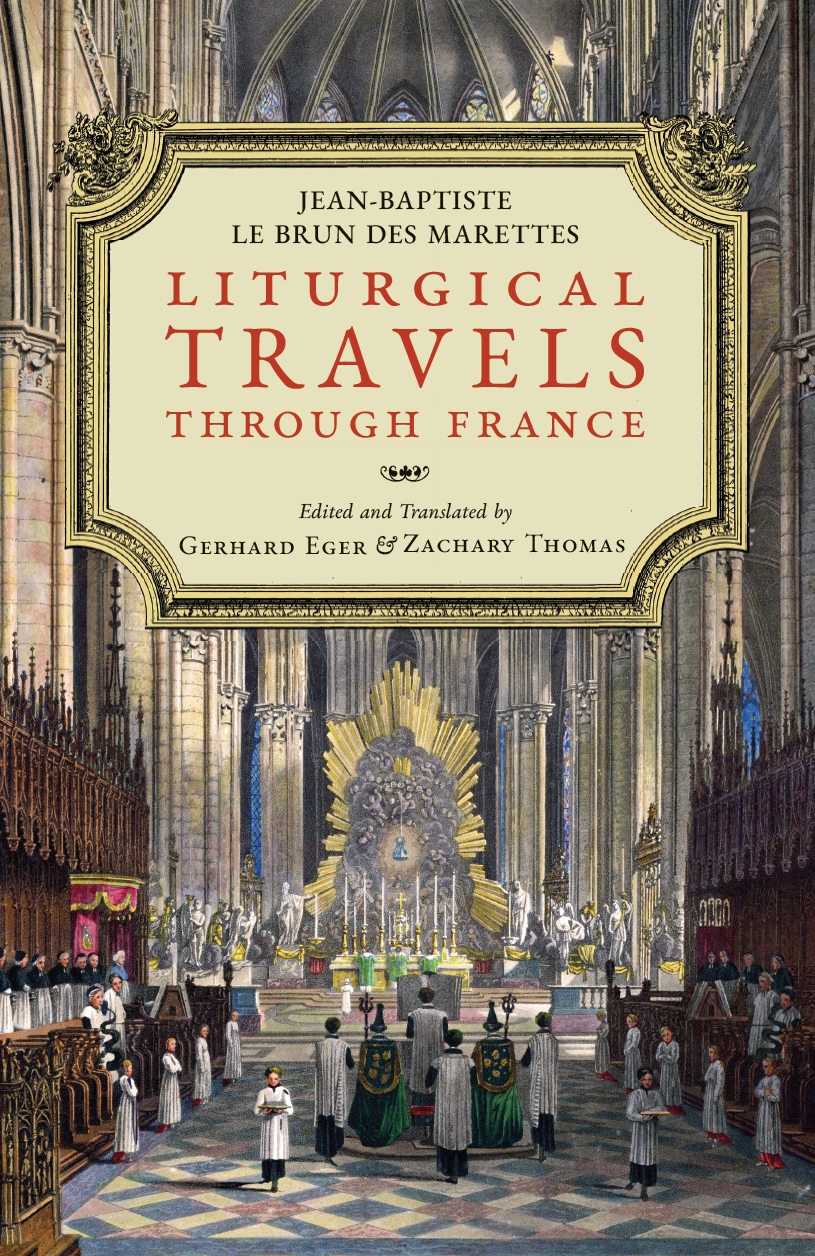
There’s something to be said for this caution; there’s also something to be said for thrills. Liturgical tourism can help remind us of the vast tradition from which our Sunday Low Mass has been derived and help us to avoid complacency. Admittedly, very few of us are in a position to restore an ancient liturgy. We might also be far from “tourist attractions” such as a monastery with traditional Tenebrae or an oratory with Old Roman chant. It would seem, then, that a kind of liturgical travel writing is needed to fulfill our need—a kind of “Rick Steves’ Europe” for liturgies. In fact, there is at least one such book: Liturgical Travels through France by Jean-Baptiste Le Brun Des Marettes. Recently translated and annotated by Gerhard Eger and Zachary Thomas and published by Os Justi Press, this volume ambles through the churches of eighteenth-century France and gives readers a glimpse of wonders untold.
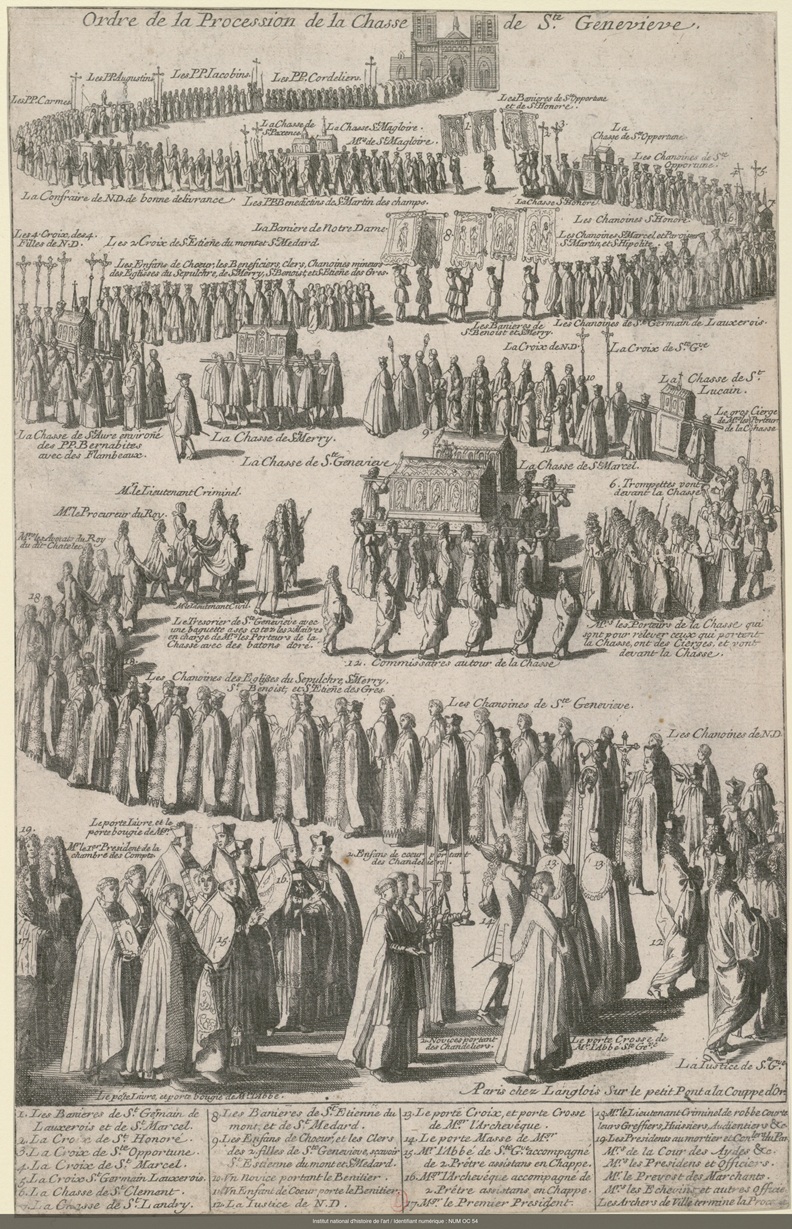
First, readers will be struck by the sheer numbers of clergy present in the great cathedral choirs of the past. At the church of St. Martin of Tours, for instance, Des Marettes tells of over three-hundred priests in residence, this not including a “large number of boys” brought up in the spirit of the clergy. With such a multitude on hand, one can imagine the church of Tours fairly humming with countless Masses and the work of God’s praises. In fact, among other churches of the day, Tours was home to the “Laus Perennis” (perpetual praises), at which the Divine Office was chanted continuously around the clock by teams of clergy that swapped in and out of the choir like guards on regular shifts.
The churches Des Marettes describes in his travels were not, one realizes, large museums hosting a Mass at a side chapel for half an hour each day and traversed aimlessly by tourists the rest of the time. Rather, they were veritable hives of ardent activity. Every stone had its place supporting the life of the liturgy and every stone pulsed with that life. Architectural form and liturgical form were woven together so perfectly that to enter a church was to enter the liturgy. When we visit the great cathedrals of the past, this is what we must remember: these buildings lie dormant now; they are awaiting the liturgies for which they were made.
Much of Liturgical Travels describes the various customs of celebrating the Divine Office in France’s cathedral choirs and monasteries, and this helps immensely in gaining a grasp of the way the hours surrounded the Mass like diamonds encircling the crown jewel. Christmas Matins at a church in Vienne, Des Marettes relates, involved an impressive lineup of clergy to chant the nine lessons: first, canons; then an archdeacon; then a dean; and, finally, the archbishop flanked by two coped priests bearing candles. During Easter week at another church, Des Marettes records the practice of each solemn Vespers beginning with the nine-fold Kyrie. Often, Des Marettes gives detailed descriptions of the exact times that each hour of the office took place from church to church, praising those communities that made regular prayer true spiritual anchors in the temporal sphere.
The pages of Liturgical Travels through France are full of delightful details and unexpected surprises. Solemn processions at Tours were led by the “Pauper of St. Martin” clad in a particolored gown of red and white. The ceremonial presentation of two ostrich eggs wrapped in silk was part of the liturgy of Holy Saturday at Angers. And there are other astonishing accounts meticulously researched by the translators, including a story of a church that claimed to have the jars of the wedding of Cana and that venerated them accordingly with a procession in which their bearers wore flower crowns in reference to matrimonial garb. While all of this may seem fantastic or even absurd to a post-modern reader, the reality is that, as a result of his Jansenist leanings, what Des Marettes included in his accounts is likely but a sampling of the vivid plethora of liturgical expression of his day.
It is also intensely interesting to read in this volume about the origins (or intermediate phases) of customs that still deeply satisfy us in the traditional liturgies today. For instance, the pre-55 Good Friday custom of creeping to the Cross in stocking feet seems but a mild derivative of the practice in Vienne in which the clergy entered the church entirely barefoot and exited in the same humble, unshod state. Such connections between past and present invite the reader to consider that the riches of our present traditional liturgies are mere nuggets from the immensely abundant motherlode of the past.
Perhaps some of the most striking (and amusing) accounts in Liturgical Travels through France are the various punishments for mistakes and truancy. At the church of Saint Just in Lyon, a canon who intoned an antiphon wrong was banished from the choir for the remainder of the office. At another church, the truancy of a single member of the choir resulted in the entire body of clergy retreating behind the altar to recite the office in a mournful recto tono rather than the usual joyous melodies. For the truant himself, the treatment was proportionally severe: he would be deprived of his regular stipend for fifteen days and barred from entering the church in his choir habit.
Each of these zealous French churches was proud and sometimes fiercely protective of her particular customs. When certain authorities challenged the group punishment for truancy described above, the canons concerned disputed the matter, took it to the King, enlisted an inquiry of two cardinals, and ultimately won their case. Elsewhere, Liturgical Travels includes the entertaining account of a boundary squabble between two communities in which a group of canons, insisting on their right to conduct a Corpus Christi procession clear through a convent cloister, resorted to locksmiths and carpenters to force open the convent doors. This forceful entrance was followed by an excommunication, an abdication, intervention by the King himself, and much ado among the laity. The liturgy, Des Marettes makes clear, in all its richness of local custom, was the center of life and well worth a vigorous fight.
Liturgical Travels through France is a kind of liturgical tourism that, far from hurting the interior life, will invigorate it. The enjoyment we experience in the book’s accounts is not the pleasure of cheap thrills but the profound comfort of coming into contact with a world that was built around the liturgy—a world we must work to rebuild today. Like all good travel, the journey on which this book draws its readers is one that broadens understanding and inspires wonder. If the dazzling splendor of the liturgies of France’s great cathedral choirs gives the reader a pang of melancholy, a longing for things long lost, it at the same time ignites a spark of hope. After all, the first step in reclaiming the birthright of our Faith is to know just how magnificent that birthright actually is. Thanks to this fine new translation of Liturgical Travels through France, we now have one more excellent aid in the quest for restoration.