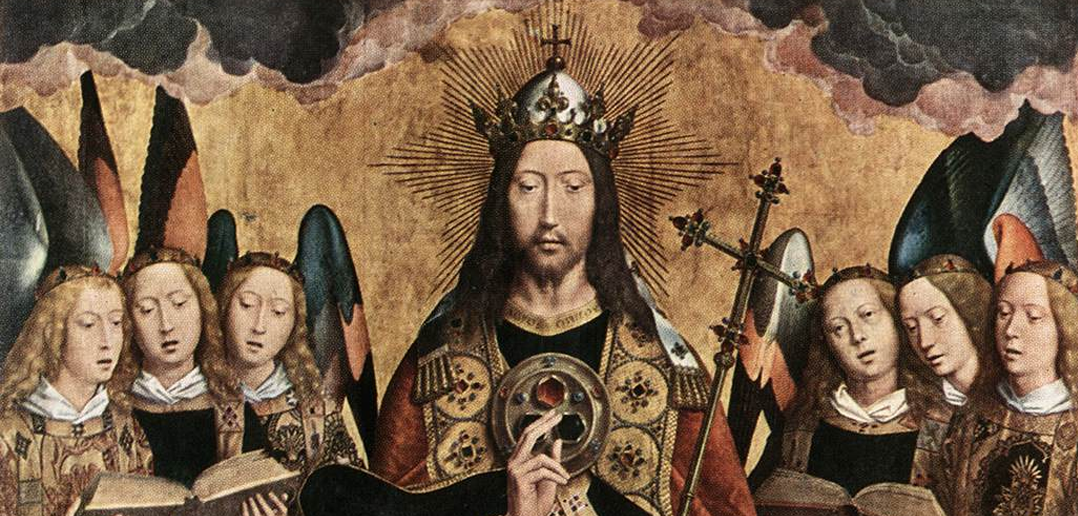

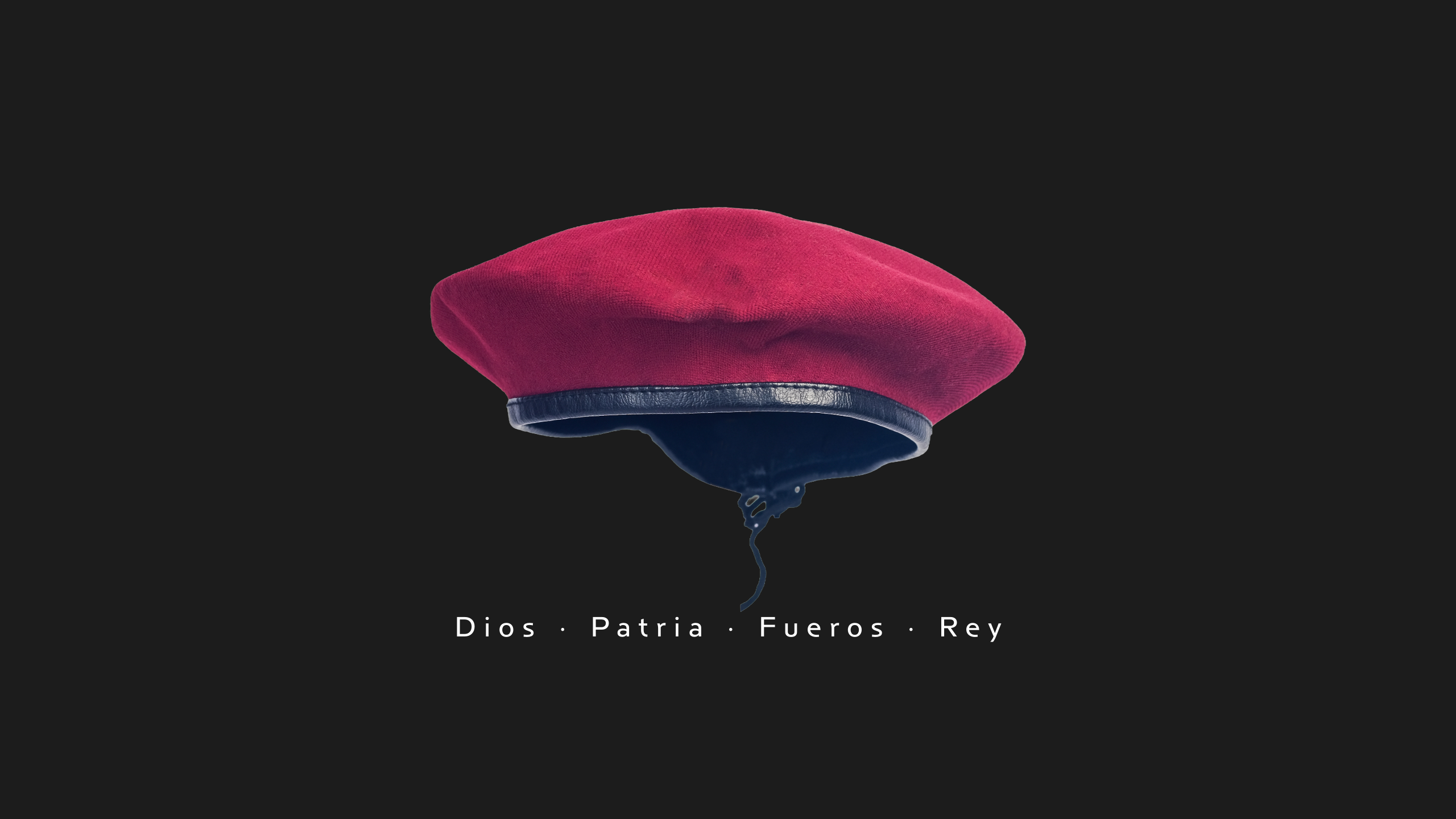
To the attention of Francisco Araújo, Frente Monárquica.
A Carlist Perspective on Portugal’s Grand Assembly of the Monarchist Front[1]
Being that we are one, Holy, universal Apostolic Church, we are spiritually interconnected. What one does reverberates across to all of us. So, I have heard your words. Now, please, hear mine.
To start, I would like to define what I understand Carlism to be, in order to provide the proper background for the perspective from which I am approaching this public discourse with you.
One must live for the moment and for eternity. Not for the disloyalty of time.
– Nicolas Gomez Davila[2]
In short, Carlism, a sister cause to Portugal’s Miguelism, is an ongoing counter-revolutionary effort to restore of the temporal expression of Christendom and of legitimate authority in the political order across all the Spains, that is, throughout Hispanidad. Carlism is the act towards the restoration of the history and political and philosophical tradition of Hispanic Catholicism through the eyes of the genuine Spanish identity inherited from Christianity from the Philippines to Puerto Rico. This restoration is manifested in completion through the throne of Monarchy.
So know that I address you as a brother in arms. Even though Miguelism remains dormant, the future Monarchy of Portugal will run congruent to the development of other Christian kingdoms.
What you are attempting is, in many respects, a step in the direction of recovering a public Christian mind. But much of your language remains conceptualized within a Liberal framework. This is a serious problem for any counter-revolutionary effort given that we are facing the throes of post-modernity: five hundred years of the Revolution (Protestant/Masonic/Liberal). So, it is critical to be conscious of how we use our concepts and terms to exercise politics. If we work within the frames of the enemies of the Church, Catholics don’t convert the Liberal order, the Liberal order converts us. We need not turn to language outside of Tradition. Speaking from my experience, it is kind of a spiritual work where we can rejoice when we uncover layers of Liberalism within ourselves. The de-Liberalizing process is an ongoing process because we are all children of the Revolution.
So, here are some points for consideration:
Monarchy is not an Ideology
Monarchy is not an ideology. It is a political orientation toward the natural order of society and toward legitimate authority.
For this reason, I am not convinced that the prefix “neo-“ is necessary. The Christian truth that political society ought to recognize the Kingship of Christ and order itself toward His Social Reign is not something that becomes obsolete and requires a modernized version. The circumstances of its application may change; its truth itself does not. The counter-revolutionary task is not about inventing something novel and new but to recover what has been obscured.
To that end, I would remove terms such as Nationalism from the vocabulary of this endeavor.
Nationalism is fundamentally alien to the universal political imagination of Christendom. It belongs to the fragmentation of Christian Europe that followed the Reformation, the rise of territorialism from the German princes, and eventually the Enlightenment sovereign nation-state.
Nationalism operates on a presumption of ethnic demarcation. It is a race-based classification.
Demographic pressure makes people brutish.
– Nicolas Gomez Davila
The Church is universal. The Liberal order is sectarian in thought. There should therefore be no “identity-based vision” in our rhetoric. The Ancient Greeks, of course, had a profound understanding of culture in terms of homonoia (Ὁμόνοια); harmonizing style to various forms of life; the ordering of a microcosm of communities toward a shared good, without erasing the distinctions among its constituent parts. Conversely, the political order of Christendom must be judged by its capacity to align the orientation of diverse societies – societies with their own unique idiosyncrasies – to reflect the Gospels within the universal order of the Catholic Church.
Dehellenizing Christianity turns it into a sect.
– Nicolas Gomez Davila
Part of our work entails each of us reclaiming the mentality of the Ancien Régime. It will be hard.
Catholics stand in the throes of postmodernity, the result of five hundred years of Protestantism and two hundred years of Anglo-Protestant Liberalism. We endured across Protestantism, Anglo-Protestant Liberalism, Enlightenment rationalism, Mercantilism, Darwinian evolutionary theory, Empiricism and data-driven governance, Financial capitalism, and the Ethics of monetary control.
There should be no compromise with Liberalism, its left/right dialectics and its syllabus of errors. Total warfare seeks structural transformation; it represents an occurrence in which a system of political organization is redesigned through a new metaphysical order. Our rhetoric does not simply offer an alternative lens; it dismantles the frame altogether. And that is precisely what is needed. Our task, then, is to reorient the public mind toward a clearer, more compelling future.
So, we must reject these postmodern ideas that are divorced from our faith: marketization, consumerism, branding, celebrity culture, competition, individualism, self-responsibility and self-entrepreneurship, mobility, new strategies of ‘Othering,’ and English as a neo-Liberal skill.
So, whether we are talking about politician Donald Trump, celebrity Taylor Swift, self-help guru Jordan Peterson, Jesuit in Name Only James Martin, social media personality Andrew Tate, or far right figure Nick Fuentes, these are all Liberals in their public statements. They all operate within, and cannot fully escape, the Liberal paradigm. They all adhere to the same neo-Liberalizing logic.
We, Catholics, must stand on our own league… beyond ideological thinking.
Our Task is not for Progress
I would be cautious about importing the language of contemporary business administration (CRM metrics, optimization, growth metrics, and similar concepts) into the internal evaluation of a Monarchist movement. Such language belongs to the mentality of neo-Liberal positivism. It risks reducing a spiritual mission to the organizational logic of acquiring market share.
The question is not simply: How efficiently are we growing? The deeper question is: What kind of Christian men are we forming, and toward what order are we orienting them?
Furthermore, Tradition is not a collection of formulas. Tradition is a transcendental society.
Everything in the Middle Ages—from a Romanesque church or a feudal relationship to a Gothic Calvary or a pilgrim from Cantuaris—is robust, sensual, and concrete. Because medieval man perceived transcendence as a perceptible attribute of the object.[3]
The future Catholicism will not be built by optimization but a restoration of Platonic Realism.
Fundamentally, a Monarchist project must start with the conversion of souls within a mystical realm. The king is the last step in this societal transformation as an integral centralizing figure. Now, a king without the structure and spiritual order of Christendom is just a secular totalitarian.
With Liberal progress, comes an integration of optimism. My advice for you is to start not with “optimism,” but with hope.
Optimists never question the social structures in which things are placed and which determine their course. They are irremediably subject to their own social system without even realizing it and are therefore incapable of fundamental criticism. Today, we do not need optimism, but radical hope in something new, hope in a completely different way of living that arises from criticism, awareness, and the will to change. Unlike optimism, which lacks nothing and is not in motion, hope is a movement of searching, an attempt to orient oneself. It pushes toward the unknown, the unfamiliar, the open, going beyond what exists today. It moves toward the unborn, toward the new.
– Byung Chul Han, The Spirit of Hope[4]
Our Policy is Oriented Toward the City of God
St. Augustine tells us that history is ultimately the story of two cities: the City of God and the City of Man. This is the tension between Bablyon vs Jerusalem. In this tension, we have to be clear. We need to draw the line and distinguish for the people.
People need practical case studies of parallel structures they can turn to in defense of the City of God. So, you have to be able to verbally articulate the structure of Monarchy in a way that audiences can visualize and understand. In my opinion, you require the ability to think of the order of political hierarchy that Carlists so well define in their quad mantra: Dios, Patria, Fueros y Rey.[5]
- God (Dios) represents the ultimate end of political life: the recognition that all human authority participates in and remains subordinate to the eternal law of God.
- Fatherland (Patria) represents the historical community received through generations, whose customs, language, faith, and institutions form the conditions through which persons pursue the common good.
- Local Rights (Fueros) embodies the principle of subsidiarity and the natural rights of intermediate communities, preserving the legitimate autonomy of families, municipalities, regions, and historic societies against excessive centralization.
- King (Rey) represents legitimate authority ordered not toward domination, but toward the stewardship, guardianship of this order.
At its deepest level, however, this is not merely a political program. A Christendom ordered toward the temporal representation of the Social Reign of Christ is a mystical kingdom. It is an interconnected mystical body ordered under Christ and within His one Church, His Mystical Body. The political order is therefore not an autonomous mechanism imposed upon society from above as some design problem; it is the manifestation of a higher spirituality from the faithful. This is where the power of the laity is represented in subsidiarity and integralism. Where our enemies demonstrate their power from the top down, our power as Catholics is bottom up.
The Problem is Spiritual Before it is Political
Portugal must recognize that its government is an external proxy for foreign interests. As Charles Coulombe says: there is the country and then there is the real, deep, country underneath – the mystical body of the Church.[6] The laity, the practicing Catholics, are the real country. However, we must accept that we are today “pusillus grex,” little flocks of Christians left in our own homelands which are governed by tyrannies. We cannot rely on the anti-Christian state. The distinction between the real, deep, country and legal country is the same distinction between a parasite and its host. Our priority focuses on the health of the Christian body-politic.
As you mentioned in your speech: Portugal needs to be a small state before it gets bigger. Yes!
So, the problem is not a secular political one: it is a spiritual one. It is not a design problem but a faith problem. Every political era is first defined by a theological era. Therefore, before we speak about acquiring political power, we need, as Carlist David David Fernández says, the maturation of the pre-political form of the modern Catholic.[7] Why? In a confessional state, Christians are not merely citizens who happen to share a religious belief. We are united as members of one mystical body. Where one of us falls into sin, the whole body suffers; where one rises in virtue, the whole body is strengthened. A kingdom, properly understood, is therefore more organic and more mystical than the modern nation-state. We are all married together in unification. (Hence why.. everyone in your congress is, in some way, related by blood to Afonso Henriques). This is more Platonic Realism. This is the hierarchy of forms: first there is the Social Reign of Christ. From that higher reality proceeds its temporal expression in legitimate authority—the King—and from the King authority is diffused organically through the different layers of the kingdom: aristocracy, municipalities, intermediary institutions, guilds, families, fueros, and the land itself.
Envision, Now, New, Future Christian Societies
Finally, we have to recover the universal and creative character of Catholicism. Our past is a rich source of principles, examples, and memory; it is not a blueprint that we are required to reproduce mechanically. Our future will necessarily be different from our past. There are no formulas in this game.
The Portuguese of old themselves understood this.
Camões captured this same spirit when he wrote:
| Cesse tudo o que a Musa antiga canta, | Cease all, that the ancient Muse sang |
| Que outro valor mais alto se alevanta. | A higher form of Valour rises.[8] |
The Portuguese, along with the traditional Jesuits, were able to envision a different future. They created new Christian societies across the Americas, Africa and Asia with Goya, India, Macau, China and Timor-Leste Indonesia; each with their own languages, customs, artistic expressions, laws, institutions, and local identities while integrating them into the universal Catholic order.
This is precisely what Catholicism means. Catholicism is not about spreading language or ethnicity, it’s about creating a society that with its own idiosyncrasies reflect the Gospel.
Part of being hopeful is also being open to these new possibilities because hope goes beyond what currently exists. It affirms the ability to build the future.
Thank you.
With a firm handshake,
Eric Aaron Castro
[1] “Neomonarquismo (Discurso) Assembleia Magna da Frente Monárquica,” YouTube video, https://www.youtube.com/watch?v=To9YXUO4ZXg.
[2] These and the following quotes are taken from Escolios a un texto implícito.
[3] Nicolás Gómez Dávila, Escolios a un texto implícito (Bogotá: Instituto Colombiano de Cultura, 1977).
[4] Byung-Chul Han, The Spirit of Hope, trans. Daniel Steuer (Cambridge: Polity Press, 2024).
[5] “El Tradicionalista,” El Tradicionalista (April 3, 1889), https://www.ermua.eus/sites/default/files/repositorio-archivos/13_03041889_O_29_09_2016_9_46_09.pdf
[6] Charles Coulombe, “Beyond Nihilism: Rebuilding Christian Culture,” YouTube video, 33:25, [https://www.youtube.com/watch?v=LeUPNG_4F-g&t=2005s].
[7] David Fernández, Navarrese Carlist, personal communication with the author (August 15, 2026).
[8] Camões Luís de Camões, Os Lusíadas, Canto I, stanza 3 (the lines “Cesse tudo o que a Musa antiga canta, / Que outro valor mais alto se alevanta”). Text: Camões Digital, https://camoesdigital.pt/genero/epopeia-os-lusiadas/.