
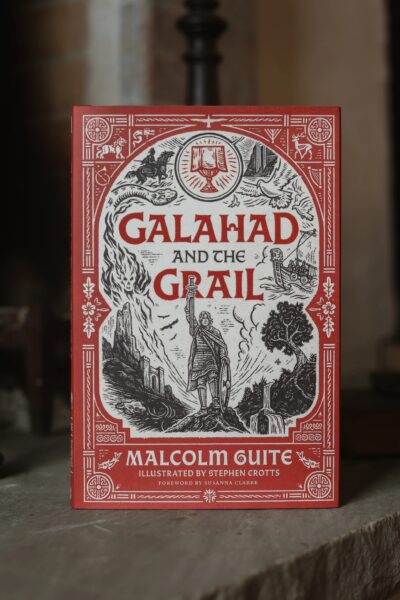
On a briskly cold Shrove Tuesday, I journeyed with a friend to the numinous candlelit gothic surroundings of Temple church in London. One of the finest surviving churches of the Knights Templar and resting place of the “best knight that ever lived,” William the Marshal, 1st Earl of Pembroke, with its characteristic round nave and rectangular chancel, the church was, like many others of the Order, modelled on what the crusaders took to be the surviving or rebuilt structure of Solomon’s Temple (in fact the Al Aqsa Mosque). No Anglican worship took place; we were in this fitting location for the release of a new epic ballad, Galahad and the Grail (Rabbit Room Press, 2026) by English poet, academic and Anglican minister, Malcolm Guite. Guite has also garnered a social media following through his YouTube channel, ‘Spell in the Library’, in which, pipe in hand, he can be found reciting poems and excerpts from poets and authors such as Tolkien, Chesterton, Barfield, Coleridge and Lewis, usually from his cosy and rather chaotic study.
There at the lectern, presenting extracts of his new work, was Guite, white haired and bearded, wearing a grey tweed jacket and a hobbitesque moleskin waistcoat, looking for all the world like an apparition of Merlin himself.
The first poetic retelling of the Matter of Britain since Lord Tennyson’s Idylls of the King cycle of Arthurian poems published between 1859 and 1885, Guite’s volume is the first in a projected epic cycle of four volumes. He has begun in media res with the most legendary of the Arthurian romances – and that which has been most deeply infused with Catholic sacramental theology through its high medieval development – the Quest of the Holy Grail. As the detailed appendices on the various Arthurian sources attest, the fruits of Guite’s long study and love for the Arthurian literature can clearly be seen in this audacious project.
Of his inspiration Guite comments:
[As a child] the stories that first moved me were not some sanitised Hollywood version, but the real thing: haunting, numinous, continuously suggestive of the holy and beautiful reality of God and His saints and angels shimmering through the fabric of the stories of the knights with all their aspirations and all their human flaws. At the heart of those early versions of the stories is the Holy Grail itself: the presence of Christ and His gospel, moving as an unbearably beautiful light through the mists and magic of pre-Christian Celtic Britain, drawing even the wizards and the faery folk towards Himself, baptising the imagination of our ancestors, fulfilling and disclosing the true meaning of our earliest stories.
Like A Midsummer Night’s Dream, in which Shakespeare’s faery characters speak in rhyming couplets, opting to present his Arthuriad in poetic verse gives Guite’s tale an otherworldly feel and almost incantatory power when read aloud, which is eminently fitting. The epic-length narrative requires a kind of ‘poetry by the yard,’ often in quatrain and quintain verse, and a semi-chanting lyrical style which rises at the moments of high action and drama. In his ballad, Guite generally favours Anglo-Saxon Germanic words rather than more elongated Latinate words. This helps maintain a steady musical rhythm and has more potency to resonate with the Brythonic-Saxon soul of the reader. It is written to be read aloud in company around a fire. I would particularly recommend this ballad for fathers to recite to their families, in the manner of the chanson de geste in halls of old, where it would be most likely to edify and enthral.
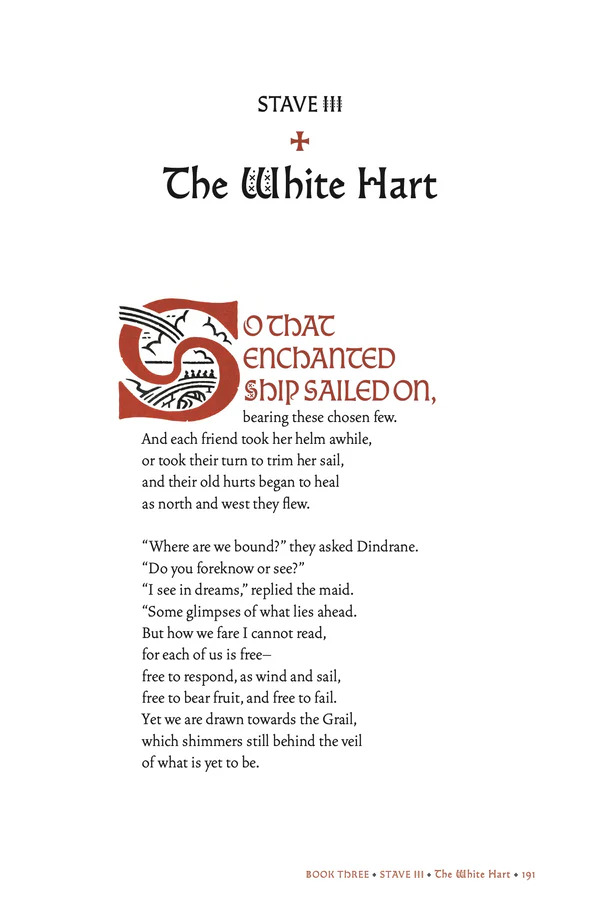
The volume is richly illustrated by American illustrator Stephen Crotts, who accompanied Guite in person to several British holy wells and chapels, as well as the mythical sites of Glastonbury and Tintagel. One senses that he picked up some of the magic of these places in his artwork. His virile and verdant illustrations situate Guite’s narrative in the sixth century world of the historical King Arthur rather than the high medieval ambience of the twelfth and thirteenth century romances, but retain these later epochs’ pageantry and high chivalry.
Renowned Humanities professor John Senior once said that the great deficiencies of English literature, touched as it was from the sixteenth century onwards by heresy and apostasy, were the lack of truly Catholic themes; chiefly ecclesial, Marian and Eucharistic. Here is a work to help correct that.
It is exceedingly rare in our present cultural desert for a work of art to appear which is good, beautiful, and true. The Matter of Britain has been retold over the centuries but in recent centuries its Catholic elements have been increasingly ignored and its pagan roots bought more to the fore. In his work, Guite has attempted to retrieve the Eucharistic significance and Christian bedrock of the Grail legend and I am delighted to report that he has succeeded.
Guite has associated himself with the growing ‘re-enchantment’ movement that has steadily coalesced in recent years in response to the reductive materialism and “immanent frame” of the “Enlightenment.” He explicitly lays out this goal of mythopoeic re-enchantment, following authors like Tolkien and Lewis, in the appendices. Guite writes of his intent to:
make an epic poem that would appeal to many of [the Inkling’s] readers and continue their vital mission to “slip past the watchful dragons” of secularism and awaken again in the modern world that openness to beauty and mystery which prepares the heart for the coming of Christ.
One episode in which Galahad overthrows an assailant brigand-knight brings this theme to the fore:
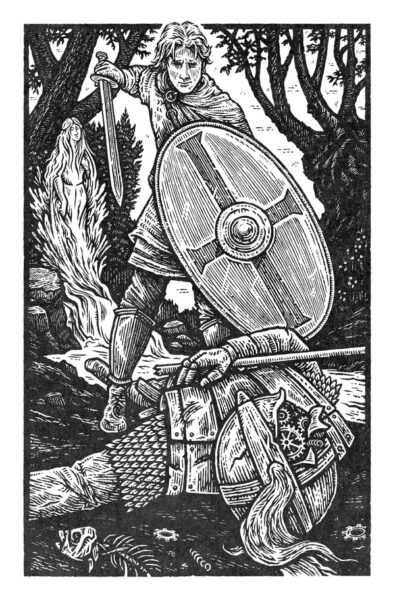
So he unlaced the dark knight’s helm
and stood back all amazed –
it was not more a human face,
the sight on which they gazed!Beneath the mask of hardened steel
no human face remained,
just springs and bolts and cogs and wheels
all rusty, worn, and stained.“I see,” sighed good Sir Galahad,
“The trap he set himself:
he set his mind on turning cogs;
he set his heart on wealth.And where he set his mind and heart
his soul flowed in their wake,
for sometimes we ourselves become
the idols that we make!
The influence of JRR Tolkien on Guite’s work is clearly visible here. Readers may recall that Treebeard says of the fallen wizard Saruman: “He has a mind of metal and wheels; and he does not care for growing things, except as far as they serve him for the moment”. While never overshadowing the classical Arthurian themes, Guite’s tale bespeaks his deep concern for modern man’s alienation, not only from his Creator, but from creation itself.
Each teller of the Arthurian tales has drawn influences from their own time. Though drawing most deeply from the medieval Arthurian literature such as Mallory’s Le Morte d’Arthur, Guite takes inspiration from a diverse range of later authors like Tolkien, Lewis and Kipling. He also integrates his theme of contemporary disenchantment and ecological estrangement into an extended section where the grail knights traverse a wasteland inspired by TS Eliot’s The Waste Land (1922), that they might heal the mysteriously maimed King Pelles of Carbonek.
Eliot’s classic of modern poetry is about the emotional, cultural, and ultimately, spiritual emptiness of modern life in the aftermath of the First World War. In Guite’s Wasteland section we once again see the interweaving of grace and nature that lattices through his work. His Wasteland very much elaborates a pagan traditional motif connecting king and kingdom, the passage of death to resurrection, a king of summer who is wounded and incapacitated in winter but rises again in spring. With King Pelles’ healing awaiting a saviour, Guite’s Christian themes are thus erected atop a deep ‘pre-Christian underlay’ which finds its baptism therein.
The Holy Eucharist is not the only Sacrament that the poem revolves around. Guite’s lyre is also attuned to other strains of contempt for the world, the pitfalls of pride and the flesh, and the sorrow of the penitent. All the knights-errant are exhorted to confess their sins before leaving Camelot and embarking on the quest. Of course, the knight most in need of absolution is the mightiest of them all, Sir Lancelot.
At the pivotal moment in Lancelot’s adventures, he finally comes to make confession for his sins, particularly those of adultery and pride, to Nacien the wise hermit-priest who speaks thus to Lancelot:
You sought the kingdoms of this world,
the treasures of this time,
but you were still outside the gates,
for all the while God’s kingdom waits.
You come to your repentance late,
but God will give you time.So come and clean confess your sin
before this ancient cross.
Spare not, but speak of all that’s passed –
the harm, the hurt, the shame, the waste –
and bring your heart to Him at last
who can redeem all loss.”So Lancelot knelt by the cross;
at last his tears flowed free –
tears he’d suppressed through all his strife,
tears for his deep-divided life –
contrition pierced him like a knife,
but also set him free.
The Holy Grail – that isthmus where earth and heaven meet – has passed into common speech as a byword for that which all men desire. The original story is of Celtic pagan origins but the Cistercians gave it a beautiful Christian meaning in the twelfth century, baptising it and presenting it anew as a parabola of the spiritual combat and mystical journey to the Divine Wisdom found in Christ’s Sacred Heart.
Guite, an ‘Anglo-Catholic’ in his theology, cites the Anglican Benedictine monk, Gregory Dix’s The shape of the liturgy, as greatly influencing his sacramental understanding. Dix was an ‘Anglican Papalist,’ affirming the Real Presence and in favour of eventual Anglican reunion with the Holy See. In Guite’s ballad can be found Marian devotion, contemplative religious life and prayers for the dead.
I carefully read the Arthuriad to find any elements contrary to Catholic doctrine. Like the High Anglican Enid Chadwick’s, My Book of the Church’s Year (a charming and luminous introduction to the Roman liturgical calendar for children), Guite’s work offers nothing at variance with Catholic belief that I could find.
In Charles Coulombe’s A Catholic Quest for the Holy Grail, he writes about how Catholics today might follow an Arthurian or chivalrous spirituality; recognising every confessional as a Siege Perilous in which we must face ourselves and our sins, and every chapel of Perpetual Adoration as a Grail Chapel, giving a foretaste of that “peace of God, which surpasseth all understanding.” I submit that Guite’s epic ballad could well serve as a preamble to such a spirituality.
When one of the three grail knights who achieves the quest returns to Arthur’s court he takes up his harp:
“For this I know,” said good Sir Bors.
“We saw the Grail depart.
Yet it did not depart from us,
for, lovely and mysterious,
its presence seemed to enter us.
It shineth, fair and glorious,
in the chapel of the heart.And now I know in any church
where people kneel and pray,
and the good priest still sings the mass,
there signs and wonders come to pass.
The Holy Grail may come to us
on any Sabbath Day.This tale is not for us alone,
but for our children too.
So take up the tale if you can
and pass it on to maid and man
that it may grow like living grain
both beautiful and true.”